
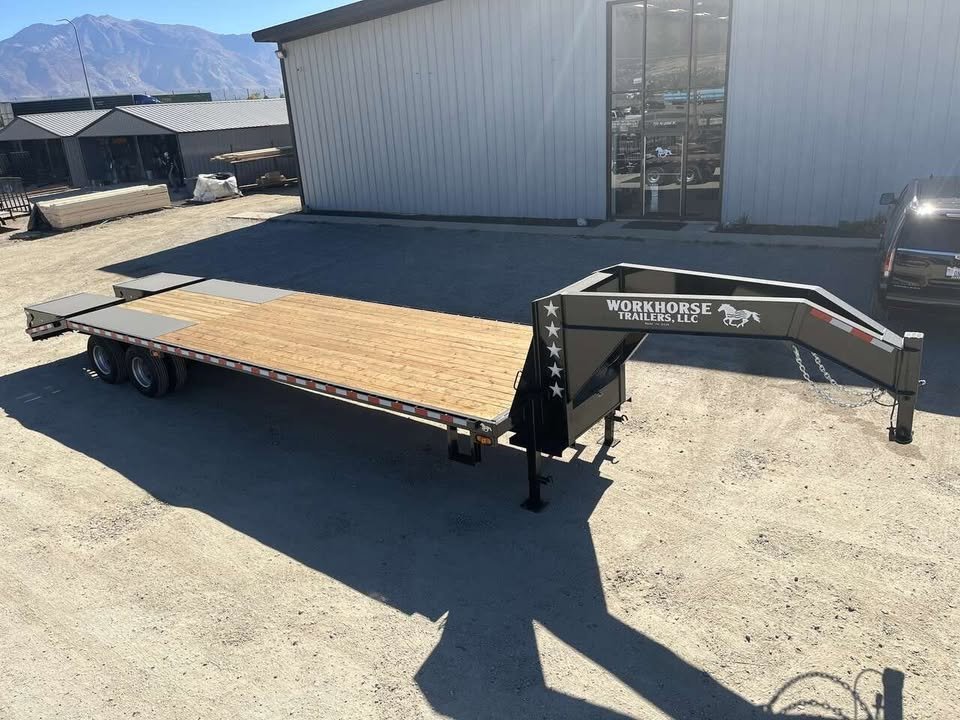
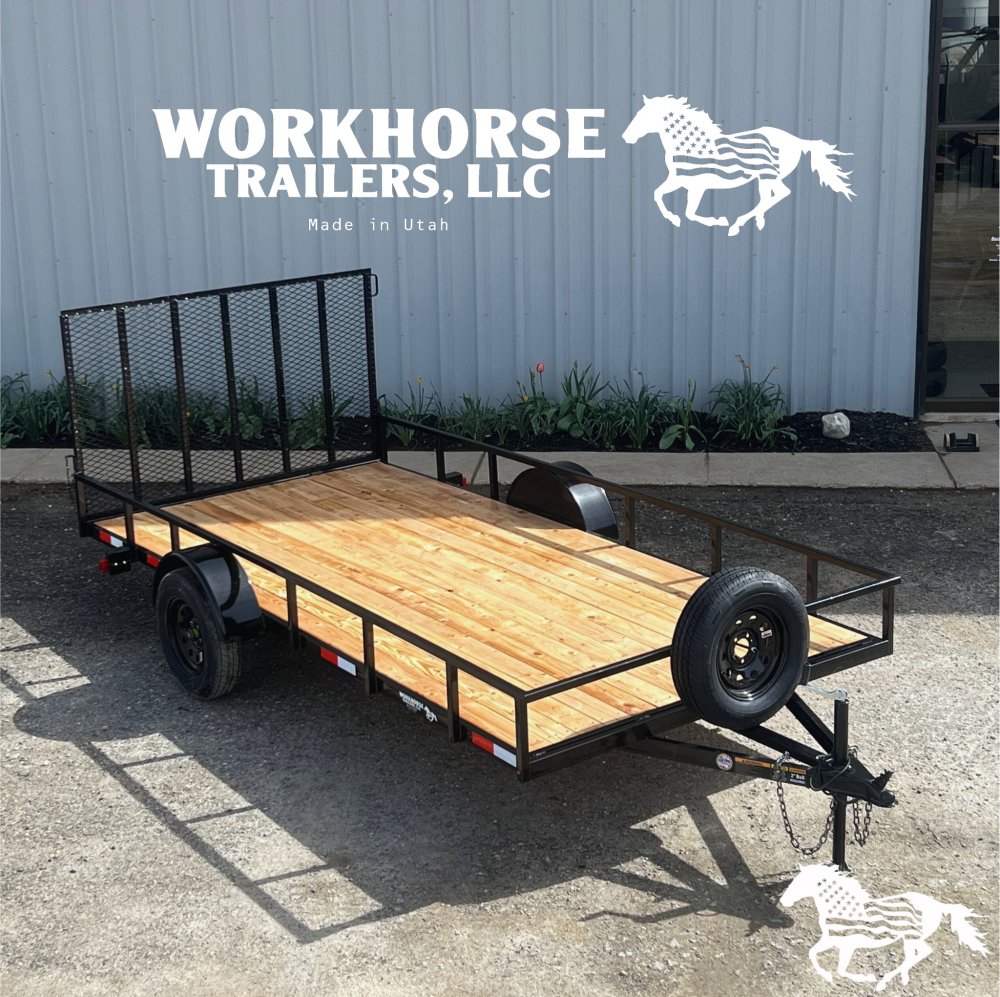
Wyoming Utility Trailers
All locationsWyoming covers nearly 98,000 square miles of open range, mountain wilderness, high desert basin, and wind-swept prairie, yet fewer than 600,000 people call it home. That combination of vast territory and sparse population means that the residents and businesses spread across this landscape depend on their own equipment to get things done. There is no calling a delivery service for a same-day drop in most of the state. There is no running to a big-box rental counter in towns that lack one. A utility trailer parked at the ranch, the shop, or the homestead is the tool that fills the gap, turning a pickup truck into a capable hauling rig that can move fencing supplies to a remote pasture, deliver firewood to a hunting camp, or transport building materials to a property that sits an hour from the nearest lumber yard. Workhorse Trailers LLC understands the self-reliant mindset that defines Wyoming, and the company provides utility trailers built to match the rugged independence that everyday life in this state demands.
From the energy fields of the Powder River Basin to the tourist corridors surrounding Yellowstone and Grand Teton, Wyoming’s economy runs on the ability to move materials and equipment across long distances in harsh conditions. Wind, altitude, extreme cold, gravel roads, and isolation combine to create an operating environment that exposes every weakness in poorly constructed equipment. Workhorse Trailers LLC offersWyoming Utility Trailers selected for the kind of structural integrity and component quality that survives season after season in a state where the nearest repair shop may be a hundred miles away and the weather does not wait for convenient timing.
The Role of Utility Trailers in Wyoming’s Working Landscape
Utility trailers occupy a unique position in Wyoming because they serve as general-purpose problem solvers in a state where specialization is a luxury most operations cannot afford. A single trailer might haul mineral supplement tubs to cattle in January, move irrigation pipe in May, transport fence posts in July, and carry elk quarters out of the backcountry in October. That year-round versatility makes the utility trailer the most commonly owned trailer type in Wyoming by a wide margin.
Ranching and Agricultural Use
Livestock production dominates Wyoming’s agricultural sector, with cattle and sheep operations stretching across millions of acres of private and leased public land. Ranchers use utility trailers constantly to distribute supplies across properties that may encompass dozens of square miles. Salt blocks, veterinary supplies, water tank floats, electric fence chargers, baling twine, and countless other consumables travel from town to the ranch headquarters and then onward to wherever the work is happening that day.
The distances involved set Wyoming apart from most other states. A rancher based near Kaycee who runs cattle on BLM allotments in the Bighorn foothills might drive 40 miles of gravel road each way to check fence and deliver supplies. That 80-mile round trip happens several times per week during grazing season. A utility trailer making those trips absorbs tremendous punishment from washboard surfaces, loose rock, creek crossings, and the occasional encounter with a washed-out section of two-track that would test a purpose-built off-road vehicle.
Energy Sector Support
Wyoming ranks among the top energy-producing states in the nation, with significant output in coal, natural gas, crude oil, wind power, and uranium. The support infrastructure surrounding these industries employs thousands of workers who use utility trailers to carry tools, safety equipment, replacement parts, and field supplies between operational sites scattered across remote basins and plateaus.
A pump jack technician working the oil fields near Casper or a wind turbine maintenance crew servicing installations along the I-80 corridor between Rawlins and Rock Springs both need utility trailers that start reliably at 20 below zero, tow steadily through sustained 40 mile per hour crosswinds, and survive the pounding delivered by access roads that receive minimal maintenance between seasons. The energy sector does not tolerate equipment downtime, and a utility trailer that breaks down on a remote well pad creates problems that cascade through the entire operation.
Outfitting and Recreation
Wyoming’s hunting, fishing, and outdoor recreation economy generates billions in annual revenue and draws visitors from every state in the country. Resident hunters, licensed outfitters, and guided fishing operations all use utility trailers to haul the gear that supports their time in the field. Wall tents, camp stoves, horse feed, coolers, game processing equipment, firewood, and water containers are standard cargo for outfitter trailers heading into the backcountry during elk and deer seasons.
The terrain that makes Wyoming a world-class hunting destination also makes it exceptionally difficult to reach. Trailhead access roads in the Wind River Range, the Absaroka Mountains, and the Sierra Madre climb through loose shale, cross seasonal streams, and traverse grades that would be considered extreme in most other contexts. A utility trailer bound for these locations needs ground clearance, a suspension system that absorbs punishment without transmitting it to the cargo, and a frame that flexes over obstacles without cracking at the weld joints.
Choosing a Utility Trailer for Wyoming Conditions
Buyers in Wyoming face environmental stresses that trailer shoppers in milder climates never consider. The state’s elevation, wind exposure, temperature range, and road conditions all influence which trailer features matter most and which construction shortcuts lead to premature failure.
Wind Resistance and Stability
Wyoming is one of the windiest states in the continental United States. Sustained winds of 30 to 50 miles per hour are routine across the southern tier of the state, and gusts exceeding 70 miles per hour shut down sections of Interstate 80 multiple times each winter. A utility trailer being towed through these conditions must have a low enough profile to minimize wind resistance and enough weight at the tongue to prevent lateral displacement when gusts strike from the side.
Mesh side panels outperform solid walls in high-wind towing situations because they allow air to pass through the trailer rather than catching it. Wyoming buyers who need to contain loose cargo in windy conditions should consider mesh-sided utility trailers or models with removable panels that can be swapped out depending on the day’s cargo and forecast.
Cold Weather Material Performance
Winter temperatures in Wyoming routinely drop below minus 20 degrees Fahrenheit in the state’s northern and central regions. At these temperatures, certain grades of steel become brittle and susceptible to fracture under impact. A trailer frame that performs perfectly during summer can develop cracks at weld joints and stress points when subjected to heavy loading in extreme cold.
Utility trailers destined for year-round Wyoming use should be fabricated from steel alloys that maintain their ductility at low temperatures. Buyers should ask about the grade of steel used in the frame and verify that it meets the requirements for cold-weather service. This is not a concern that arises in warmer markets, but in Wyoming it represents the difference between a trailer that lasts and one that fails catastrophically on a February morning when help is nowhere nearby.
Tire and Suspension Selection for Unpaved Roads
The majority of miles a Wyoming utility trailer travels may be on gravel, dirt, or unimproved surfaces rather than paved highways. Standard highway-rated trailer tires with shallow tread patterns wear quickly on abrasive surfaces and provide poor traction in the mud, snow, and loose rock that characterize Wyoming back roads.
Radial trailer tires with deeper tread patterns and reinforced sidewalls handle unpaved conditions more effectively and resist the punctures caused by sharp rock common along the shoulders and surfaces of rural Wyoming roads. Suspension systems that provide adequate travel to absorb the jolts and drops encountered on rough terrain protect both the trailer structure and the cargo from the repeated impact loading that destroys equipment designed for smooth pavement.
Sizing a Utility Trailer for Wyoming Applications
The wide-open spaces and long travel distances in Wyoming shift the calculus of trailer sizing compared to urban and suburban markets. In a city, a smaller trailer makes sense because storage space is tight and trips are short. In Wyoming, a larger trailer often proves more practical because every trip to town covers significant mileage and carrying more per load reduces the total number of trips required.
Mid-Range Models for Ranch and Property Use
Trailers in the 6-by-12-foot to 6-by-14-foot range handle the bulk of ranching, property maintenance, and general hauling tasks encountered across Wyoming. They carry enough fencing material, feed bags, or firewood to make each trip productive while remaining light enough for towing behind the three-quarter-ton and half-ton trucks that serve as the standard work vehicles on most Wyoming operations.
These mid-range models fit through ranch gates, navigate between corrals, and back up to loading chutes without the clearance issues that larger trailers create in working agricultural environments. Their moderate weight also reduces fuel consumption during the long highway stretches that connect Wyoming towns, which is a meaningful consideration when the nearest supply point might be 60 or 80 miles from the property.
Full-Size Models for Commercial and Industrial Use
Trailers measuring 7 by 16 feet and larger serve Wyoming businesses that haul heavier loads or bulkier cargo as part of their daily commercial operations. Oilfield supply companies, construction contractors, municipal road crews, and commercial landscaping firms operating in communities like Cheyenne, Sheridan, Gillette, and Laramie put these larger trailers to work carrying loads that smaller models simply cannot accommodate in a single trip.
Tandem axle configurations on full-size utility trailers distribute the heavier payloads across a wider footprint, which improves road manners on the long highway runs common in Wyoming. The second axle also provides a measure of redundancy. If a tire fails on a remote stretch of Highway 287 or Highway 20, the remaining tires on the tandem set support the load long enough to reach a safe pullover location rather than causing an immediate loss of control.
Registration and Compliance in Wyoming
Wyoming requires trailers operated on public roads to be titled and registered through the county clerk’s office in the owner’s county of residence. Registration fees are based on the trailer’s weight and must be renewed annually. New trailer purchases require a manufacturer’s certificate of origin for the initial title application, while used trailer purchases require a properly assigned title from the previous owner.
Lighting requirements follow federal motor vehicle safety standards. Tail lamps, stop lamps, turn signals, and reflectors must be present and functional on every trailer regardless of size. Trailers over a certain width require amber clearance lamps at the front corners and red clearance lamps at the rear corners to alert oncoming and following traffic to the trailer’s full width during nighttime and low-visibility conditions.
Brake requirements in Wyoming apply to trailers with a gross vehicle weight rating exceeding 3,000 pounds. Electric brakes activated through a controller in the tow vehicle are the standard compliance method for most utility trailers in this weight category. Maintaining the brake system in working condition is not only a legal requirement but a practical necessity on the steep grades found along routes like Highway 14 through the Bighorn Mountains, the switchbacks on Teton Pass, and the descents along I-80 through the Wasatch Range into Utah.
Maintaining a Utility Trailer Across Wyoming Seasons
The severity and duration of Wyoming winters demand a maintenance approach that anticipates problems before they strand an operator in a location where roadside assistance may take hours to arrive.
Bearing maintenance tops the priority list. Wheel bearings packed with quality grease before the start of winter withstand the cold temperatures and moisture exposure that cause standard grease to break down. Repacking bearings at least once annually, and twice for trailers that see heavy year-round use, prevents the seized bearing failures that leave trailers stranded on remote highways.
Electrical connections corrode quickly in Wyoming’s harsh environment, especially when exposed to the chemical road treatments applied on state highways during winter storms. Applying dielectric grease to all plug-in connections and inspecting wiring harnesses for cracked insulation or abraded conductors before each season catches deterioration before it causes a roadside lighting failure during a December supply run.
Frame and fastener inspections should coincide with seasonal transitions when the trailer shifts from one type of use to another. Checking every bolt, examining weld joints for cracking, and touching up paint or coating damage before rust gains a foothold keeps the trailer structurally sound through the years of continuous service that Wyoming operators expect from their equipment.
Workhorse Trailers LLC Serves Wyoming Buyers Statewide
Wyoming residents understand that quality equipment is not a luxury but a necessity when the nearest help is far away and the conditions are unforgiving. Workhorse Trailers LLC shares that understanding and applies it to every utility trailer recommendation made to Wyoming buyers. Customers drive from Evanston, Kemmerer, Riverton, Lander, Thermopolis, Cody, Powell, Buffalo, Douglas, Torrington, and every crossroads community in between because the Workhorse team speaks the language of people who work hard in difficult conditions and expect their equipment to do the same. For Wyoming residents and businesses that need a utility trailer capable of earning its keep across the toughest landscape in the lower 48, Workhorse Trailers LLC provides the selection, the knowledge, and the honest guidance that this state’s operators deserve.