Wyoming Gooseneck Trailers
All locationsWyoming asks more of its towing equipment than almost any other state in the country. The loads are heavier because the industries are bigger. The distances are longer because the towns are farther apart. The roads are rougher because the terrain is wilder. And the wind never stops pushing against anything tall enough to catch it. When the cargo on the trailer outgrows what a bumper-pull hitch can control safely through these conditions, a gooseneck trailer becomes the only responsible answer. The gooseneck connection seats the trailer’s tongue weight directly over the tow truck’s rear axle, creating a union between vehicle and trailer that handles the punishment Wyoming dishes out without transferring instability to the steering wheel. Workhorse Trailers LLC serves Wyoming’s hardest-working operators with gooseneck trailers selected for the kind of load capacity and road composure that this state’s extraordinary demands require.
The working landscape across Wyoming generates trailer loads that routinely push past the comfort zone of conventional bumper-pull hitching. A load of structural steel destined for a building project in Jackson weighs three times what a receiver hitch was designed to manage. A string of five horses headed to a branding in the Bighorn foothills exceeds both the weight and the length that a bumper-pull horse trailer can handle safely on mountain roads. A drilling support package bound for a pad site 120 miles into the Powder River Basin carries enough combined weight to overwhelm a rear bumper connection before the truck ever leaves pavement. Workhorse Trailers LLC providesWyoming Gooseneck Trailers that absorb these loads at the strongest point on the tow vehicle’s frame and deliver them across any distance this state can measure, on any road surface its geography can produce.
What Wyoming’s Geography Demands from a Hitch System
The physical characteristics of Wyoming’s road network create towing conditions that expose every limitation in a poorly matched hitch arrangement. Understanding how these conditions interact with different hitching methods explains why the gooseneck format dominates professional hauling across the state.
Mountain Pass Grades and Braking Forces
Wyoming’s highway system crosses mountain passes that generate sustained braking demands on loaded trailer combinations. Teton Pass on Highway 22 descends at a 10 percent grade. Togwotee Pass on Highway 26 climbs above 9,500 feet before dropping toward Dubois. The Bighorn Mountains present multiple crossing options on Highways 14, 14A, and 16, each involving extended grades that load the braking system continuously for miles.
A gooseneck hitch places the trailer’s tongue weight over the truck’s rear axle rather than behind it. This forward weight position keeps the truck’s rear brakes loaded with traction during descents, which improves their ability to contribute meaningful stopping force alongside the trailer’s own brakes. A bumper-pull hitch, by contrast, applies tongue weight behind the rear axle in a way that can actually reduce rear brake traction during downhill travel. On the grades Wyoming presents, that difference in brake loading geometry directly affects stopping distance and driver control.
Crosswind Corridors and Lateral Stability
Wyoming contains some of the most consistently windy highway segments in North America. The gap winds that funnel between mountain ranges along I-80, the open prairie exposure along I-25 between Cheyenne and Casper, and the basin winds that sweep across Highway 20 between Shoshoni and Thermopolis all push against loaded trailers with forces that can exceed the lateral stability limits of improperly hitched combinations.
The gooseneck pivot point sits approximately four feet forward of where a bumper-pull receiver positions the trailer connection. That four-foot difference shortens the effective pendulum arm between the hitch and the trailer body, which reduces the amplitude of any wind-induced oscillation. A gooseneck trailer that sways half an inch in a crosswind gust might produce two or three inches of sway in a bumper-pull configuration of identical length and load. Across hundreds of miles of Wyoming wind exposure, that reduction translates into dramatically less driver fatigue and a significantly wider margin of safety.
Rough Surface Tracking and Control
The unpaved county roads, ranch access tracks, and energy field roads that form the final leg of most Wyoming deliveries present irregular surfaces that challenge trailer tracking behavior. Potholes, washboard corrugation, embedded rocks, and seasonal ruts apply sudden lateral and vertical inputs to the trailer’s axle system. These inputs propagate forward through the hitch connection to the tow vehicle, where they affect steering response and directional stability.
A gooseneck hitch absorbs and dampens these inputs more effectively than a bumper-pull connection because the pivot point sits within the truck’s wheelbase rather than behind it. Road disturbances transmitted through a gooseneck coupler reach the truck at a point where the frame structure provides maximum resistance to deflection. The same disturbances reaching a bumper-pull receiver arrive at the cantilevered end of the frame where leverage amplifies their effect on the truck’s handling. Wyoming operators who split their towing between highway and off-pavement surfaces notice this difference immediately.
Core Gooseneck Applications Across Wyoming
The gooseneck hitch format underpins hauling operations across every major sector of Wyoming’s economy. Its combination of high payload capacity, superior road behavior, and compatibility with long trailer platforms makes it the natural choice for operators whose loads regularly push past the boundaries of lighter towing systems.
Cattle Transport and Livestock Management
Wyoming’s cattle industry moves hundreds of thousands of animals between seasonal ranges, feedlots, auction markets, and processing facilities each year. Gooseneck stock trailers ranging from 20 to 32 feet in length handle the majority of these movements, carrying anywhere from a handful of pairs to a full pot load of yearlings depending on the size of the trailer and the class of livestock aboard.
The gooseneck connection provides the stability needed to maintain a smooth ride for animals that shift their weight in response to turns, stops, and road surface changes. Cattle that lose their footing during transport suffer bruising and stress that reduces their value at market and compromises their welfare. A stable gooseneck platform minimizes these events by keeping the trailer’s motion predictable and controlled, even on the winding two-lane highways that connect Wyoming’s rural communities.
Ranching families across Fremont, Park, Big Horn, and Washakie counties who manage their own livestock transport rather than hiring commercial carriers consider their gooseneck stock trailer as fundamental to the operation as the horses they ride and the dogs they work.
Long-Haul Flatbed Freight
Independent owner-operators running hotshot freight out of Wyoming hubs like Casper, Rock Springs, and Gillette use gooseneck flatbed trailers as their primary revenue-generating tools. These operators haul oilfield pipe, structural steel, manufactured housing components, and industrial equipment across multi-state routes that may cover 600 miles in a single dispatch.
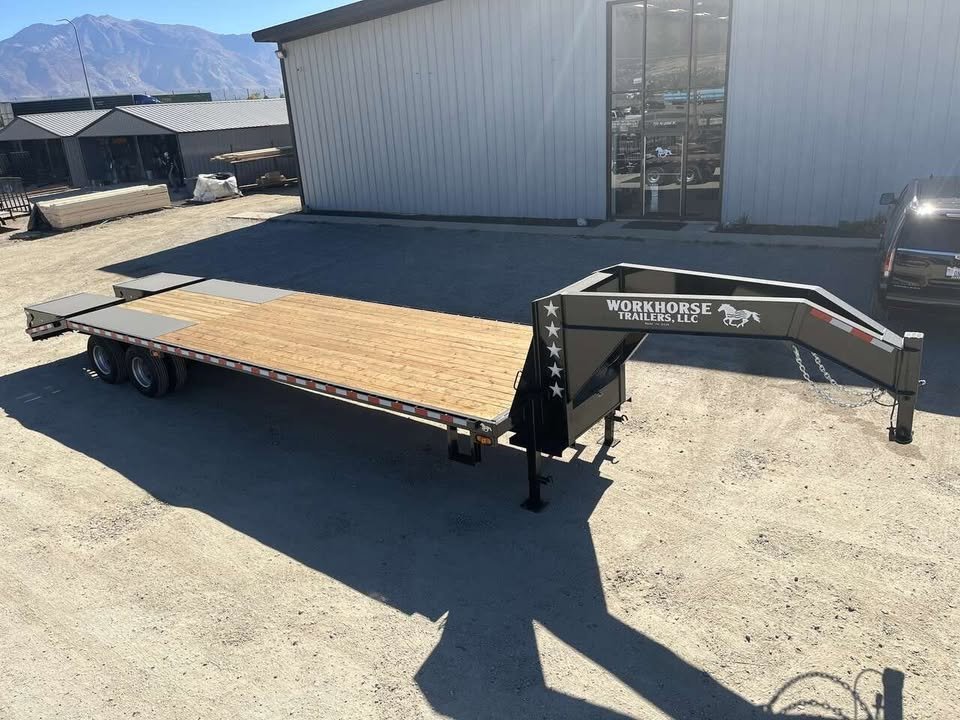
Gooseneck flatbeds in the 35-foot to 40-foot range with ratings above 25,000 pounds provide the legal payload capacity needed to compete for loads that shorter or lighter trailers cannot accept. The gooseneck connection keeps these long trailers tracking straight at highway speeds, which matters enormously on the straight, exposed highway segments where Wyoming winds could turn a poorly hitched long trailer into a dangerous liability.
Portable Building and Structure Relocation
Wyoming’s oil boom towns, construction camps, and temporary work sites use portable buildings, storage containers, and modular office units that relocate as project needs shift. A wellsite office near Wamsutter that served a two-year drilling program might need to move 80 miles to a new development area near Big Piney when the program concludes. Portable bunkhouses at a pipeline construction camp near Baggs relocate to the next spread when the pipe is in the ground.
Gooseneck trailers configured for building relocation carry these structures on platforms designed to distribute the load’s weight evenly and to accommodate the non-standard dimensions of portable buildings that often overhang the trailer sides by several feet. The gooseneck hitch manages the substantial tongue weight these wide, tall loads generate while maintaining enough steering authority for the tow vehicle to navigate the access roads connecting these remote work locations to the state highway system.
Hay Commerce and Forage Distribution
Wyoming’s hay market involves commercial growers, broker operations, and large ranch buyers who move semi loads of baled forage between production areas and feeding destinations throughout the state and across its borders. Gooseneck flatbed trailers stacked with large square bales or carrying round bales on their sides travel from irrigated hayfields in the Star Valley to cattle feeding operations in the eastern plains, covering distances that challenge both driver and equipment.
A fully loaded gooseneck hay trailer can approach or exceed 25,000 pounds gross weight, and the tall stack of bales raises the center of gravity well above the trailer deck. The gooseneck hitch’s position directly over the truck’s rear axle provides the most favorable leverage ratio for controlling this top-heavy load during the highway travel, grade changes, and wind exposure that every long-distance hay haul across Wyoming inevitably encounters.
Gooseneck Hitch Systems and Truck Compatibility
The mechanical connection between a gooseneck trailer and its tow vehicle must be properly engineered, correctly installed, and diligently maintained to deliver the performance advantages the format promises. Wyoming’s demanding conditions leave no tolerance for shortcuts in any element of the hitch system.
Ball and Coupler Sizing
The standard gooseneck ball diameter for trailers in the weight classes commonly used in Wyoming is 2-5/16 inches. This ball size interfaces with a matching round coupler on the trailer and provides the articulation range needed for turning, grade transitions, and the angular deflection that occurs when the tow vehicle and trailer ride over uneven terrain at different moments.
Confirming that the ball diameter matches the coupler specification before every trip prevents the loose connection that results from a mismatched pairing. A 2-inch ball seated in a 2-5/16-inch coupler may latch closed but does not fill the coupler cavity correctly, allowing excessive play that accelerates wear on both components and creates a separation risk during aggressive maneuvering or rough road travel.
Mounting Integrity Inspection
The gooseneck ball mounts to the truck bed through a system of brackets, plates, and fasteners secured to the truck’s frame rails. These components transmit tens of thousands of pounds of vertical and horizontal force from the trailer through the truck’s structure with every mile traveled. Fasteners that have loosened from vibration, frame brackets that have developed fatigue cracks, and mounting plates that have shifted position all compromise the hitch’s ability to control the trailer safely.
Wyoming operators should incorporate a visual and physical inspection of the gooseneck mounting hardware into their regular maintenance routine. Checking fastener torque values against the hitch manufacturer’s specifications, examining bracket welds for cracking, and verifying that the ball seats firmly in its receiver without wobble takes ten minutes and provides assurance that the foundation of the entire towing system remains sound.
Safety Chain Configuration
Gooseneck trailers require safety chains routed from the trailer’s neck structure to attachment points on the tow vehicle’s frame. These chains serve as the last line of defense against complete separation if the coupler-to-ball connection fails during travel. Wyoming law requires safety chains on all towed trailers, and the penalties for non-compliance are secondary to the catastrophic consequences of a loaded gooseneck trailer departing the tow vehicle on a public highway.
Safety chains must be crossed beneath the gooseneck neck to form a cradle that catches the coupler if it drops free from the ball. The chains should be short enough to prevent the trailer tongue from contacting the road surface but long enough to allow full turning articulation without binding. Inspecting chain links for stretch, corrosion, and cracking before each trip ensures this critical backup system functions if called upon.
Seasonal Considerations for Wyoming Gooseneck Operators
The transition between Wyoming’s short summer working season and its extended winter creates operational shifts that affect gooseneck trailer performance and maintenance requirements.
Winter towing introduces reduced traction, limited visibility, and road surface conditions that change within minutes as storms pass through. Gooseneck trailer operators traveling between Wyoming communities during winter months should carry recovery equipment including tow straps, a shovel, and traction mats aboard the truck in case the combination loses traction on an unplowed county road or an icy bridge deck. The weight of a loaded gooseneck trailer provides excellent rear-axle traction for the tow vehicle on level ground, but the same weight increases stopping distances on slippery surfaces and requires earlier brake application during descents.
Spring thaw brings weight restrictions on many of Wyoming’s county roads as frost leaves the subgrade and temporarily reduces load-bearing capacity. Gooseneck operators hauling heavy loads during spring breakup should check county road restriction postings before departing and plan routes that avoid restricted segments. Violating spring weight restrictions damages road surfaces that are expensive to repair and can result in fines that exceed the cost of alternative routing.
Workhorse Trailers LLC Connects Wyoming Operators with the Right Gooseneck
The gooseneck trailer is the workhorse of Wyoming’s hauling infrastructure, and the operators who depend on it deserve a purchasing experience that matches the seriousness of the investment. Workhorse Trailers LLC provides that experience to buyers from Cheyenne, Sheridan, Cody, Lander, Rawlins, Evanston, Afton, Saratoga, Wheatland, Douglas, and every ranch gate and field office address that defines Wyoming’s working map. Each recommendation reflects the specific loads, routes, and conditions the buyer will face, producing a gooseneck trailer purchase that delivers exactly the capacity, stability, and durability that Wyoming’s unforgiving landscape demands from the first loaded mile to the last.