St George Gooseneck Trailers
All locationsWhen the loads get heavier, the distances get longer, and the margin for error gets smaller, the hitching method matters as much as the trailer itself. A gooseneck trailer connects to a ball mounted in the bed of a pickup truck rather than at the rear bumper, placing the trailer's tongue weight directly over the truck's rear axle. That single engineering difference transforms how the entire rig behaves on the road, and for buyers in St. George who haul serious weight across southern Utah's demanding terrain, it is often the detail that separates a confident towing experience from a white-knuckle one. Workhorse Trailers LLC designs and builds gooseneck trailers at its Utah production facility, offering Washington County buyers a locally manufactured option backed by hands-on expertise and a reputation for durable construction.
Why the Gooseneck Configuration Matters
Every bumper pull trailer has a structural limit. Once your loaded weight climbs past a certain threshold, the physics of hanging that weight behind the rear axle start working against you. Sway increases, braking becomes less predictable, and the tail of the tow vehicle wants to wag every time a crosswind or a passing semi hits the rig broadside. A gooseneck trailer addresses these problems at the connection point.
Weight Distribution Over the Rear Axle
The defining advantage of a gooseneck hitch is where the load bears down on the truck. Instead of pulling from behind the rear axle, the gooseneck transfers a significant portion of the trailer's tongue weight downward through the truck bed directly onto the axle. This keeps the truck's rear tires planted firmly on the pavement, improves front-axle steering response, and dramatically reduces the pendulum effect that causes trailer sway. On the long, exposed stretches of Interstate 15 where spring winds gust hard enough to push an empty pickup sideways, that stability is not a minor convenience. It is a safety requirement for anyone towing heavy loads at highway speed.
Increased Towing Capacity
Gooseneck trailers can be rated significantly higher than bumper pull models. While most bumper pull configurations top out in the 10,000 to 14,000-pound GVWR range, gooseneck trailers commonly reach 20,000 to 30,000 pounds depending on the axle and frame configuration. For buyers who need to move loads that exceed what a bumper pull can legally or safely carry, the gooseneck is not just an upgrade. It is the only viable option that does not require stepping up to a commercial semi rig.
Tighter Turning Radius
This surprises many first-time gooseneck buyers. Because the pivot point sits over the rear axle rather than several feet behind it, a gooseneck trailer follows a tighter arc when turning. Backing into a narrow barn opening, threading between parked vehicles on a crowded job site, or maneuvering through the tight residential streets in older St. George neighborhoods all become more manageable with a gooseneck than with a comparable-length bumper pull. The shorter effective overhang behind the truck also means less risk of clipping curbs, posts, or other obstacles during low-speed maneuvers.
Reduced Trailer Length Behind the Truck
A gooseneck's neck section extends forward over the truck bed, which means that for any given total trailer length, less of that length trails behind the rear bumper compared to a bumper pull of the same overall dimension. The practical result is a rig that feels shorter on the road, responds more quickly to steering inputs, and creates fewer blind spots when checking mirrors.
Who Buys Gooseneck Trailers in St. George
The gooseneck buyer in Washington County tends to be someone who has already owned a bumper pull and reached the limits of what it can do. That progression usually happens when loads get heavier, trips get longer, or the stakes of a loaded haul get higher.
Heavy Equipment Operators Needing Maximum Payload
Contractors moving machines in the 10,000 to 20,000-pound range, including larger skid steers, full-size excavators, and rubber-tired backhoes, need a trailer that can handle both the weight and the concentrated footprint of those machines. A gooseneck flatbed or deck over in this weight class provides the structural backbone and the hitch stability to get heavy iron from the yard to the job site without pushing the tow vehicle past its limits.
The volume of grading, excavation, and site preparation work happening across Washington County creates steady demand for this type of hauling. New housing developments on the eastern benches, commercial projects along the Bluff Street corridor, and infrastructure improvements on state routes throughout the area all require heavy equipment that needs to be repositioned regularly.
Ranchers and Agricultural Operations
The agricultural communities ringing the St. George metro, from the cattle operations near Motoqua and Shivwits to the small farms scattered through the Santa Clara and Ivins valleys, depend on gooseneck trailers for livestock transport, hay hauling, and moving farming implements between parcels. A rancher loading 12 round bales of hay onto a gooseneck flatbed is working well beyond what any bumper pull can safely carry. The same applies to a cattle operator pulling a stock trailer loaded with 10 or 15 head across 40 miles of two-lane highway to reach winter pasture.
Gooseneck trailers are the default in agriculture for good reason. The stability at weight, the capacity to carry full loads in a single trip rather than splitting them into multiple runs, and the tighter turning radius for navigating ranch gates and feed lot entrances make the gooseneck the practical standard in rural operations.
Commercial Fleet Operators
Businesses that operate multiple trailers or that use a trailer as a core revenue-generating asset often prefer the gooseneck configuration for its durability under high-frequency use. Hotshot haulers, material delivery services, and heavy transport operators working the corridor between Las Vegas and Salt Lake City through St. George put thousands of miles on their trailers each month. The gooseneck's superior road manners under load reduce driver fatigue, minimize tire wear on the tow vehicle, and lower the cumulative stress on the truck's suspension and frame compared to dragging equivalent weight from a bumper hitch over the same distance.
Gooseneck Trailers from Workhorse Trailers LLC
Workhorse Trailers LLC has operated from its northern Utah facility since 2018, manufacturing a full range of trailer types for residential and commercial buyers across the state. The company is family-owned by the Martinez family, BBB-accredited, and licensed under Dealer #937A. Their gooseneck trailers represent the top tier of the Workhorse lineup, built for buyers whose hauling demands exceed what lighter trailer configurations can deliver.
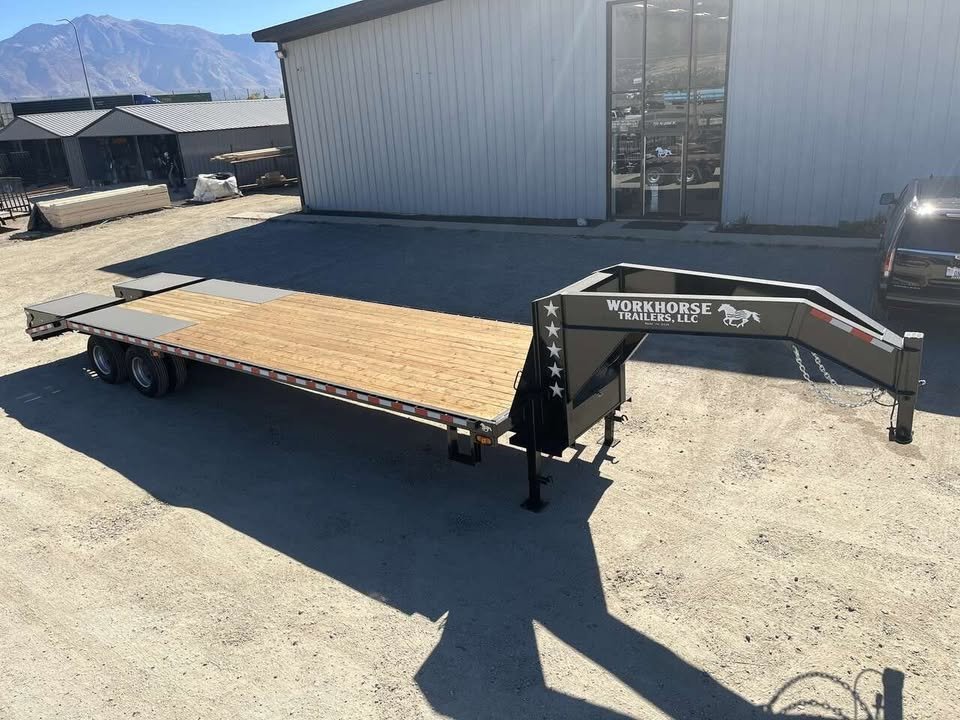
Workhorse gooseneck models are fabricated with heavy-duty frames designed to handle the sustained stress of maximum payload operation. The neck assembly connects to the deck through reinforced gussets and structural bracing that prevent the flex and cracking that cheaper gooseneck builds develop after repeated loading cycles. Spring-assisted fold-down ramps allow one person to deploy and stow the ramps without struggling against the weight of heavy-gauge steel. Sealed LED lighting, heavy-duty axles, and a complete electrical system built for long-term reliability round out the standard package.
The Workhorse team takes a consultative approach to gooseneck sales. Because gooseneck trailers involve a higher investment and serve more demanding applications than lighter models, the staff spends time understanding each buyer's specific towing setup, load types, and frequency of use before recommending a configuration. That conversation helps prevent the common mistake of mismatching trailer capacity to tow vehicle capability, which is both a safety risk and a costly error when it results in premature wear on the truck.
To explore available gooseneck configurations, compare specifications across models, and discuss which setup matches your towing requirements, visitSt. George Gooseneck Trailers and speak with the Workhorse team.
Preparing Your Truck for Gooseneck Towing
Unlike a bumper pull trailer that hooks onto a receiver hitch most trucks already have, a gooseneck requires a dedicated ball and mounting plate installed in the truck bed. Getting this right is essential to safe operation, and cutting corners on the installation creates problems that range from annoying to dangerous.
Hitch Installation
A gooseneck ball mounts through the truck bed floor and bolts to the frame rails beneath. The ball should sit approximately four inches ahead of the rear axle centerline for optimal weight distribution. Some truck owners attempt to install the hitch themselves, but a professional installation ensures the mounting hardware is torqued to specification, the ball height matches the trailer coupler, and the frame attachment points are properly reinforced. An improperly mounted gooseneck hitch can crack the truck bed floor under load or allow the ball to shift, neither of which you want to discover while towing 20,000 pounds down a 6 percent grade.
Truck Bed Considerations
The gooseneck neck occupies space in the truck bed when hitched, which reduces available bed storage. Buyers who use their truck bed for tools, supplies, or jobsite materials should plan for that reduction. Some gooseneck hitch systems feature a removable or flip-over ball that sits flush with the bed floor when not in use, preserving full bed utility when the trailer is detached. Turnover ball systems are popular among St. George buyers who tow regularly but also use their truck bed for other work throughout the week.
Tow Vehicle Rating Verification
The truck's gross combined weight rating (GCWR) must accommodate the total weight of the truck, passengers, in-bed cargo, and the fully loaded trailer. Exceeding this rating does not always produce an immediate failure, but it accelerates wear on the transmission, brakes, cooling system, and suspension in ways that lead to expensive repairs down the line. Three-quarter-ton and one-ton trucks with factory tow packages are the appropriate match for most gooseneck trailer configurations. Half-ton trucks, even those marketed with high tow ratings, are generally not suited for sustained gooseneck use at or near their maximum capacity, particularly in the high-heat conditions that define summer towing around St. George.
Towing a Gooseneck Through Southern Utah Terrain
The road network surrounding St. George presents a set of towing conditions that test both the trailer and the driver.
Elevation Changes
The climb from St. George at 2,800 feet to Cedar City at 5,800 feet covers roughly 50 miles and includes sustained grades that push tow vehicles hard, especially when loaded to capacity. Transmission temperatures climb quickly under these conditions. Tow-haul mode, if equipped, adjusts shift points to keep the transmission in a more favorable gear range. Monitoring the transmission temperature gauge and pulling over to let things cool if the reading spikes above the manufacturer's threshold protects the most expensive drivetrain component in the truck.
Desert Heat and Tire Pressure
Ambient temperatures above 110 degrees increase tire pressure as the air inside heats up during highway driving. Trailer tires that were inflated to the correct cold pressure in the morning can climb 10 to 15 PSI during a midday haul, pushing them toward their rated maximum. Check pressures before departure and understand how heat expansion affects your specific tire size and load rating. Overinflated tires at high speed on hot pavement are a blowout waiting to happen, and a blowout on a loaded gooseneck creates a far more serious control situation than the same event on a lighter rig.
Wind Exposure
Open desert corridors between St. George and the Nevada border, along the I-15 stretch through the Virgin River Gorge, and across the high plateau toward Beaver expose tow vehicles and trailers to sudden crosswind gusts. A gooseneck handles these gusts substantially better than a bumper pull of comparable size because the hitch point's proximity to the rear axle minimizes the leverage that wind can exert on the truck. Even so, maintaining a speed appropriate for conditions and keeping both hands on the wheel through exposed stretches is a habit that experienced gooseneck operators never abandon.
Making the Step Up
A gooseneck trailer is not a casual purchase. It represents a commitment to heavier hauling, longer service life, and the kind of towing performance that lighter configurations cannot provide. For buyers in St. George whose work or lifestyle demands that level of capability, Workhorse Trailers LLC offers a gooseneck product line built to deliver it. Every unit is manufactured in Utah, backed by a team that understands the specific conditions of southern Utah towing, and sold through a process designed to match the right trailer to the right truck and the right job. Get in touch with the Workhorse team to start that conversation and find out what a purpose-built gooseneck can bring to your operation.