
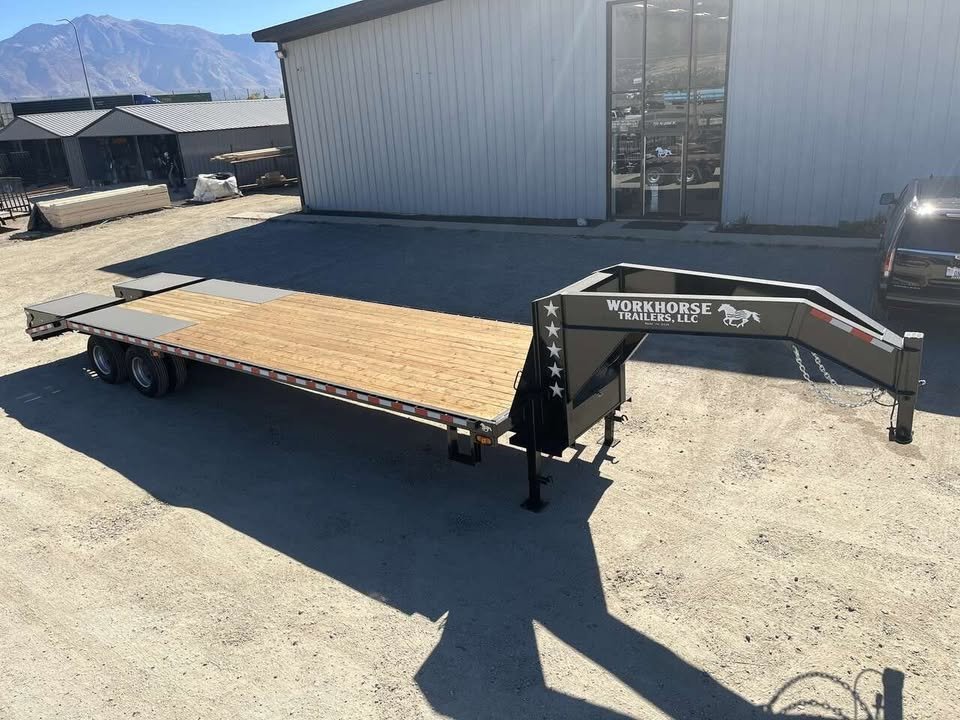
Rawlins Tilt Deck Trailers
All locationsThere is a particular kind of frustration that belongs exclusively to operators who work alone in places where the nearest help is an hour away and the ground beneath the trailer has never seen a paving machine. The machine needs loading. The ramps are frozen to the trailer deck. The ground behind the trailer slopes away at an angle that makes ramp placement a gamble. And the wind is blowing hard enough to turn a loose ramp into a projectile the moment it comes free. This is not a hypothetical scene. It is a regular Tuesday morning for equipment operators working out of Rawlins, where the combination of isolation, terrain, and weather turns every conventional ramp-based loading event into a test of patience, strength, and improvisation. A tilt deck trailer eliminates the entire ordeal by building the loading ramp into the platform itself. One latch releases. The deck drops. The machine drives on. The deck levels. The operator is moving before a ramp-based rig would have the first pin seated. Workhorse Trailers LLC provides Rawlins buyers with tilt deck trailers that remove the most aggravating bottleneck from the equipment transport process in a county where aggravation is the last thing any operator needs added to an already demanding workday.
Carbon County’s working geography guarantees that equipment loading happens on surfaces and in conditions that trailer manufacturers in gentler climates never contemplate during the design process. A wellsite pad carved from native clay south of Wamsutter offers a loading surface that ranges from concrete-hard in summer to ankle-deep mud in spring. A forest service landing in the Sierra Madre provides a sloped gravel platform hemmed in by timber on three sides. A county road shoulder near Elk Mountain gives the operator a narrow strip of frozen ground with traffic passing 10 feet from the trailer’s edge. Workhorse Trailers LLC stocksRawlins Tilt Deck Trailers that handle every one of these loading scenarios by conforming to whatever ground surface exists rather than demanding the flat, firm, level conditions that only a paved yard provides.
The Case for Tilt Deck Trailers in Carbon County’s Operating Reality
The advantages of a tilt deck trailer apply everywhere, but they compound dramatically in an environment like Carbon County where the factors that make ramp loading difficult are present at nearly every loading location and on nearly every working day.
Solo Loading as the Standard Operating Condition
The population density of Carbon County means that most equipment operators travel and work alone. A fence contractor driving 50 miles to a ranch job outside Savery does not bring a helper whose sole purpose is to manage trailer ramps at each end of the trip. A county road crew member dispatched to retrieve a message board from a completed work zone near Sinclair operates as a single individual responsible for every aspect of the retrieval, including loading the sign trailer onto the hauler without assistance.
Tilt deck trailers reduce the loading operation to a sequence that one person executes from the equipment cab and the trailer’s latch mechanism without ever needing a second pair of hands to position, stabilize, or secure detachable ramps. This solo capability is not a convenient bonus in Carbon County. It is a fundamental operational requirement that shapes which trailer format serves the market effectively and which format creates problems that the local workforce structure cannot solve.
Loading Surfaces That Reject Conventional Ramps
Detachable ramps depend on stable ground beneath their tips to support the combined weight of the ramp and the machine crossing it. When the ground is soft, sloped, frozen into uneven ridges, or covered with loose aggregate, the ramp tips sink, slide, or teeter in ways that make loading dangerous for both the operator and the machine. The loading locations characteristic of Carbon County present these problematic surfaces with overwhelming frequency.
A tilt deck trailer’s rear edge contacts the ground directly along the full width of the platform, distributing the loading forces across a contact area many times larger than the two small points where ramp tips would rest. This distributed contact makes the tilt deck functional on soft clay pads that would swallow ramp tips, on gravel surfaces where ramps slide sideways under load, and on frozen ground where the irregular surface created by tire ruts and ice formations prevents ramps from sitting flat. Rawlins operators who have fought with ramps at remote loading locations understand this advantage at a visceral level that no specification sheet can convey.
Eliminating Ramp Loss and Damage in Remote Locations
Detachable ramps represent a perpetual logistical liability for operators working across Carbon County’s vast distances. A set of aluminum ramps left at a wellsite 60 miles south of Rawlins when the operator forgot to reload them after the last unloading event requires a 120-mile round trip to retrieve. Ramps damaged by a tracked machine that exceeded the ramp’s weight rating during a field loading event need replacement from a supplier that may be in Casper or Rock Springs, adding another 200 miles of driving and a day of lost productivity to the cost of the failure.
A tilt deck trailer carries its loading mechanism permanently. It cannot be left behind, forgotten at a job site, or separated from the trailer through any oversight. The deck is always present, always attached, and always ready to perform its function at every loading location the operator visits throughout the day. For Rawlins operators whose routes span dozens of miles between stops, eliminating the possibility of arriving at a loading event without functional ramps removes a source of operational disruption that ramp-based trailers introduce by design.
Carbon County Work Sectors Built Around Tilt Deck Efficiency
The industries that generate the majority of equipment transport activity in and around Rawlins have adopted the tilt deck format at rates that reflect how well the platform matches their specific operational patterns.
Gas Field Wellsite Maintenance
The production wellsites scattered across the basins surrounding Rawlins require periodic visits from maintenance equipment including compact excavators, hydrovac trucks, pump-pulling units, and portable crane trucks that address the mechanical and environmental needs of active production infrastructure. The field technicians operating this equipment visit multiple wellsites per day on routes that cover 80 to 150 miles of mixed highway and field road.
Each wellsite visit involves unloading the machine at the pad, performing the maintenance task, and reloading for the drive to the next location. On a ramp-based trailer, the cumulative time spent deploying and stowing ramps across five or six wellsite stops per day adds up to an hour or more of non-productive activity. A tilt deck compresses each loading cycle to its mechanical minimum, recovering that hour for actual maintenance work at a time when every billable minute of field labor carries significant value for the contractor.
Highway Emergency Response and Debris Clearance
Carbon County’s section of I-80 produces vehicle accidents, cargo spills, and road debris events that require rapid equipment deployment to clear the highway and restore traffic flow. WYDOT maintenance crews and contracted emergency responders stage compact loaders, skid steers, and sweeper attachments on trailers that must deploy equipment at the incident scene as quickly as possible.
The tilt deck’s rapid unloading capability matters critically in these situations where every minute of highway closure creates a backup that extends for miles through a corridor with no alternate routes. A responder who arrives at a debris field on I-80 near Walcott Junction and has the loader on the ground within two minutes of parking provides a fundamentally different level of service than one who spends eight minutes wrestling with ramps on an icy highway shoulder before the machine can begin clearing the scene.
Ranching Equipment Rotation Between Seasonal Tasks
Carbon County ranches transition between seasonal operations that require different machines at different locations throughout the year. Spring brings calving equipment to the home pastures. Summer moves haying machinery to the meadows. Fall deploys feeding equipment to the winter range. Each transition involves loading and unloading compact tractors, skid steers, and specialized attachments at locations that shift with the seasons and the livestock.
A ranch operator who handles these transitions with a tilt deck trailer executes each equipment move as a quick, solo task rather than the production event that ramp loading creates. The ranch hand who can load a compact tractor alone at the hay meadow, drive it to the winter feeding ground, unload it, and return to the meadow for the next task accomplishes in one trip what a ramp-based operation might stretch into a half-day project requiring two workers and a tolerance for frustration.
Keeping Tilt Mechanisms Functional Through Rawlins Conditions
The environmental extremes around Rawlins attack tilt deck mechanisms through pathways that operators in milder markets never encounter. Addressing these specific threats through targeted maintenance preserves the rapid, reliable tilt operation that justifies the format’s adoption in the first place.
Pivot Contamination from Basin Dust and Field Debris
The fine alkali dust common across Carbon County’s basin floor and the mud, gravel fragments, and organic debris encountered at ranch and field loading sites accumulate in the pivot assembly where the tilting deck hinges against the stationary frame section. This contamination mixes with the bearing grease to form an abrasive paste that grinds pivot surfaces with every tilt cycle, accelerating wear that eventually introduces sloppiness and binding into what should be a smooth, controlled motion.
Flushing the pivot assembly with a pressure washer or compressed air before re-greasing at monthly intervals during the active season removes accumulated contaminants before they cause measurable damage. Using a lithium-complex grease with high film strength and water resistance maintains the protective barrier between metal surfaces even when residual contamination remains after cleaning. Rawlins operators who work primarily in dusty basin environments may need to shorten this interval to every two or three weeks during the driest months when airborne particulate levels peak.
Latch Reliability in Extreme Cold and Wind
The latch mechanism securing the tilt deck in its flat transport position must function reliably at temperatures that can drop below minus 20 degrees during Rawlins winters. Metal components contract and lubricants thicken at these temperatures, creating resistance in the latch engagement and release mechanism that ranges from annoying stiffness to complete refusal to operate depending on the severity of the cold and the adequacy of the lubrication.
Applying a dry film lubricant rated for extreme cold to the latch mechanism’s moving surfaces before winter provides consistent operation across the full temperature range Carbon County winters deliver. Dry film lubricants do not attract and hold the dust and grit that wet lubricants trap, which reduces the contamination-related binding that compounds the cold-temperature stiffness problem during the months when both threats are active simultaneously.
Hydraulic Fluid Performance at Elevation and Low Temperature
Rawlins sits at roughly 6,800 feet elevation where atmospheric pressure is approximately 20 percent lower than at sea level. Hydraulic tilt systems that rely on atmospheric pressure to assist fluid return and reservoir venting operate with reduced efficiency at this altitude. Combining reduced atmospheric assistance with the increased fluid viscosity caused by cold temperatures creates conditions where hydraulic tilt response slows noticeably or fails entirely on the coldest mornings of the Rawlins winter.
Switching to a full-synthetic hydraulic fluid formulated for low-temperature and high-altitude service addresses both issues simultaneously. Synthetic formulations maintain lower viscosity at cold temperatures than mineral-based equivalents, which partially compensates for the reduced atmospheric assistance the altitude imposes. Rawlins operators who run hydraulic tilt systems year-round should make this fluid change before the first hard freeze of the season and confirm that the reservoir is filled to the high-altitude mark specified in the system’s service manual.
Sizing Tilt Deck Trailers for Carbon County Equipment
The machines that Rawlins operators transport most frequently fall into weight and dimension ranges that align with specific tilt deck trailer capacities. Matching the trailer to the primary machine it will carry ensures that the tilt mechanism and frame structure operate within their designed performance envelope on every trip.
Compact equipment under 8,000 pounds fits trailers with 16-to-18-foot decks and single or tandem axle sets rated for the specific machine weight. Mini excavators, compact track loaders, and utility tractors used across ranch, energy field, and municipal operations throughout Carbon County fall within this bracket. These trailers pair with the three-quarter-ton and one-ton trucks that serve as standard work vehicles in the Rawlins area.
Heavier equipment between 8,000 and 16,000 pounds requires trailers with 20-to-24-foot decks and tandem or triple axle configurations that distribute the machine weight across enough tire contact area to maintain traction during loading on the soft and loose surfaces common at Carbon County delivery points. Standard skid steers, mid-size excavators, and loaded utility vehicles occupy this weight range and represent the machines most frequently transported by Rawlins contractors and energy field operators.
Operators whose equipment fleet spans both categories should size the trailer for the heaviest regular load and accept the slight towing penalty of pulling a heavier trailer when hauling lighter machines. A tilt deck rated for 16,000 pounds that occasionally carries a 5,000-pound mini excavator handles the lighter load without any performance concern, while the reverse scenario of a 10,000-pound-rated trailer attempting to carry a 14,000-pound skid steer creates an overload condition that jeopardizes safety and accelerates structural failure.
Workhorse Trailers LLC Eliminates the Ramp Problem for Rawlins Operators
Loading equipment in Carbon County will never be a gentle activity performed on a clean concrete pad under a covered roof. It will always involve wind, dust, mud, cold, and isolation in combinations that punish operators who depend on accessories and assistance to get machines on and off the trailer. Workhorse Trailers LLC provides Rawlins buyers with tilt deck trailers that accept these conditions as given and perform reliably within them. Customers arrive from Sinclair, Baggs, Dixon, Savery, Encampment, Saratoga, Hanna, Elk Mountain, Medicine Bow, and Wamsutter because the Workhorse team recommends tilt deck trailers that function in the actual field conditions Carbon County operators face rather than the ideal conditions that exist only in a manufacturer’s test facility. For Rawlins operators who have spent years fighting with ramps at the worst possible locations in the worst possible weather, a tilt deck trailer from Workhorse Trailers LLC represents the permanent end of that fight.