Rawlins Gooseneck Trailers
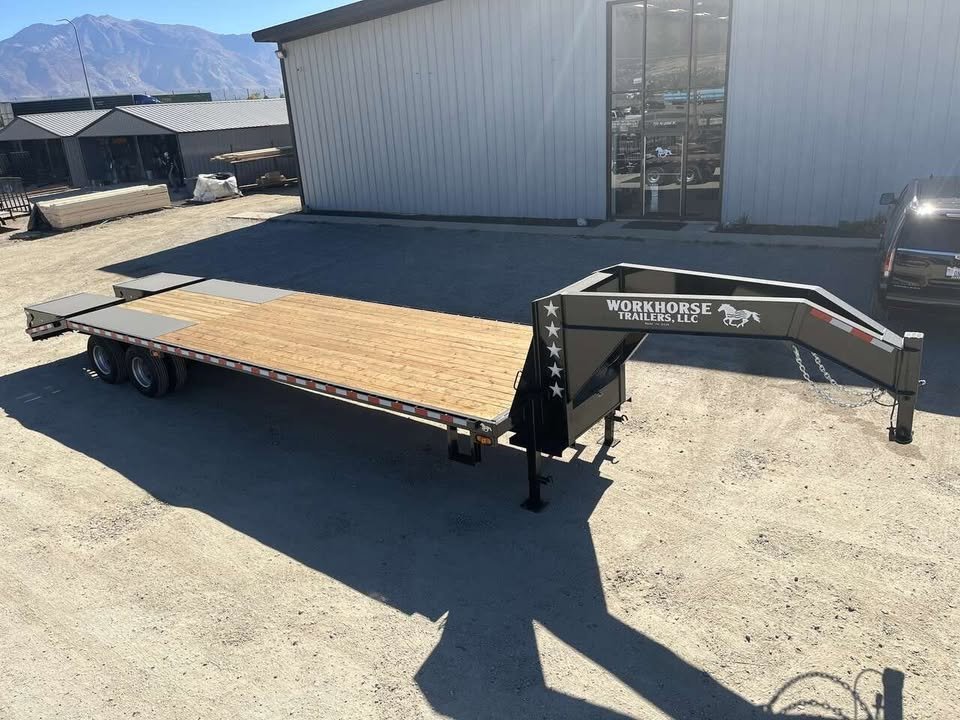
All locationsThe loads that leave Rawlins each morning are not light and they are not short. Pipe strings bound for a gathering line project south of Wamsutter stretch 30 feet behind the truck. Portable production buildings headed for relocation between lease sites weigh north of 20,000 pounds. Strings of three and four horses traveling to a fall roundup on a mountain allotment load a stock trailer past the capacity of anything a rear bumper receiver can control. And every one of these loads must cross distances and terrain that punish any weakness in the connection between the truck and the trailer behind it. The gooseneck hitch exists to handle exactly this category of hauling, routing the trailer’s tongue weight through the truck bed and directly onto the rear axle where the frame is strongest and the physics of towing work most favorably. For Rawlins operators whose cargo has grown beyond what a bumper-pull arrangement can manage safely across Carbon County’s vast and unforgiving distances, the gooseneck trailer represents the step up that restores control, capacity, and confidence to every loaded mile. Workhorse Trailers LLC serves Rawlins buyers with gooseneck trailers matched to the specific loads, routes, and conditions that define heavy hauling in this corner of Wyoming.
Carbon County generates hauling demands that would challenge even a well-equipped operation in a more compact geography. A pipeline contractor bidding work in the Rawlins area must be able to move a 25,000-pound excavator 90 miles to a right-of-way south of Baggs and return the same day. A hay producer selling to a feedlot buyer in Saratoga must deliver 12 tons of baled forage across 60 miles of mixed highway and county road. A stock contractor supplying rough stock for a regional rodeo must transport 15 head of bucking horses to Casper safely enough that the animals arrive fit to compete. Workhorse Trailers LLC providesRawlins Gooseneck Trailers that meet the weight ratings, platform lengths, and structural durability these demanding transport cycles require, giving Carbon County operators the heavy hauling capability their businesses and livelihoods depend on.
Why Rawlins Operations Outgrow Bumper-Pull Towing
The transition from bumper-pull to gooseneck is not a matter of preference for most Rawlins operators. It is a response to specific limitations they have encountered firsthand while attempting to handle Carbon County loads with a hitch system that was never designed for the weight and distance involved.
Cargo Weight Exceeding Receiver Ratings
A bumper-pull receiver hitch on even the most capable one-ton truck tops out at a gross trailer weight rating of approximately 14,000 to 16,000 pounds. The loads Rawlins operators haul regularly push past this ceiling. A fully loaded stock trailer carrying 12 mature cows and their calves to a sale barn exceeds 16,000 pounds comfortably. A flatbed loaded with casing pipe for a wellsite completion approaches 20,000 pounds. A tandem axle trailer carrying a loaded water buffalo tank for field dust suppression can reach 22,000 pounds before the tank is completely full.
Operating above the rated capacity of a bumper-pull hitch is not merely a regulatory violation. It places stress on the receiver tube, the hitch pin, the truck’s rear frame section, and the suspension components that exceed their engineered limits. The consequences range from accelerated wear at the mild end to catastrophic hitch failure at the severe end, with every outcome falling somewhere on a spectrum that no responsible operator wants to test on a remote Carbon County highway.
Trailer Length Creating Instability
Pipeline support trailers, multi-horse stock trailers, and extended flatbed platforms commonly used in the Rawlins area measure 28 to 40 feet from coupler to tail. At these lengths, a bumper-pull connection creates a pendulum arm between the hitch point and the trailer body that amplifies every road disturbance, steering input, and crosswind gust into a lateral oscillation felt in the truck’s steering wheel and mirrors.
The gooseneck hitch shortens this effective pendulum by moving the connection point forward into the truck bed, roughly four feet ahead of where a bumper-pull receiver sits. That geometric reduction suppresses oscillation amplitude dramatically, allowing long trailers to track straight behind the truck through the sustained crosswinds and rough road surfaces that define most Rawlins hauling routes. Operators who have towed a 32-foot trailer in both bumper-pull and gooseneck configurations through the I-80 wind corridor west of Rawlins describe the stability difference as the single most convincing argument for making the switch.
Need for Greater Tongue Weight Capacity
Gooseneck hitches support tongue weight loads of 4,000 to 6,000 pounds or more, compared to the 1,000 to 1,500 pounds a typical bumper-pull receiver handles. This expanded tongue weight capacity matters for loads whose weight distribution naturally concentrates toward the front of the trailer, including livestock that cluster toward the front of a stock trailer during travel and heavy equipment positioned forward on a flatbed to achieve proper balance.
A trailer that cannot accept adequate tongue weight without exceeding its hitch rating forces the operator to position cargo further rearward than optimal, which shifts weight behind the axles and promotes the tail-heavy condition that causes trailer sway. The gooseneck’s generous tongue weight rating eliminates this compromise, allowing Rawlins operators to position their cargo where physics dictates it should ride rather than where the hitch limitation forces it.
Gooseneck Applications Central to Carbon County Commerce
The gooseneck format underpins hauling operations across every revenue-generating sector of Carbon County’s economy. Its combination of weight capacity, platform length, and towing stability makes it the default connection for loads that represent the serious end of the commercial hauling spectrum.
Cattle Marketing and Seasonal Movement
Carbon County ranches cycle cattle between seasonal ranges, move animals to sale barns and auction markets, and transport breeding stock to and from operations across multiple states. A gooseneck stock trailer in the 24-to-28-foot range carries 15 to 25 head depending on animal size and class, providing enough capacity to make each trip to market or between pastures economically productive.
The seasonal cattle drives that once moved animals on foot across open range have given way to trailer transport that accomplishes the same relocation in hours rather than days. A rancher moving 60 head from summer range in the Sierra Madre foothills to winter pasture near the Platte River valley makes three or four loaded gooseneck trips over the course of a day, with each trip covering 40 to 60 miles of road that includes both paved highway and graded county surface. The gooseneck connection keeps these loaded stock trailers tracking predictably through the turns, grades, and wind exposure each trip presents.
Oversized Flatbed Hauling for Energy Infrastructure
The oil and gas infrastructure across Carbon County requires periodic delivery of components that exceed the size and weight capabilities of bumper-pull flatbed trailers. Separator vessels, flare stacks, production tank skids, and portable generator sets all ride on gooseneck flatbed trailers rated for 25,000 pounds or more. The gooseneck hitch manages the concentrated tongue weight these heavy, forward-loaded items produce while maintaining directional stability during the long highway segments and rough field road approaches that connect Rawlins to active production sites.
Energy field operators based in Rawlins who transition from bumper-pull to gooseneck flatbed trailers gain access to a weight class of cargo that previously required hiring a commercial heavy-haul carrier for each delivery. Internalizing this transport capability with a company-owned gooseneck trailer eliminates the per-load expense and scheduling dependency of commercial carriers, giving the operator complete control over delivery timing on the urgent schedules energy field work demands.
Portable Building and Camp Infrastructure Relocation
The temporary workforce housing, field offices, and camp structures supporting energy and construction projects across Carbon County relocate as projects start, finish, and shift between locations. Portable buildings measuring 10 to 14 feet wide and weighing 8,000 to 15,000 pounds travel between sites on gooseneck trailers configured for building transport with adjustable support cradles and wide-load lighting packages.
These relocations follow unpredictable schedules driven by contract timelines and project sequencing rather than by calendar seasons. A field office that served a six-month pipeline project near Muddy Gap needs to reach a new drilling program staging area south of Creston Junction within days of the pipeline project’s completion. The gooseneck trailer that makes this transfer must be available, functional, and capable of handling the building’s weight and dimensions on the specific route connecting the two locations.
Maintaining Gooseneck Systems Through Carbon County Extremes
The mechanical components of a gooseneck hitch system operate within an environment that attacks metal, lubricant, and electrical connections through multiple degradation pathways simultaneously. A maintenance program calibrated for Carbon County conditions preserves the safety and reliability of the hitch system across the years of service Rawlins operators demand.
Coupler and Ball Wear Monitoring
The contact surfaces where the trailer coupler seats onto the hitch ball endure continuous friction loading during every mile of towing. On smooth roads, this friction remains moderate. On the rough gravel and washboard surfaces common across Carbon County, the vibration-induced micro-movements between coupler and ball accelerate surface wear dramatically compared to pavement-only towing.
Inspecting the coupler socket for wallowing, egg-shaping, and surface erosion at regular intervals catches wear before the fit between coupler and ball loosens to the point where excess play allows the trailer to lift off the ball during severe impacts. Replacing worn couplers before they reach critical dimensions costs a fraction of the damage that a coupler-ball separation produces at highway speed on a loaded gooseneck combination.
Safety Chain Integrity in Corrosive Conditions
Safety chains on a Rawlins gooseneck trailer spend their service life bathed in the road spray, chemical residue, and alkali dust that Carbon County roads deposit on every undercarriage component. Link-by-link corrosion reduces the cross-sectional area of chain material and weakens the load-bearing capacity that the chains must provide if the primary coupler connection fails.
Inspecting safety chain links for corrosion pitting, stretch elongation, and cracking at the beginning of each season identifies chains that have degraded below their rated strength. Replacing chains proactively rather than waiting for visible failure maintains the backup retention system that represents the last line of defense against complete trailer separation during travel.
Hitch Mounting Hardware Torque Verification
The bolts securing the gooseneck hitch assembly to the truck’s frame rails absorb the full vertical and horizontal force the trailer transmits during every towing mile. Vibration from rough Carbon County roads works these fasteners incrementally loose over time, reducing the clamping force that keeps the hitch rigidly attached to the frame.
Verifying fastener torque against the hitch manufacturer’s specification at least twice annually and after any particularly rough trip catches loosening before the hitch develops the play that leads to accelerated bolt hole wear, frame rail deformation, and eventual mounting failure. The torque check requires a calibrated wrench and ten minutes of time, an investment that protects against a failure mode whose consequences include losing control of a loaded gooseneck trailer on a highway where the nearest assistance may be an hour away.
Tow Vehicle Readiness for Rawlins Gooseneck Service
The truck pulling a loaded gooseneck trailer across Carbon County operates under sustained stress that exceeds the intermittent loading most tow vehicles experience in less demanding markets. Verifying that the truck’s critical systems match the demands of Rawlins-area gooseneck towing prevents the mechanical failures that strand loaded combinations at the worst possible locations.
Cooling system capacity deserves attention because the sustained grades along Highway 71 south toward Baggs and the long pulls on I-80 westbound toward Creston Junction generate engine and transmission heat loads that factory cooling systems handle adequately at sea level but may struggle with at the 6,800-foot elevation surrounding Rawlins where thinner air reduces radiator and charge-air cooler effectiveness.
Transmission temperature monitoring through an aftermarket gauge gives the driver real-time visibility into the thermal state of the component most vulnerable to heat-related failure during loaded towing. Transmission fluid temperatures that climb above 250 degrees signal the need to reduce speed, downshift for increased engine braking, or stop to allow cooling before irreversible damage occurs to clutch packs and valve body components.
Tire load ratings on the tow vehicle must account for the tongue weight the gooseneck adds to the rear axle on top of any cargo already riding in the truck bed. A truck rated for 7,000 pounds of rear axle load that carries 1,500 pounds of tools in the bed and accepts 4,000 pounds of gooseneck tongue weight operates at 5,500 pounds of rear axle load before the truck’s own rear-end weight is counted. Verifying that this combined loading stays within the truck’s rear axle weight rating prevents the tire overload conditions that produce blowouts during the extended highway runs Rawlins towing requires.
Workhorse Trailers LLC Anchors Heavy Hauling in Rawlins
The loads that keep Carbon County’s economy running are not getting lighter, the distances are not getting shorter, and the conditions are not getting gentler. Workhorse Trailers LLC meets these realities with gooseneck trailers built for exactly what Rawlins operators face every time they hitch up and head out. Customers arrive from Sinclair, Baggs, Dixon, Savery, Encampment, Saratoga, Hanna, Elk Mountain, Medicine Bow, and Wamsutter because the Workhorse team understands that a gooseneck trailer in Carbon County is the foundation of every heavy hauling operation in the territory. For Rawlins operators ready to step up to the capacity and stability that their growing loads demand, Workhorse Trailers LLC delivers the gooseneck solutions that make heavy hauling across one of America’s most challenging landscapes a reliable daily reality.