Provo Gooseneck Trailers
All locationsThere is a weight threshold where bumper pull towing transitions from manageable to inadvisable, and most Provo operators discover that threshold through firsthand experience rather than a specifications chart. The trailer that tracked straight at 8,000 pounds begins wandering at 12,000. The truck that stopped confidently with a moderate load now pushes through intersections with unsettling momentum at higher payloads. The hitch that felt solid on flat ground develops a noticeable wobble during canyon descents. These experiences are the practical education that sends Provo's serious haulers to the gooseneck category, where an over-axle hitch connection, elevated tongue weight capacity, and fundamentally different towing geometry address every limitation that bumper pull rigs impose on heavy transport. Workhorse Trailers LLC provides Provo buyers with gooseneck trailers selected for the payload classes, terrain profiles, and commercial use patterns that characterize heavy hauling in and around Utah County's largest southern city.
Provo generates gooseneck demand from a wider base than many cities its size because its economy blends urban construction, institutional operations, rural agriculture, and mountain recreation into a single municipal boundary. A gooseneck flatbed delivering steel beams to a downtown building project shares the road with a gooseneck stock trailer moving horses to a Provo Canyon trailhead and a gooseneck equipment hauler shuttling a loader between subdivision phases on the city's western edge. This breadth of application means the gooseneck trailer market in Provo is not dominated by a single industry but sustained by a coalition of users whose individual needs are distinct but whose shared requirement for heavy, stable towing brings them all to the same trailer category. This page maps that coalition to the gooseneck inventory at Workhorse Trailers LLC, explores the technical decisions that shape a successful gooseneck purchase, and delivers the towing and maintenance guidance that Provo's terrain and climate demand.
The Coalition of Provo Gooseneck Users
Provo's gooseneck trailer market draws from sectors that rarely overlap in their daily operations but converge around the same fundamental need for payload capacity and towing stability.
Heavy Commercial Construction
Provo's sustained construction boom generates constant demand for gooseneck trailers capable of transporting structural steel, precast concrete elements, engineered wood packages, and the heavy machinery that assembles these materials into finished structures. General contractors and steel erectors working downtown high-rises, mid-rise apartment projects along University Avenue, and the commercial developments expanding west toward the lake rely on gooseneck flatbeds as the primary vehicle for moving materials between fabrication yards, staging areas, and active job sites. The concentrated weight of structural materials pushes payloads well beyond bumper pull territory, making gooseneck hitching the only viable connection for these loads.
Livestock and Equestrian Operations
Provo's agricultural heritage persists along its western and southern margins, where cattle operations, horse breeding facilities, and boarding stables maintain active livestock programs. The equestrian community extends deeper into the city through riding clubs, therapeutic horsemanship programs connected to BYU, and private horse owners who stable their animals at nearby facilities and trail ride in Provo Canyon and the surrounding mountain valleys. Gooseneck stock trailers dominate livestock transport in this community because the hitch geometry produces a smoother ride that reduces animal stress, and the elevated weight ratings accommodate multi-animal loads that bumper pull stock trailers cannot carry safely.
Provo Canyon Service and Recreation Access
Provo Canyon serves as the gateway to Deer Creek Reservoir, Sundance Resort, and the network of mountain roads and trails that Provo residents access year-round. Outfitters, marina service companies, campground maintenance crews, and recreational property owners haul boats, construction materials, heavy equipment, and seasonal supplies through the canyon on gooseneck trailers whose stability on sustained grades and tight curves provides a safety margin that lighter hitching cannot match. The canyon's geometry punishes unstable towing rigs with guardrail proximity, oncoming traffic in the opposing lane, and steep drop-offs that leave zero room for the sway corrections a wandering bumper pull trailer demands.
Institutional and Campus Logistics
BYU's physical plant operations, Utah County government facilities, and Provo City's public works department all maintain gooseneck trailers for institutional hauling tasks that exceed the capacity of their standard fleet vehicles. Campus infrastructure projects, facility equipment relocations, emergency response material staging, and seasonal maintenance operations generate periodic but recurring demand for heavy transport capability that gooseneck trailers provide on call without requiring the institutions to contract outside hauling services for every heavy load.
Gooseneck Inventory at Workhorse Trailers LLC for Provo Buyers
Workhorse Trailers LLC maintains gooseneck trailer inventory organized by the primary cargo category each model is built to serve, allowing Provo buyers to identify relevant options quickly.
Material Transport Gooseneck Flatbeds
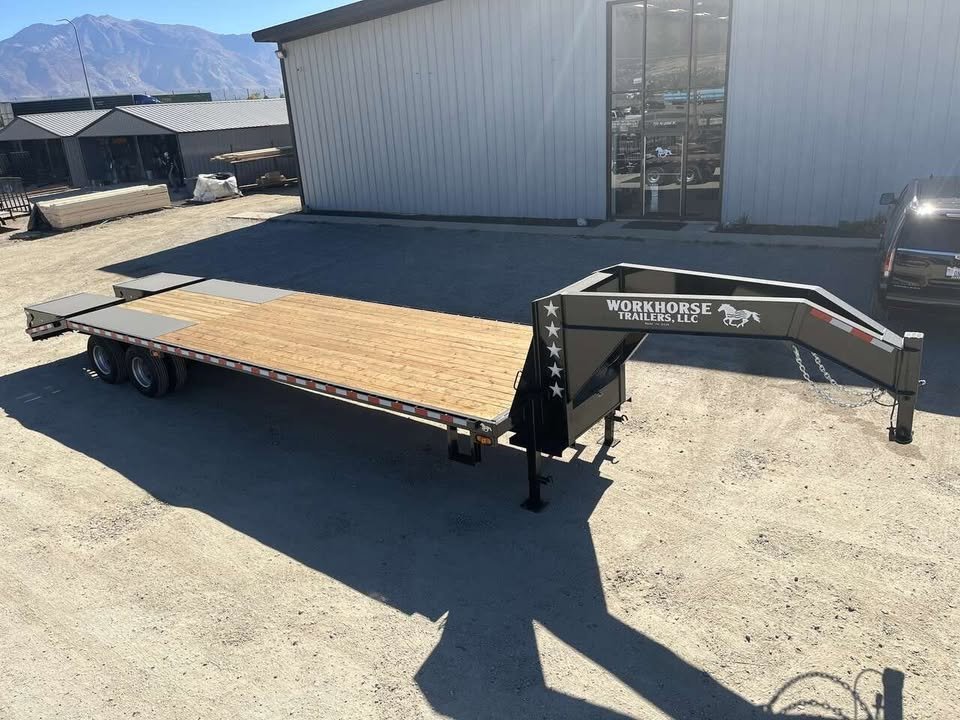
Material transport gooseneck flatbeds anchor the Workhorse inventory with open-deck platforms ranging from 24 to 32 feet in length and GVWR ratings from 16,000 to 25,000 pounds. These trailers carry the palletized building products, bundled structural components, and oversized fabrications that Provo's construction sector moves daily. Treated lumber decking on closely spaced crossmembers provides the distributed load support these materials require, while perimeter stake pockets and recessed tie-down anchors offer the securement versatility needed for cargo profiles that change from one delivery to the next.
Workhorse Trailers LLC offers material transport flatbeds with both straight deck and dovetail rear configurations. Straight decks maximize usable platform length for long cargo. Dovetail designs angle the rear section downward to create a gentler ramp transition for equipment that occasionally shares the platform with material loads, giving Provo buyers a dual-purpose capability on a single trailer.
Livestock Gooseneck Trailers
Livestock gooseneck trailers at Workhorse Trailers LLC range from compact two-horse models to full-size cattle trailers capable of handling a dozen head per load. Construction materials span steel and aluminum, with aluminum commanding a premium but offering corrosion resistance and weight savings that extend the trailer's usable lifespan and increase the net payload available for animal weight.
Interior configurations include adjustable divider gates, slam-latch mechanisms operable with one hand while managing animals, slip-resistant rubber flooring that cushions hooves during transit, and ventilation systems calibrated to maintain airflow without creating drafts that chill wet animals during cold-weather transport. Provo buyers who transport horses to Provo Canyon trailheads and regional competition venues find that Workhorse livestock models provide the ride quality and interior environment that keep animals calm and injury-free across distances ranging from five miles to five hundred.
Tilt Deck Gooseneck Trailers
Tilt deck gooseneck trailers combine powered or gravity-actuated deck tilting with the over-axle stability of a gooseneck hitch, producing a loading system that handles heavy equipment without separate ramps. Provo contractors who load compact excavators, skid steers, and tracked loaders multiple times per week value the time savings and single-operator capability this combination provides.
Buyers exploringProvo Gooseneck Trailers at Workhorse Trailers LLC will find tilt deck gooseneck models with GVWR ratings from 16,000 to 22,000 pounds, hydraulic tilt cylinders powered by onboard battery systems, and reinforced pivot assemblies designed for the high-cycle commercial use that Provo's active construction market demands. The gooseneck connection adds stability during the tilting process itself, resisting the weight transfer that can lift the tongue of a bumper pull tilt trailer off the hitch ball when heavy cargo crosses the pivot point.
Enclosed Gooseneck Cargo Trailers
Enclosed gooseneck cargo trailers pair a sealed cargo box with the towing stability and elevated payload of the gooseneck hitch system. Provo businesses that transport high-value merchandise, fragile equipment, or weather-sensitive materials over long distances select these models for the combined advantage of cargo protection and towing confidence. Interior configurations include electrical systems, climate management provisions, and modular storage components that transform the cargo box into a mobile operations base. Workhorse Trailers LLC stocks enclosed gooseneck models in lengths from 20 to 28 feet with GVWR ratings scaled to the cargo density each size category typically serves.
Critical Decisions in the Gooseneck Buying Process
Purchasing a gooseneck trailer involves several decision points that experienced buyers navigate deliberately and first-time buyers sometimes overlook until the consequences surface during use.
Choosing Between Round and Square Neck Profiles
Gooseneck trailers use either a round tube or a square tube neck structure extending from the trailer frame forward to the coupler. Round necks offer a clean aesthetic and slightly better clearance around the tow vehicle's bed rails during tight turns. Square necks provide flat mounting surfaces for toolboxes, battery compartments, and accessory brackets that bolt directly to the neck without custom fabrication. Provo buyers who plan to mount equipment on the neck structure typically prefer square profiles, while those who prioritize unobstructed turning clearance in confined job sites lean toward round.
Selecting the Appropriate Coupler Style
Gooseneck couplers come in standard ball-and-socket designs and adjustable models that accommodate minor variations in ball height between different tow vehicles. A fixed coupler costs less and introduces fewer moving parts into the connection, while an adjustable coupler provides flexibility for operations that tow the same trailer behind multiple trucks with slightly different bed heights. Workhorse Trailers LLC evaluates each Provo buyer's tow vehicle situation during the purchasing conversation and recommends the coupler style that balances flexibility against mechanical simplicity for that specific operation.
Determining Axle Configuration
Gooseneck trailers ride on tandem, triple, or occasionally quad axle assemblies depending on the GVWR and the intended cargo. More axles distribute the payload across additional tire contact patches, reducing the load per tire and per axle, which extends component life and improves braking distribution. However, additional axles add weight, cost, and complexity to the trailer, and they increase tire scrub during tight turns that can accelerate wear on inner tires. Provo operators who work primarily on highway routes with minimal tight maneuvering benefit from the stability of triple axles, while those who navigate confined job sites and urban delivery points frequently may find tandem axles provide adequate capacity with better turning behavior.
Towing a Gooseneck Through Provo's Terrain
Provo's terrain variety creates towing conditions that test gooseneck operators across multiple driving scenarios within a single workday.
Canyon Grade Protocol
Provo Canyon's sustained grades demand deliberate speed management on both ascent and descent. During climbs, maintain a steady throttle in a gear that keeps engine RPMs in the power band without requiring the transmission to hunt between ratios under load. During descents, select a lower gear before the grade steepens and maintain engine braking as the primary speed control method, applying the trailer brakes intermittently to supplement rather than continuously to replace engine braking. This approach prevents the heat buildup in brake components that continuous application causes on extended downhill runs.
Urban Intersection Management
Provo's signalized intersections along University Avenue, State Street, and Freedom Boulevard require the driver to judge whether the combined rig can clear the intersection before the signal cycles. A gooseneck trailer's length, often exceeding 35 feet behind the truck, means that the rear of the trailer may still be in the intersection when the truck itself has already crossed. Count the signal's remaining time against your rig's clearing distance and wait for the next cycle if the margin is tight. Being stranded mid-intersection with a 40-foot gooseneck rig creates a traffic obstruction that no amount of urgency can resolve faster than patience at the signal would have prevented.
Soft Surface Navigation at Delivery Sites
Construction staging areas, agricultural properties, and unpaved access roads on Provo's developing western side present soft surfaces that can trap a loaded gooseneck trailer's tires, particularly after rain or snowmelt saturates the soil. Assess surface firmness before committing the loaded rig to an unpaved path. If the tow vehicle's tires leave deep ruts during the approach, the trailer's tires under substantially more weight per axle will sink deeper and may become immobilized. Use timber mats, gravel pads, or alternative access routes when ground conditions are questionable.
Maintaining Gooseneck Trailers in Provo's Climate
Provo's climate inflicts predictable wear on gooseneck trailers that proactive maintenance intercepts before it escalates into expensive repairs or dangerous failures.
Coupler and Ball Wear Tracking
Record the coupler and ball dimensions at the time of purchase using a caliper measurement and store the baseline figures with your trailer documentation. Remeasure annually to track the wear rate and determine when either component has reached the replacement threshold specified by the manufacturer. This objective measurement removes the guesswork from wear assessment and prevents the gradual loosening that happens so slowly the operator fails to notice it until the coupler rocks visibly on the ball during a pre-trip check.
Safety Chain Inspection and Replacement Criteria
Safety chains endure constant vibration, road debris impact, and salt corrosion that degrade their load-bearing capacity over time. Inspect each link individually for cracks, elongation, and corrosion pitting that reduces the cross-sectional area of the steel. Replace the entire chain if any single link shows damage, because the chain is only as strong as its weakest point and a failed safety chain provides zero backup protection if the primary coupler connection fails. Provo's winter salt exposure accelerates chain corrosion, making spring inspection an annual priority.
Neck Structure Fatigue Monitoring
The gooseneck neck absorbs every towing force transmitted between the trailer and the truck, creating a fatigue environment that concentrates stress at the bends, gussets, and frame junction. Inspect these zones before every trip by running your fingers along the paint surface and feeling for the ridges and cracks that indicate subsurface weld fatigue. Any crack discovered at the neck, regardless of how small, warrants immediate professional evaluation and repair before the trailer returns to loaded service on Provo's roads.
Seasonal Lubrication Program
Establish a quarterly lubrication schedule covering the coupler mechanism, jack gears, ramp hinges, latch assemblies, and any pivot points specific to the trailer's configuration. Use marine-grade grease formulated to resist washout from Provo's precipitation and the pressurized water used during post-winter undercarriage cleaning. Consistent lubrication prevents the metal-on-metal wear that generates loose tolerances in hardware designed to operate within precise clearances, extending the service interval of these components by years compared to trailers whose lubrication is addressed only when problems become audible.
Why Provo's Gooseneck Buyers Rely on Workhorse Trailers LLC
The gooseneck trailer occupies the highest responsibility tier in the towing world. It carries the heaviest loads, operates at the greatest speeds, and creates the most significant consequences when something goes wrong. Workhorse Trailers LLC meets that responsibility for Provo buyers through gooseneck inventory built to commercial specifications, pre-sale compatibility verification that confirms every truck and trailer pairing operates within rated limits, and ongoing maintenance guidance rooted in Provo's actual terrain and climate conditions. Their material transport flatbeds keep construction projects supplied. Their livestock trailers move animals humanely. Their tilt deck models streamline equipment loading. And their enclosed gooseneck options protect high-value cargo over any distance. For Provo operators whose work demands the capability that only a gooseneck trailer provides, Workhorse Trailers LLC delivers the product quality, the technical knowledge, and the dealer partnership that heavy hauling requires.