Nevada Gooseneck Trailers
All locationsThe distances Nevada demands of its haulers separate casual trailer owners from operators who depend on towing stability as a working condition. A contractor pulling 18,000 pounds from a Reno equipment yard to a mine site near Elko covers 290 miles of open highway through desert terrain that offers no shelter from crosswinds, no shade for rest stops, and minimal options if something goes wrong mechanically. A rancher moving cattle from winter range in the Lahontan Valley to summer pasture near Wells crosses similar distances under similar exposure. At these weights and over these miles, the hitch configuration holding the trailer to the truck isn’t a technical footnote. It’s the engineering decision that determines whether the rig handles predictably or fights the driver at every gust and grade. Gooseneck trailers have become the default heavy hauling platform in Nevada because the physics of the hitch point simply work better at the weights and distances this state requires. Workhorse Trailers LLC supplies gooseneck trailers to Nevada buyers who operate in these conditions daily and need equipment that performs without compromise from the Las Vegas valley floor to the high desert corridors of the north.
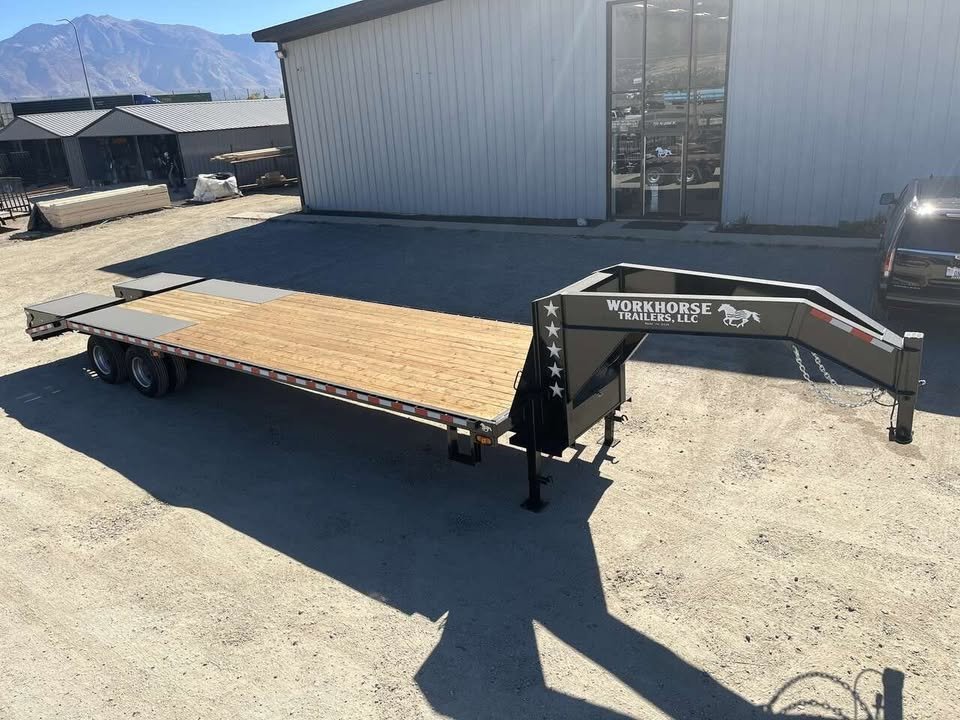
The gooseneck hitch positions the trailer’s connection point in the truck bed, directly above the rear axle centerline. That placement directs the trailer’s tongue weight downward through the strongest structural axis of the truck’s frame. Compared to a bumper pull configuration that leverages tongue weight behind the rear axle, the gooseneck coupling keeps the truck’s front axle loaded, the steering responsive, and the overall combination resistant to the lateral forces that crosswinds and uneven pavement generate. For Nevada buyers towing above 14,000 pounds across highways where wind, heat, and isolation compound every handling deficiency, the gooseneck’s stability advantage isn’t marginal. It’s foundational.
Gooseneck Towing Through Nevada’s Corridor Network
Nevada’s highway system connects its population centers and work sites through corridors that present distinct towing challenges. Understanding these corridors helps gooseneck buyers appreciate why trailer specification and tow vehicle matching matter more here than in states with shorter, more sheltered routes.
The I-80 Northern Corridor
Interstate 80 crosses Nevada from Reno to the Utah border near Wendover, passing through Fernley, Lovelock, Winnemucca, Battle Mountain, Elko, and a series of long open stretches between each town. This corridor serves the mining industry, agricultural operations in the Humboldt River drainage, and the warehousing and distribution sector clustered around the Tahoe Reno Industrial Center and the Fernley logistics zone.
Gooseneck trailers towing this route face sustained crosswinds through the valleys between mountain ranges, elevation changes over summits near Golconda and Emigrant Pass, and winter conditions that include chain controls and whiteout visibility between October and April. A loaded gooseneck flatbed carrying mining support equipment at 20,000 pounds handles the wind loading and grade changes with a stability margin that a bumper pull of equivalent capacity simply cannot provide.
The I-15 Southern Corridor
Interstate 15 connects Las Vegas to the California border at Primm and to the Utah border near Mesquite. Southbound toward California, the route descends through the Ivanpah Valley and climbs through Mountain Pass into the Mojave. Northbound toward Utah, it crosses the Virgin River Gorge, one of the most technically demanding stretches of interstate highway in the western states for loaded trailer combinations.
Gooseneck operators running the Virgin River Gorge section need trailers with properly functioning brakes and tow vehicles with cooling systems capable of sustained grade performance. The gorge includes steep descents with tight curves where trailer braking must supplement engine braking to maintain safe speeds. A gooseneck’s superior coupling stability keeps the trailer tracking behind the truck through these curves rather than pushing laterally as bumper pull trailers tend to do under heavy braking on descents.
The US-93 and US-95 Interior Routes
These north-south highways traverse some of the most remote territory in the contiguous United States. US-93 runs from the I-80 junction near Wells south through Ely and on to Las Vegas. US-95 parallels the California border from Reno south through Hawthorne, Tonopah, and Beatty before reaching Las Vegas. Services on both routes are sparse. Fuel stops can be separated by 80 miles or more. Cell service drops out across substantial stretches.
Gooseneck trailers operating these interior routes need to be mechanically sound before departure, because field repairs happen in environments where help is far away. The gooseneck hitch itself, being a relatively simple mechanical connection compared to fifth wheel jaw assemblies, has fewer failure modes. But the simplicity only provides confidence if the coupler, ball, safety chains, and electrical connections were inspected before the trip began.
Heat Effects on the Gooseneck Coupling Interface
The ball-and-coupler connection that defines the gooseneck hitch experiences thermal conditions in Nevada that other states don’t replicate. The truck bed where the gooseneck ball sits absorbs direct solar radiation all day. Bed surface temperatures on dark-colored truck beds in southern Nevada regularly exceed 170 degrees during summer. The gooseneck ball, coupler socket, and surrounding hardware sit immersed in this thermal zone for every minute the rig is parked.
Grease Degradation in the Coupler Socket
The ball-and-coupler interface requires grease to prevent metal-to-metal wear, reduce articulation friction, and inhibit corrosion. Standard lithium grease applied to the ball and coupler socket breaks down and migrates away from the contact surfaces at elevated temperatures. Nevada gooseneck owners who grease the ball in spring and assume it remains effective through August are operating on depleted lubrication for the hottest months of the year, exactly when the thermal stress on the connection is highest.
High-temperature synthetic grease rated for sustained operation above 400 degrees maintains its film strength across Nevada’s temperature range without the thinning and migration that conventional grease exhibits. Applying this grease and replenishing it at monthly intervals during the May-through-September season keeps the coupling interface protected during peak thermal exposure.
Coupler Latch Binding
The coupler latch mechanism that secures the coupler over the ball can bind when differential thermal expansion causes the latch components to tighten against each other. A coupler that latches and unlatches smoothly at 80 degrees may require significant force to release after sitting in direct sun at 160 degrees. Operators who encounter a stuck coupler latch should allow the assembly to cool rather than forcing the mechanism with tools, which can bend the latch arm or damage the release spring.
Periodically cycling the latch through its full range and applying dry lubricant to the pivot points prevents the corrosion buildup that makes heat-related binding worse. This takes seconds per trip and prevents the frustration and potential injury that accompany a seized latch at a remote unhitching point.
Payload Optimization for Long Nevada Hauls
Nevada’s distances create a financial incentive to maximize payload per trip that shorter-haul states don’t experience with the same intensity. Every pound of unused capacity on a 300-mile round trip represents wasted fuel, wasted time, and wasted truck wear. Gooseneck trailers offer higher payload ceilings than bumper pull alternatives at every GVWR tier, but realizing that payload advantage requires understanding where the weight budget goes.
Trailer Empty Weight as a Payload Tax
A gooseneck trailer’s empty weight subtracts directly from its GVWR to determine usable payload. A trailer rated at 20,000 pounds GVWR that weighs 5,500 pounds empty provides 14,500 pounds of payload. The same GVWR on a heavier-built trailer weighing 6,800 pounds provides only 13,200 pounds. That 1,300-pound difference is an extra half-ton of cargo on every trip. Across a year of weekly long-haul runs, the lighter trailer carries tons more material without adding a single trip.
Nevada buyers should request certified empty weights on any gooseneck trailer under consideration and compare payload capacities across models at the same GVWR. Two trailers with identical sticker ratings can differ meaningfully in how much cargo they actually carry.
Axle Configuration and Per-Axle Loading
Gooseneck trailers distribute their payload across the axle group and the tongue. The axle group carries the majority of the load, and each axle within the group has its own rated capacity. A tandem-axle gooseneck with two 7,000-pound axles provides 14,000 pounds of axle capacity. If the tongue weight absorbs 4,000 pounds on a 20,000-pound GVWR trailer, the axles carry 16,000 pounds of the loaded weight (trailer structure plus cargo), which exceeds the 14,000-pound combined axle rating.
This mismatch catches buyers who assume the GVWR automatically distributes within component limits. The tongue weight percentage, axle rating, tire load rating, and GVWR must all work together. Nevada’s weight enforcement at highway scales verifies these numbers independently, and an axle overweight citation applies even if the overall GVWR isn’t exceeded.
Tire Load Capacity at Temperature
Tire load ratings published by manufacturers assume operation at specified inflation pressures and ambient temperatures. Nevada highway surface temperatures that exceed 150 degrees reduce the effective load capacity of trailer tires because the rubber compound softens and the internal air pressure rises beyond the cold-inflation set point. A tire inflated to 65 PSI in a 75-degree morning shop may reach 80 PSI or higher during an afternoon highway run across the Nevada desert, which stresses the casing beyond its design parameters if the tire is simultaneously carrying its maximum rated load.
Running tires at 5 to 10 percent below maximum rated load provides thermal margin during hot-weather Nevada towing. Alternatively, upgrading to tires with a higher load rating than the minimum required for the trailer’s GVWR builds the same margin through increased casing strength rather than reduced loading.
Gooseneck Applications Across Nevada’s Economic Sectors
Ranching and Livestock
Nevada’s cattle operations span vast rangeland allotments managed by the Bureau of Land Management, with ranches holding grazing permits across hundreds of thousands of acres in counties like Humboldt, Eureka, Lander, and Elko. Moving cattle between seasonal ranges, to veterinary facilities, and to sale barns requires gooseneck stock trailers rated for the distance and terrain these operations cover. The combination of unpaved range roads and multi-hour highway transits demands both structural durability and towing stability that only gooseneck configurations provide at livestock-scale payloads.
Heavy Construction and Infrastructure
The ongoing buildout of highway capacity, water systems, energy transmission, and commercial development across both the Las Vegas and Reno metros drives daily gooseneck equipment and flatbed hauling. Contractors moving excavators, loaders, and material loads between projects use gooseneck trailers as the primary transport platform for anything above the bumper pull comfort zone.
Specialty and Oversize Transport
Gooseneck trailers serve as the base platform for many specialty hauling applications in Nevada, including boat transport from Lake Mead and Pyramid Lake, heavy recreational vehicle repositioning, and industrial machinery delivery to manufacturing and processing facilities. The gooseneck’s higher payload ceiling and improved towing dynamics make it the appropriate starting point for any load that exceeds what a bumper pull can safely manage.
Nevada Registration, Taxation, and Compliance
Gooseneck trailers registered in Nevada follow the state DMV titling and registration process. County-specific sales tax applies at purchase, ranging from 6.85 to 8.375 percent depending on the county of registration. Annual registration renewal fees are based on declared weight class.
CDL requirements apply when the gross combined weight of the loaded truck and trailer exceeds 26,001 pounds. Many gooseneck trailer configurations used in Nevada’s mining, construction, and agricultural sectors approach or cross this threshold when loaded. Operators should calculate their specific combination weights against the CDL cutoff before purchasing a trailer that may require commercial licensing they don’t currently hold.
Nevada’s highway weight enforcement applies to gooseneck combinations at permanent and portable weigh stations across the interstate system and on major state routes. Compliance requires that the truck’s GVWR, the trailer’s GVWR, the truck’s GCWR, and individual axle ratings all remain within their respective limits simultaneously. Exceeding any single rating triggers enforcement action even if all other ratings are within compliance.
Workhorse Trailers LLC and Nevada Gooseneck Buyers
Workhorse Trailers LLC helps Nevada gooseneck buyers navigate the intersection of payload requirements, towing distances, thermal conditions, and regulatory compliance that defines heavy hauling in this state. The company’s approach starts with the specific loads, routes, and operating frequency that each buyer faces and builds the trailer recommendation from those realities.
Nevada buyers evaluating gooseneck trailers across flatbed, stock, equipment, and enclosed configurations can visitNevada Gooseneck Trailers to compare current inventory and connect with the Workhorse team for Nevada-specific recommendations.
The gooseneck trailer you choose becomes the backbone of your hauling operation in a state that tests every component across long miles and extreme heat. Workhorse Trailers LLC ensures that backbone is built strong enough to handle Nevada without qualification.