Montana Gooseneck Trailers
All locationsPull a loaded trailer across Montana a few times and you learn fast which hitch setup you can trust. For buyers towing heavy loads over long distances on highways that cut through mountain passes, river valleys, and open rangeland, gooseneck trailers offer a level of stability and capacity that bumper pull configurations simply cannot match. Workhorse Trailers LLC supplies gooseneck trailers to Montana buyers across a wide spectrum of industries and uses, from cattle ranchers moving livestock between seasonal pastures to contractors hauling excavators between job sites separated by a hundred miles of two-lane highway. The company’s focus on matching each buyer to the right gooseneck setup, rather than defaulting to whatever happens to be available, is the reason customers keep returning and referring others.
A gooseneck trailer connects to the tow vehicle through a ball hitch mounted in the bed of the truck, directly over or just forward of the rear axle. That hitch placement is what makes everything else about the gooseneck design work. By positioning the coupling point over the rear axle instead of behind the bumper, the trailer transfers its tongue weight downward into the strongest structural point of the truck’s frame. The result is a towing experience that feels planted and controlled, even at highway speeds and under loads that would make a bumper pull trailer sway dangerously.
How Gooseneck Trailers Differ From Bumper Pull and Fifth Wheel Setups
Buyers shopping for heavy-duty trailers in Montana often weigh gooseneck configurations against bumper pull and fifth wheel alternatives. Each has a place, but the differences matter enough that choosing the wrong one affects safety, payload capacity, and day-to-day usability.
Gooseneck vs. Bumper Pull
A bumper pull trailer attaches to a receiver hitch at the rear of the truck, behind the rear axle. This works well for lighter loads, generally those under 10,000 to 12,000 pounds. Beyond that weight threshold, the leverage created by the hitch point behind the axle starts working against you. The trailer’s tongue weight pushes down on the very end of the truck’s frame, which lifts weight off the front axle and reduces steering authority. Add a crosswind on Interstate 90 near Deer Lodge or a steep descent coming off MacDonald Pass, and the physics become unfriendly quickly.
Gooseneck hitching moves the attachment point forward, over the axle, which keeps the truck’s weight distribution closer to its designed balance. Montana ranchers who switched from bumper pull stock trailers to gooseneck configurations years ago can tell you the difference is immediately noticeable. The truck handles like it’s supposed to. The trailer tracks straight. Lane changes and curves feel deliberate rather than reactive.
Gooseneck vs. Fifth Wheel
Fifth wheel hitches use a large jaw-and-pin coupling similar to what you see on commercial semi-trucks. They provide excellent stability and are the standard for RV towing. For work trailers, though, gooseneck hitches offer a practical advantage: when the trailer is unhitched, a gooseneck ball can be removed or flipped flush with the truck bed in seconds, leaving the bed fully usable. A fifth wheel hitch occupies a significant portion of the bed permanently unless you invest in a sliding or removable fifth wheel system, which adds cost and complexity.
For Montana buyers who use their truck as both a daily work vehicle and a tow rig, that bed space matters. A rancher who tows cattle on Tuesday and hauls feed bags on Thursday doesn’t want to work around a fifth wheel plate every time the trailer isn’t attached.
Montana Applications for Gooseneck Trailers
Gooseneck trailers serve nearly every heavy hauling need in Montana, and the applications reflect the industries that keep the state’s economy running.
Livestock and Agriculture
Montana’s cattle industry relies on gooseneck stock trailers more than any other trailer type. Moving cattle between pastures, hauling livestock to auction facilities in Billings, Miles City, or Great Falls, and transporting horses to events and trailheads all require a trailer that handles live, shifting weight safely. Gooseneck stock trailers distribute that dynamic load over the rear axle of the truck, reducing the sway and instability that live cargo creates. A 24-foot gooseneck stock trailer with a center cut gate can sort and manage cattle during loading and unloading without requiring additional portable panels.
Hay hauling is another constant for Montana agricultural operations. A gooseneck flatbed rated for 14,000 pounds or more can stack round bales efficiently, and the forward deck area over the gooseneck neck provides additional tie-down and storage space that bumper pull flatbeds lack entirely.
Construction and Heavy Equipment
Moving equipment between sites is a daily reality for Montana contractors. Gooseneck equipment trailers with fold-down or hydraulic ramps allow operators to load and unload skid steers, compact track loaders, and mid-size excavators without the ground clearance issues that plague lighter trailer designs. Ratings of 20,000 to 30,000 pounds GVWR are common in this category, and the gooseneck hitch distributes that weight in a way that keeps the tow vehicle manageable on mountain grades and narrow forest access roads.
Welders and fabricators also gravitate toward gooseneck flatbed trailers. A 30-foot gooseneck flatbed with ratchet-strap tie points along the rails provides a stable platform for transporting steel, pipe, structural beams, and fabricated components to remote installation sites.
Hotshot Freight
Montana’s energy sector, particularly the Bakken oil field operations in the northeast and pipeline projects crossing the state, generates consistent demand for hotshot hauling. Hotshot operators typically run 40-foot gooseneck flatbeds behind heavy-duty pickups, hauling oilfield equipment, pipe, valves, and other freight on tight timelines. The gooseneck configuration is the standard for hotshot work because it provides the payload capacity needed for commercial freight while keeping the overall rig within non-CDL weight limits when loaded appropriately.
Selecting the Right Gooseneck Trailer Size and Rating
Gooseneck trailers range from relatively modest 16-foot flatbeds to 40-foot-plus commercial platforms. Picking the right size and weight rating depends on answering a few straightforward questions about your intended use.
What Are You Hauling Most Often?
Start with your most common load, not your heaviest possible load. A buyer who hauls a 6,000-pound skid steer three times a week doesn’t necessarily need a trailer rated for 25,000 pounds just because they might occasionally move a larger machine. Overspecifying the trailer means you’re towing more steel than necessary on every trip, burning more fuel, and dealing with a longer, heavier rig that’s harder to park and maneuver at tight job sites.
That said, a reasonable margin of safety above your typical load is smart. Trailer ratings account for the trailer’s own empty weight plus payload, and buyers frequently underestimate how quickly tools, materials, and fuel cans add up alongside the primary load.
What Truck Are You Towing With?
Gooseneck trailers require a pickup truck with a gooseneck ball installed in the bed. Three-quarter-ton and one-ton trucks are the standard tow vehicles. Your truck’s GVWR, GCWR, and rear axle weight rating all set hard limits on what you can legally and safely tow. Matching the trailer to the truck is not optional. An overloaded tow vehicle is a liability on Montana’s highways, and it voids warranty coverage on the truck’s drivetrain and frame.
Single rear wheel trucks handle gooseneck trailers up to a point, but for loads consistently above 16,000 pounds, a dually (dual rear wheel) truck provides the additional tire contact and load-carrying capacity that keeps the combination stable. Montana’s winter driving conditions amplify this consideration. Traction on icy or snow-packed roads deteriorates faster when the rear axle is overloaded relative to tire capacity.
Deck Length and Style
Gooseneck flatbeds, equipment trailers, stock trailers, and enclosed gooseneck trailers each serve different purposes. Flatbeds offer maximum versatility for general hauling. Equipment trailers add features like heavy-duty ramps, dovetail rear sections, and reinforced deck structures for machinery. Stock trailers are purpose-built for livestock with aluminum or steel side walls, ventilation systems, and interior gate configurations. Enclosed gooseneck trailers combine high-capacity hauling with weather protection for cargo that can’t be exposed to the elements.
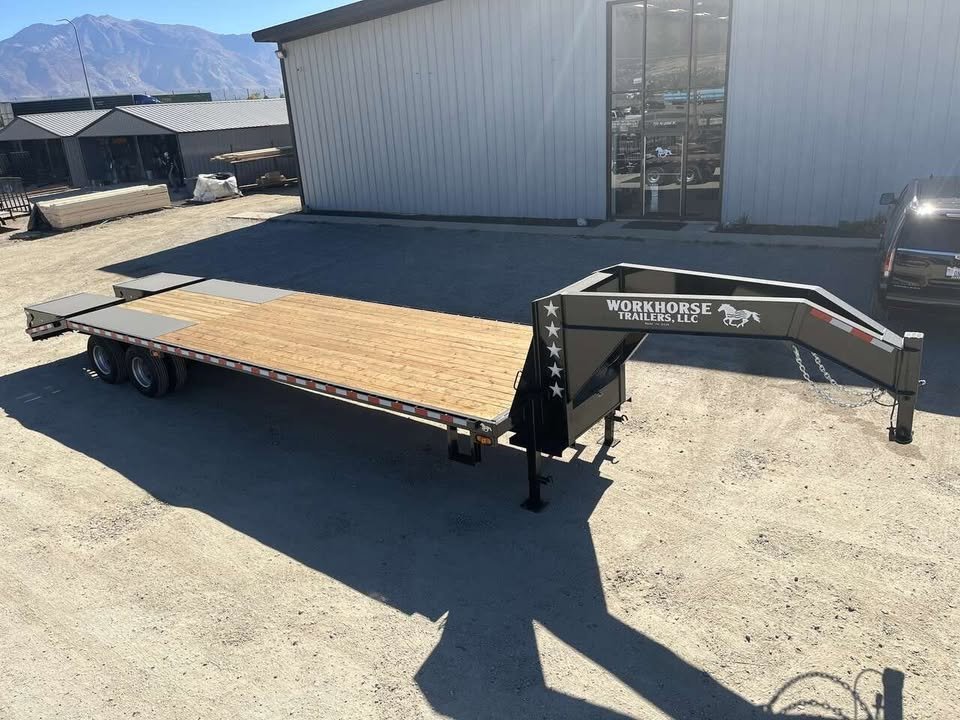
The gooseneck neck itself adds usable space over the truck bed. Many flatbed and equipment trailer designs incorporate a flat platform or storage area on the neck, which is useful for toolboxes, chains, binders, and spare tires.
Gooseneck Hitch Installation and Compatibility
Installing a gooseneck hitch requires drilling or cutting into the truck bed and bolting a mounting plate or rail system to the truck’s frame. Several hitch systems are available, and the choice affects both function and future flexibility.
Fixed ball systems are the simplest and least expensive. A ball mounts permanently through the truck bed, and the trailer coupler drops over it. The ball protrudes above the bed surface when not in use, which limits how you can use the bed for other purposes.
Flip-over ball systems install flush with the bed floor when not in use and flip up into towing position when needed. These maintain a flat bed surface for non-towing use without requiring you to remove anything.
Rail-mounted systems like the B&W Turnoverball or Curt gooseneck kits integrate into the truck bed with a removable ball that stores out of sight when not in use. These are popular among Montana buyers who switch between towing and using their truck bed for everyday ranch or job site tasks.
Workhorse Trailers LLC can advise on hitch compatibility for specific truck and trailer combinations. The hitch needs to match not just the trailer’s coupler size (2-5/16-inch balls are standard for most gooseneck trailers) but also the truck’s frame-mounted towing capacity.
Legal and Registration Details for Montana
Montana requires registration of all trailers operated on public roads, handled through the county treasurer’s office. The state’s absence of a sales tax applies to trailer purchases, which represents a tangible savings compared to buying the same gooseneck trailer in neighboring states that impose sales and use taxes.
CDL requirements come into play when the combined gross weight of the truck and loaded trailer exceeds 26,001 pounds. Many gooseneck trailers rated at 14,000 to 24,000 pounds GVWR can be towed legally with a standard Class D license when paired with an appropriate truck, provided the combined weight stays below the CDL threshold. Hotshot operators and commercial haulers running heavier combinations should verify their licensing requirements with Montana’s Motor Carrier Services division before purchasing.
Braking requirements mandate that any trailer exceeding 3,000 pounds GVWR must have brakes on all wheels. Electric brake systems are standard on most gooseneck trailers in this weight class, though commercial-grade units may use hydraulic surge brakes or air brake systems. A breakaway brake system is also required by Montana law.
Keeping a Gooseneck Trailer Road-Ready in Montana
The gooseneck coupler and neck assembly experience more stress than most other trailer components because they bear the concentrated tongue weight during every trip. Inspect the coupler latch mechanism regularly for wear, and grease the ball socket to prevent binding and corrosion. A coupler that doesn’t latch securely is a catastrophic failure waiting to happen.
The neck welds where the gooseneck assembly meets the main frame deserve visual inspection at least seasonally. Cracking at these junctions, while uncommon on quality trailers, can develop on units subjected to heavy loads over rough terrain. Catching a hairline crack early means a simple weld repair. Ignoring it means a potential structural failure under load.
Standard running gear maintenance applies to gooseneck trailers just as it does to any towed equipment. Bearing service, brake adjustment, tire condition, and electrical system checks should follow a schedule tied to mileage and usage intensity. Montana’s gravel roads and seasonal road treatments accelerate wear on all of these components compared to paved-road-only use.
Why Workhorse Trailers LLC Serves Montana Buyers Well
Buying a gooseneck trailer is a significant investment, and the wrong choice costs more than the price difference between models. It costs you in wasted fuel, reduced payload efficiency, and handling problems that make every trip more stressful than it should be. Workhorse Trailers LLC approaches each sale by working backward from the buyer’s actual needs. What loads are you carrying, how far, how frequently, and with what truck? Those answers drive the recommendation.
Montana buyers looking to compare available gooseneck models, specifications, and pricing can visitMontana Gooseneck Trailers to review the current inventory. The selection spans flatbed, equipment, and stock trailer configurations across a range of weight ratings and deck lengths suited to the hauling demands that Montana’s industries and geography create.
Workhorse coordinates with buyers throughout the state, whether you’re based in the Yellowstone Valley, the Hi-Line corridor, the Bitterroot, or anywhere in between. The buying process is built around getting you the right gooseneck trailer efficiently and without pressure, because the best sale is one where the trailer earns its keep from the first trip forward.