Elko Gooseneck Trailers
All locationsThe loads that Elko County generates don’t stay light for long. A rancher who starts with a small cow-calf operation and a bumper pull stock trailer eventually builds the herd to the point where the trailer can’t carry enough head per trip. A mining contractor who begins with a flatbed hauling small support equipment graduates to machines that exceed the bumper pull’s stability threshold within a season. A hay operation that starts selling beyond the home ranch needs to stack more bales per load to justify the drive to a buyer 80 miles away. In every case, the operator reaches a ceiling that the bumper pull configuration imposes and the gooseneck configuration removes. The gooseneck trailer has become the dominant heavy hauling platform in Elko County not because it’s trendy or overbuilt for the work, but because the weight, the distance, and the terrain that define northeastern Nevada hauling eventually push every serious operator past the point where anything else makes sense. Workhorse Trailers LLC supplies gooseneck trailers to Elko buyers who have reached that point and need a platform that handles the loads their operations have grown into.
The gooseneck hitch connects to a ball mounted in the truck bed above the rear axle, directing the trailer’s tongue weight through the strongest structural point of the truck’s chassis. This coupling geometry keeps the truck’s front tires loaded for steering authority, distributes the combined weight more evenly across the truck’s axle pair, and resists the sway and push-pull oscillation that bumper pull trailers develop under heavy loads. For Elko buyers routinely towing 14,000 to 25,000 pounds across mountain highways and unpaved ranch roads, the gooseneck provides a stability margin that directly affects safety on every trip.
Tow Vehicle Performance at Elko’s Elevation
Every gooseneck trailer purchase in Elko is actually two decisions: the trailer and the truck. The trailer’s capability means nothing if the truck pulling it can’t perform at the elevation and across the terrain that Elko’s geography demands.
Engine Output Loss at Altitude
Internal combustion engines lose power as elevation increases because the thinner air delivers less oxygen per combustion cycle. A naturally aspirated gasoline engine loses roughly three percent of its rated horsepower per 1,000 feet of elevation above sea level. At Elko’s base elevation of 5,000 feet, that translates to a 15 percent reduction from the sea-level rating. A truck rated at 400 horsepower at sea level produces approximately 340 horsepower in Elko, and less still when climbing to mine sites or mountain ranch properties above 6,000 feet.
Turbocharged diesel engines compensate for altitude better than naturally aspirated gasoline engines because the turbocharger forces additional air into the cylinders, partially offsetting the thinner atmosphere. However, even turbodiesels experience some output reduction at extreme elevations, and the turbocharger works harder to maintain boost pressure, which increases heat generation and accelerates turbo component wear over the long term.
Elko gooseneck buyers should evaluate tow vehicle capability based on the effective power available at local elevation, not the factory rating established at sea level. A truck that tows a loaded gooseneck competently in Sacramento may struggle on the grades outside Elko because it’s operating with substantially less engine output than its specification sheet advertises.
Cooling System Demands
The combination of reduced air density, sustained grades, and heavy trailer loads creates cooling system stress that flat-terrain towing doesn’t produce. Thinner air transfers heat less efficiently across the radiator core. Engine and transmission temperatures climb faster under sustained load. The long grades on I-80 approaching Emigrant Pass from either direction, the climb on State Route 228 toward the southern Ruby Mountains, and the mine access roads ascending into the Tuscarora and Independence ranges all subject the tow vehicle’s cooling system to extended high-load operation.
Trucks towing loaded gooseneck trailers in the Elko area benefit from auxiliary transmission coolers if not factory equipped, and from monitoring transmission fluid temperature during loaded climbs. A transmission that overheats on a sustained grade can suffer damage in minutes that costs thousands to repair.
Gooseneck Trailer Applications Across Elko County
The industries and activities that drive gooseneck trailer purchases in Elko reflect the county’s economic base and geographic character.
Livestock Transport
Cattle ranching is woven into Elko County’s identity, and moving livestock by trailer is a constant throughout the year. Spring turnout to grazing allotments, fall gathering to home ranches, trips to the Elko Livestock Auction, veterinary visits to clinics in town, and emergency relocations during drought or wildfire all require stock trailers capable of carrying meaningful numbers of head per trip.
A mature cow weighs between 1,000 and 1,400 pounds depending on breed and condition. A bumper pull stock trailer rated at 7,000 pounds GVWR carrying approximately 4,500 pounds of payload accommodates three to four cows per load. A gooseneck stock trailer rated at 14,000 to 20,000 pounds GVWR with 10,000 to 14,000 pounds of payload carries eight to twelve cows per trip. For a rancher moving 60 head from a summer allotment to winter pasture, the difference between four cows per load and ten cows per load means six trips instead of fifteen. Across a 90-minute round trip on unpaved roads, that reduction saves roughly 13 hours of driving time per gather cycle.
The math alone justifies the gooseneck for any Elko ranching operation moving cattle with regularity.
Heavy Flatbed Hauling
Elko-area contractors, mining service companies, and ranch operations use gooseneck flatbed trailers to haul loads that exceed bumper pull weight or stability limits. Steel structural members for a building project. Pipe sections for a water system installation on a grazing allotment. Palletized mine supplies headed to a remote drill site. Heavy equipment that sits below the weight threshold for a dedicated equipment hauler but above what a bumper pull carries comfortably.
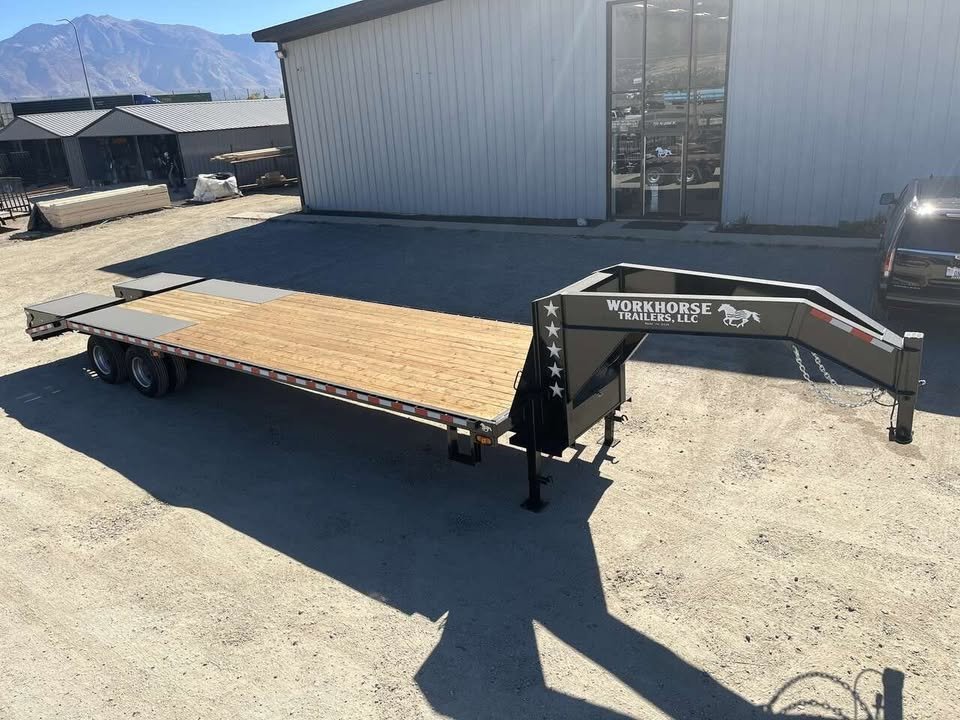
The gooseneck flatbed in the 20 to 30-foot range with a GVWR between 14,000 and 25,000 pounds serves as the workhorse platform for these mixed heavy hauling demands. Its open deck accepts loading from all sides, its gooseneck coupling handles the tongue weight that heavy loads generate, and its length accommodates the oversized items that shorter bumper pull flatbeds cannot carry.
Horse Transport
Elko’s ranching community, combined with its position as a gateway to backcountry horse packing in the Ruby Mountains and Jarbidge Wilderness, supports steady demand for gooseneck horse trailers. Living quarter gooseneck models that combine a horse compartment with a small camper section are particularly popular among Elko buyers who pack into remote trailheads for multi-day hunting, fishing, and ranching operations.
The gooseneck configuration provides the towing stability that mountain road travel with live cargo demands. Horses shift their weight constantly during transit, and that moving load creates dynamic forces that challenge the tow rig’s stability. The gooseneck’s hitch geometry handles these shifting forces with less sway and less impact on steering control than a bumper pull, which matters significantly on the narrow, winding roads leading to trailheads at Lamoille Canyon, the South Fork Reservoir, and the Harrison Pass area.
Cold Weather Coupling and Hitch Maintenance
Elko’s winters subject the gooseneck hitch interface to conditions that accelerate wear and create operational challenges during the months when livestock and equipment transport doesn’t slow down.
Ice Formation in the Coupler Socket
Moisture from snow, sleet, and condensation collects in the coupler socket and freezes when temperatures drop below 32 degrees. A layer of ice in the socket prevents the coupler from seating fully over the ball, which can leave the latch partially engaged. A partially latched coupler can separate from the ball during transit, with catastrophic consequences.
Before coupling in freezing conditions, Elko gooseneck owners should inspect the coupler socket visually and physically verify that no ice has formed inside the cavity. If ice is present, pouring warm water into the socket or applying a heat gun briefly clears the obstruction. Applying a thin coat of grease to the ball before coupling in cold weather creates a barrier that inhibits ice formation in the socket during subsequent stationary periods.
Reduced Dexterity and Inspection Shortcuts
The physical act of coupling a gooseneck trailer in sub-zero temperatures tempts operators to rush the process. Cold hands, bulky gloves, and the desire to get inside the warm truck cab encourage shortcuts in the connection verification that mild weather makes easy to perform thoroughly. A coupler latch that wasn’t fully confirmed, safety chains that were hooked but not crossed properly, or an electrical connector that was plugged in without checking light function create hazards that cold weather increases by reducing the operator’s willingness to spend extra minutes outside.
Building a coupling checklist into muscle memory eliminates the reliance on willpower during cold weather hookups. The sequence should become automatic: seat coupler, verify latch, test by raising jack, connect chains in X-pattern, plug electrical, walk behind to check lights, release jack, stow jack handle. Performing this sequence identically every time, regardless of temperature, prevents the cold-weather shortcuts that produce preventable failures.
Hitch Ball and Receiver Corrosion
Road treatment material on Elko County’s highways during winter includes cinders and occasionally chemical deicers that settle in the truck bed around the gooseneck ball and receiver. This material holds moisture against the steel surfaces through repeated freeze-thaw cycles, creating corrosion that pits the ball surface and roughens the receiver bore. A pitted ball creates excessive wear on the coupler socket’s internal bearing surfaces. A corroded receiver bore binds against the ball shank, making height adjustment difficult.
Cleaning the ball and receiver area after winter driving and applying a corrosion inhibitor keeps the hitch interface functional. This maintenance takes five minutes after each winter trip and prevents the progressive deterioration that builds up unnoticed over an entire cold season.
Weight Distribution on Mixed-Surface Routes
Elko gooseneck trips frequently involve highway driving followed by extended unpaved road travel. The weight distribution that provides optimal highway towing stability may not provide optimal performance on rough unpaved surfaces, and understanding the relationship between tongue weight and off-pavement handling helps Elko buyers configure their loads more effectively.
Highway Tongue Weight Targets
On paved highway, the standard recommendation of 20 to 25 percent tongue weight relative to the loaded trailer’s total weight provides the best combination of towing stability and steering responsiveness. A gooseneck trailer loaded to 16,000 pounds should place 3,200 to 4,000 pounds on the hitch ball during the highway portion of the trip.
Off-Pavement Adjustments
On rough unpaved roads, excessive tongue weight amplifies the impact force transmitted from the trailer through the hitch into the truck’s rear suspension. Every washboard bump and pothole drives the tongue downward with a force proportional to the tongue weight. A truck absorbing 4,000 pounds of tongue weight over washboard takes substantially more punishment at the rear suspension and bed floor than the same truck carrying 3,200 pounds of tongue weight.
When a trip involves significant unpaved mileage, positioning the load slightly further rearward to reduce tongue weight toward the lower end of the acceptable range, approximately 20 percent, reduces the beating the truck absorbs without sacrificing towing stability at the lower speeds typical of unpaved road travel. The reduced highway speed on gravel means the trailer is less susceptible to sway at the slightly lower tongue weight, making the adjustment safe for the conditions.
Elko County Registration and Practical Ownership
Gooseneck trailers registered in Elko County follow Nevada’s DMV process at the local office on Fifth Street. The 6.85 percent county sales tax applies to purchases. Registration renewal fees are based on the trailer’s declared weight class and remain straightforward.
CDL requirements apply when the loaded truck-and-trailer combination exceeds 26,001 pounds gross combined weight. Many gooseneck stock trailers and heavy flatbeds used in Elko’s ranching and mining sectors approach this threshold when fully loaded. Operators should calculate their specific loaded combination weight and verify CDL requirements before assuming their standard driver’s license covers the rig they intend to run.
Insurance for gooseneck trailers in the Elko market typically extends from the tow vehicle’s liability policy. Cargo insurance for high-value livestock loads deserves separate consideration, as the value of a full gooseneck stock trailer of bred cows can exceed $30,000 and a standard auto policy may not cover livestock loss during a transport incident.
Workhorse Trailers LLC and Elko Gooseneck Buyers
Workhorse Trailers LLC serves Elko gooseneck buyers with recommendations built around the specific demands that northeastern Nevada places on both the trailer and the truck pulling it. Altitude, terrain, temperature, and road quality all factor into the guidance the company provides, ensuring that Elko buyers select gooseneck trailers that perform under local conditions rather than under the idealized conditions that specification sheets assume.
Elko area buyers evaluating gooseneck trailers for livestock transport, heavy flatbed hauling, horse packing operations, or general heavy-duty use can visitElko Gooseneck Trailers to compare available models and connect with the Workhorse team for northeastern Nevada-specific guidance.
The gooseneck trailer you select in Elko has to handle the heaviest load on the roughest road during the coldest month. Workhorse Trailers LLC makes sure it can.