
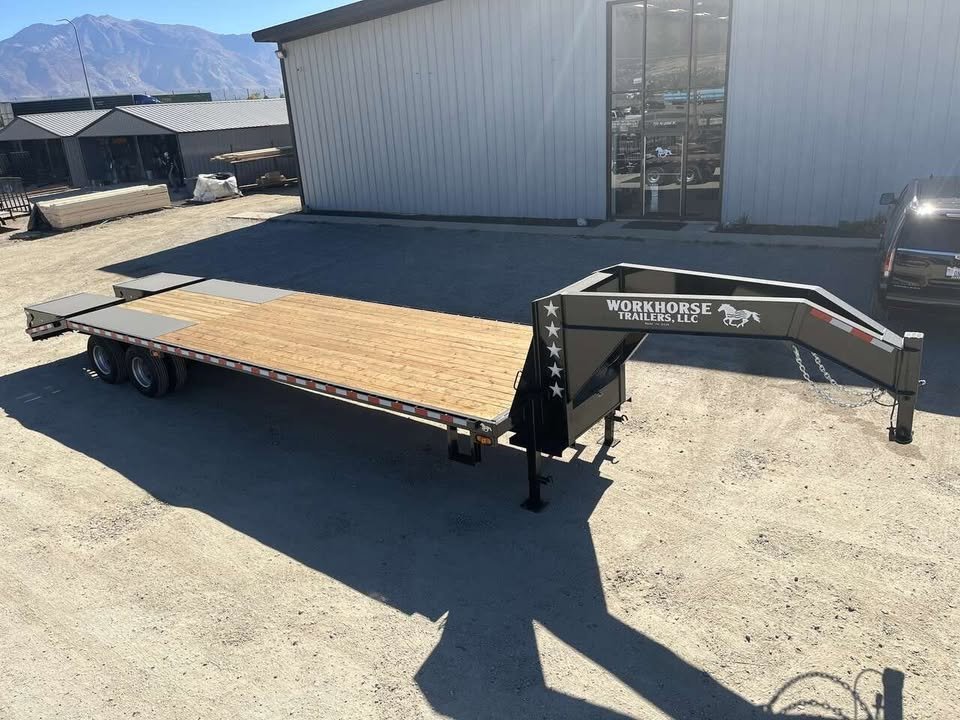
Cheyenne Equipment Hauler Trailers
All locationsCheyenne wakes up early, and the equipment hauler trailers rolling out of yards across the city before sunrise prove it. By the time most office workers pour their first cup of coffee, excavators are already riding south toward subdivision grading projects along College Drive, skid steers are headed east to ranch improvement jobs outside Burns, and compactors are bouncing along I-80 toward a road rehabilitation segment west of town. The city’s position as both Wyoming’s capital and its most commercially connected hub means that heavy equipment flows through Cheyenne in volumes that rival cities three times its size. Every one of those machines depends on an equipment hauler trailer to bridge the gap between where it is stored and where it needs to work. Workhorse Trailers LLC provides Cheyenne operators with equipment hauler trailers rated and constructed for the relentless cycle of loading, hauling, and delivering that keeps this city’s machinery productive across Laramie County and beyond.
Cheyenne’s steady commercial and residential expansion has pushed development outward in every direction. New neighborhoods climb the ridges north of town. Industrial parcels fill in along the Roundtop Road corridor. Infrastructure projects funded by state and federal dollars improve highways, bridges, and utility systems on schedules that compress years of work into months of frantic activity. The contractors, municipal crews, and equipment rental operators who execute this work depend on equipment hauler trailers as the essential link between the staging yard and the active project. Workhorse Trailers LLC suppliesCheyenne Equipment Hauler Trailers that maintain that link reliably through the demanding pace of a construction market that shows no signs of slowing down.
Where Equipment Hauler Trailers Earn Their Keep in Cheyenne
The specific sectors driving equipment hauler demand in Cheyenne reflect the city’s blended identity as a government seat, military installation host, transportation crossroads, and regional service center for the surrounding agricultural and energy economy.
Residential Subdivision Infrastructure
The housing developments spreading across Cheyenne’s perimeter require complete underground and surface infrastructure before the first foundation gets poured. Storm sewers, water mains, sanitary sewer lines, electrical conduit, gas service, and telecommunications utilities all need to be installed in trenches cut through the native clay and caliche that underlies most of Laramie County. The machines that perform this work include rubber-tired backhoes, compact excavators, directional boring units, vibratory plows, and trenching machines that shuttle between active subdivision phases aboard equipment hauler trailers.
A single subdivision project may involve four or five different specialty contractors, each bringing their own machines to the site for a defined scope of work before clearing out for the next trade. This rotating equipment cycle means that equipment hauler trailers load and unload at subdivision entrances multiple times per week throughout the development timeline. The trailers absorb the wear of staging on unfinished road surfaces that transition from packed dirt to loose gravel to fresh mud depending on the day’s weather.
WYDOT Maintenance and Highway Projects
The Wyoming Department of Transportation maintains a regional maintenance facility in Cheyenne that serves as the staging base for highway projects, winter operations, and emergency repairs across southeastern Wyoming. WYDOT crews and the private contractors they hire transport pavement milling machines, asphalt rollers, bridge inspection platforms, and portable message boards between project sites along I-80, I-25, and the network of state highways that radiate from the capital.
The construction season along these corridors operates under tight deadlines imposed by WYDOT’s contracting schedule and by the narrow weather window that separates spring thaw from fall freeze-up. Equipment hauler trailers serving highway projects must deliver machines to precise locations along active roadways where work zones restrict maneuvering space and traffic control plans dictate exactly where and when the trailer can park, unload, and depart. Delays caused by trailer mechanical failures or loading complications cascade through the entire project timeline and can trigger contractual penalties.
F.E. Warren Air Force Base Facility Maintenance
The ongoing maintenance and modernization of facilities at F.E. Warren Air Force Base generates a continuous flow of construction and maintenance equipment through the base gates. Contractors performing building renovation, grounds improvement, utility upgrades, and security infrastructure installation bring machines ranging from compact track loaders to aerial work platforms aboard equipment hauler trailers that must meet base access requirements for safety and documentation.
Base security protocols require that all vehicles and trailers entering the installation carry current registration, proper lighting, and functional safety equipment. An equipment hauler trailer with expired registration, non-functional brake lights, or missing safety chains will be denied entry at the gate, which delays the project and reflects poorly on the contractor’s professional standing. Cheyenne contractors who serve Warren regularly maintain their equipment hauler trailers to a standard that exceeds minimum road-legal requirements specifically to avoid gate-access rejections.
Agricultural Equipment Dealer and Rental Support
Cheyenne’s position at the junction of Wyoming’s agricultural southeast corner and Colorado’s northern farming corridor makes it a natural base for equipment dealers and rental companies that serve both states. These businesses transport tractors, mowers, hay equipment, sprayers, and tillage implements between their Cheyenne facilities and customer locations scattered across Laramie, Platte, and Goshen counties in Wyoming and Weld and Larimer counties in Colorado.
The delivery radius for a Cheyenne-based agricultural equipment dealer can easily exceed 100 miles in any direction. An equipment hauler trailer making a round-trip delivery from Cheyenne to a ranch near Lingle and back covers 200 miles through terrain that shifts from interstate highway to county blacktop to unpaved ranch road within a single journey. The trailer must handle every surface on that route without mechanical issues that could strand a loaded machine on a road shoulder 80 miles from the shop.
Trailer Specifications Matched to Cheyenne Operating Conditions
The equipment hauler trailers that thrive in Cheyenne share certain specifications driven by the city’s elevation, climate, and road characteristics. Selecting a trailer that meets these specifications from the outset prevents the incremental failures and workarounds that consume time and money when a trailer is mismatched to its operating environment.
Axle Ratings and Brake Configuration
Equipment hauler trailers serving the Cheyenne market typically operate in the 12,000-to-24,000-pound gross vehicle weight range, which covers the compact and mid-size machines that dominate local construction and agricultural work. Tandem axle setups with electric brakes on all four wheel positions provide the payload distribution and stopping power appropriate for this weight class.
The grades encountered on routes departing Cheyenne, particularly the climb westbound on I-80 toward the Summit and the rolling terrain south along I-25 through the Terry Ranch area, place sustained demand on trailer brakes during both loaded ascents and descents. Brake drums or rotors sized for repeated heavy use rather than occasional light duty maintain their thermal capacity through the multi-hour loaded runs that Cheyenne equipment haulers routinely perform.
Suspension Specification for Mixed-Surface Routes
Nearly every equipment delivery originating from Cheyenne involves a combination of paved highway and unpaved final-mile surface. The ranch roads east of town cross native grassland over clay soils that turn into an adhesive slurry when wet. The access roads to new subdivision projects feature freshly placed aggregate that has not yet compacted into a stable surface. County roads in the rural corners of Laramie County carry washboard corrugation from seasonal grader maintenance schedules that leave the surface rough between passes.
Leaf spring suspension packs with adequate travel to absorb these varied surface conditions protect the trailer frame and the machine on the deck from the impact damage that stiff, underspecified suspension transmits directly to the structure. Springs rated for the trailer’s full gross weight maintain proper ride height when loaded and provide sufficient deflection range to handle the worst surfaces the route includes without bottoming out on the axle stops.
Ramp Length and Approach Angle
Cheyenne’s 6,060-foot elevation means the air is thinner than at sea level, which reduces engine power output on any machine that relies on atmospheric air intake. A compact excavator that climbs a standard ramp effortlessly at 2,000 feet elevation may struggle on the same angle at Cheyenne’s altitude because its engine produces approximately 20 percent less horsepower in the thinner air. Longer ramps that present a shallower approach angle compensate for this power reduction by decreasing the grade the machine must climb under its own diminished power.
Operators who have experienced a machine stalling partway up a steep ramp on a cold Cheyenne morning understand this issue viscerally. Selecting an equipment hauler trailer with ramps proportioned for the altitude and temperatures the trailer will encounter locally prevents the embarrassing and potentially dangerous situation of a stalled machine teetering on an incline too steep for the available engine output.
Loading Discipline on Wind-Exposed Staging Areas
Cheyenne’s wind exposure affects equipment hauler trailer operations not only during highway travel but also during the loading and unloading events that bookend every trip. Open staging areas at construction sites, equipment yards, and roadside delivery points offer no wind protection, and gusts that strike during critical moments of the loading sequence create hazards that disciplined operators learn to manage.
Machine Stability During Ramp Travel
A machine climbing or descending a trailer ramp is at its most vulnerable to lateral wind force because its center of gravity is elevated above the ramp surface and its traction is limited to the narrow ramp width. A crosswind gust striking a compact track loader while it straddles a ramp can push the machine sideways off the ramp edge, resulting in a rollover that damages both the machine and the trailer.
Cheyenne operators develop the habit of positioning the trailer so that the ramp faces into the prevailing wind whenever the loading area allows a choice of orientation. Loading into the wind means that gusts push the machine toward the ramp surface rather than sideways off it. When site constraints prevent optimal positioning, slowing the loading speed and maintaining the machine’s center of gravity as low as possible during the ramp crossing reduce the risk of a wind-assisted tip.
Deck Securing in Gusty Conditions
Applying tie-down straps to a machine sitting on the trailer deck while 40-mile-per-hour gusts whip loose strap ends around the operator’s hands is an exercise in controlled frustration that every Cheyenne equipment hauler has experienced. Developing a systematic approach where each strap is pre-positioned and pre-threaded before tilting or driving the machine onto the deck eliminates the fumbling and re-threading that gusty conditions make doubly difficult.
Operators who pre-rig their tie-down straps on the trailer deck before arriving at the pickup location convert the on-site securing process from a wrestling match with wind-blown webbing into a quick connection sequence where each strap hooks onto the machine and tightens in a single motion. This technique saves time on calm days and saves sanity on the days when Cheyenne’s wind turns every outdoor task into a test of patience.
Seasonal Equipment Hauling Patterns in Cheyenne
The annual cycle of construction, agricultural, and maintenance activity in Cheyenne creates seasonal peaks and valleys in equipment hauler demand that affect both trailer utilization rates and maintenance scheduling.
Spring through fall represents peak hauling season when construction projects operate at full capacity, agricultural equipment moves between seasonal tasks, and road maintenance projects fill every available lane closure window. Equipment hauler trailers during these months run daily and accumulate miles rapidly. Scheduling preventive maintenance during brief project gaps rather than waiting for the off-season prevents the in-service failures that take a trailer offline during the months when its absence hurts the most.
Winter brings a shift in equipment hauling patterns rather than a complete stop. Snow removal equipment repositions between commercial properties and municipal routes as storms pass through. Indoor construction projects at base facilities and government buildings continue generating equipment transport needs that ignore the calendar. Ranchers haul feeding equipment to winter pasture locations that may be accessible only during frozen ground conditions.
The transition weeks between seasons offer the best opportunity for thorough trailer inspection and maintenance. Bearing repacks, brake adjustments, electrical system cleaning, and frame coating repairs completed during March or October align with natural breaks in the hauling schedule and prepare the trailer for the demands of the upcoming peak season.
Workhorse Trailers LLC Keeps Cheyenne Equipment Moving
The machinery that builds, maintains, and improves Cheyenne depends on equipment hauler trailers that show up ready every morning and perform without complaint through every loading cycle, highway mile, and rough-road delivery the day includes. Workhorse Trailers LLC delivers that performance standard to Cheyenne buyers by recommending trailers specified for the actual conditions this city and county present rather than the generalized assumptions of a national product catalog. Customers visit from Laramie, Wheatland, Guernsey, Lingle, Hawk Springs, Albin, and across the southeastern Wyoming landscape that Cheyenne serves as its commercial anchor, knowing the Workhorse team will match them with an equipment hauler trailer that handles the altitude, the wind, the temperature swings, and the relentless workload that Cheyenne’s growing economy places on every piece of hauling equipment in the fleet.