
Billings Equipment Hauler Trailers
All locationsConstruction activity in Billings hasn’t slowed down. Residential development continues pushing into the surrounding benchlands, commercial projects line up along the Main Street and Shiloh Road corridors, and infrastructure upgrades keep excavation and utility crews busy across Yellowstone County year-round. Behind every one of those projects is a piece of equipment that had to get there somehow. Skid steers, mini excavators, compact track loaders, trenchers, plate compactors, and scissor lifts don’t drive themselves to the job site. They ride on equipment hauler trailers, and the buyers in Billings who depend on those trailers need units built to handle concentrated weight, rough loading conditions, and the kind of daily use that exposes every shortcut a manufacturer tried to hide. Workhorse Trailers LLC serves Billings equipment hauler buyers with trailers selected for the demands of real job site work, not showroom appearances.
An equipment hauler trailer is engineered for a fundamentally different task than a car hauler or general-purpose utility trailer. The loads are heavier per square foot of deck space. The cargo drives itself on and off using steel tracks or rubber tires that punish ramp surfaces. The tie-down forces involved in securing a 10,000-pound excavator bear no resemblance to strapping down a pallet of lumber. Every component on an equipment hauler, from the main frame rails to the ramp hinges, exists under greater stress than its counterpart on a lighter trailer type. That’s why equipment haulers cost more, weigh more, and last longer when built correctly.
What Separates an Equipment Hauler From a Standard Flatbed
Billings buyers sometimes ask whether a heavy-duty flatbed trailer can substitute for a purpose-built equipment hauler. On paper, the weight ratings might overlap. In practice, the differences show up the first time you try to load a tracked machine onto a trailer that wasn’t designed for it.
Deck Height and Loading Geometry
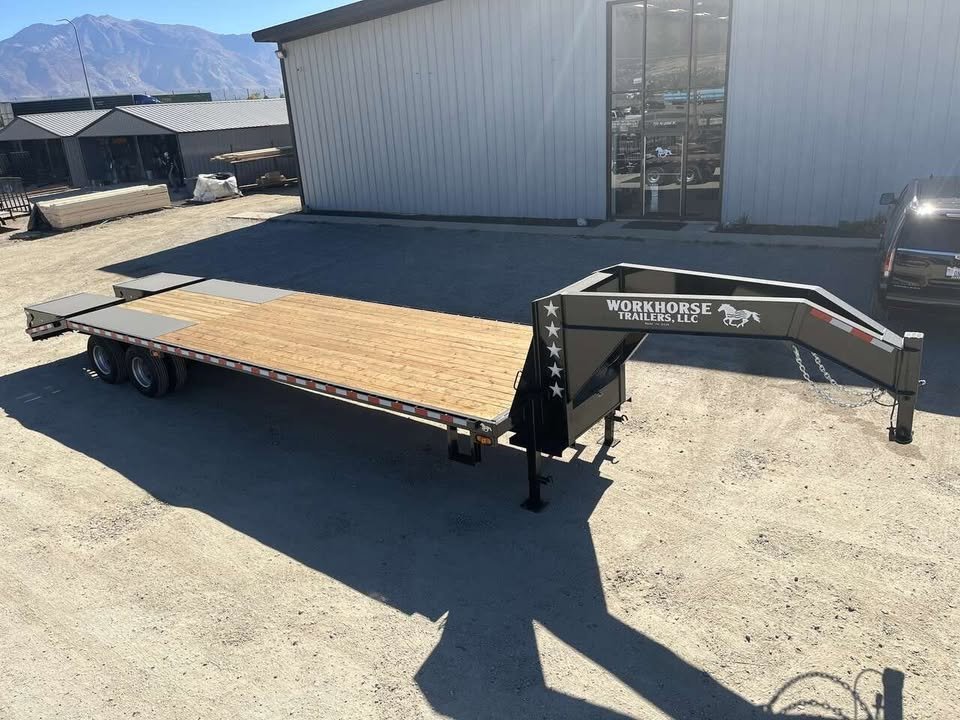
Equipment hauler trailers position their decks lower than standard flatbeds, often through drop-axle configurations or channel-iron main frames that place the deck surface closer to the ground. A lower deck reduces the ramp angle for loading and lowers the overall center of gravity of the loaded trailer, both of which matter when the cargo weighs several tons and sits on a relatively narrow footprint.
A typical equipment hauler deck sits 20 to 24 inches off the ground, compared to 28 to 34 inches on a standard flatbed of comparable weight rating. Those extra inches of height translate directly into a steeper ramp climb, which creates problems for machines with limited horsepower, poor traction on steel surfaces, or low ground clearance beneath the chassis.
Ramp Design and Capacity
Standard flatbed ramps are often afterthoughts, bolted on as accessories. Equipment hauler ramps are structural components designed to bear the full weight of the heaviest machine the trailer is rated for. They’re wider, thicker, and reinforced with cross supports that prevent deflection under load. Many equipment haulers use stand-up ramps that store vertically against the rear of the trailer when not in use and fold down to create a loading surface rated for the trailer’s full payload capacity.
Spring-assisted ramps reduce the physical effort required to raise and lower heavy ramp assemblies. On a 20,000-pound rated equipment hauler, the ramps alone can weigh several hundred pounds. Without spring assist, deploying and stowing ramps multiple times per day becomes a fatigue hazard for operators working alone.
Reinforced Deck Structure
Equipment hauler decks must handle concentrated point loads from track edges, outrigger pads, and narrow tire footprints that distribute weight very differently than a passenger vehicle’s four rubber contact patches. Cross members are spaced more closely together, typically on 12 to 16-inch centers rather than the 24-inch spacing common on lighter trailer types. The deck surface itself, whether steel tread plate or heavy treated timber, is selected for its ability to absorb repeated impact loading without cracking, bending, or loosening from the frame.
Common Equipment Types Hauled in the Billings Market
The equipment moving around Billings on any given workday reflects the city’s active construction, utility, and land management sectors. Each machine type presents specific trailer requirements that buyers should factor into their purchase decision.
Mini Excavators (2,000 to 12,000 Pounds)
Mini excavators are arguably the most frequently trailered piece of equipment in the Billings area. They show up on residential digs, commercial foundation work, utility line installations, and landscaping projects across the valley. A compact mini excavator in the 3,500-pound class fits comfortably on a 14,000-pound GVWR equipment hauler, while larger minis approaching 12,000 pounds operating weight require trailers rated at 16,000 pounds or higher to maintain a safe payload margin after accounting for the trailer’s own weight.
The rubber tracks on mini excavators grip steel ramp surfaces poorly, especially when those surfaces are wet or muddy. Equipment haulers with expanded metal ramp overlays or punch plate tread patterns give tracked machines the traction they need to climb without the operator having to fight the controls on the incline.
Skid Steers and Compact Track Loaders (5,500 to 11,000 Pounds)
Skid steers with bucket attachments frequently travel between sites operated by Billings-area excavation companies, demolition contractors, and agricultural operations. Operating weights vary significantly depending on the model and attachment. A Bobcat S570 with a standard bucket weighs roughly 6,100 pounds, while a larger Caterpillar 272D3 compact track loader tips the scales near 10,000 pounds before adding attachment weight.
Attachment weight is the variable that catches buyers off guard. A skid steer that weighs 7,000 pounds with a bucket weighs considerably more with a hydraulic breaker, auger drive, or grapple installed. Equipment hauler buyers should calculate their most common loaded weight including the heaviest attachment they regularly carry, not just the base machine specification.
Compaction and Paving Equipment
Plate compactors, walk-behind rollers, and small asphalt pavers move between road projects and parking lot jobs throughout Billings. These machines are relatively light individually, but contractors often load several pieces onto a single equipment hauler for each trip. A trailer carrying a walk-behind roller, two plate compactors, a cut-off saw, and associated hand tools can approach its payload limit quickly when the individual weights accumulate. Securing multiple pieces on a shared deck also requires more tie-down points and more careful load arrangement than hauling a single machine.
Aerial Equipment
Scissor lifts, boom lifts, and personnel carriers used on Billings commercial construction sites and building maintenance projects ride on equipment haulers when they move between locations. These machines carry their weight high, which raises the loaded trailer’s center of gravity and demands attention to towing stability. A scissor lift with its platform retracted may stand eight feet tall on the trailer deck. Wind loading on that vertical profile during highway towing between job sites adds lateral forces that a low-profile load like a skid steer doesn’t generate.
Weight Class Breakdown for Equipment Haulers
Equipment hauler trailers sold in the Billings market cluster around several weight classes that correspond to the most common machine categories.
10,000 to 14,000 Pound GVWR
This class handles compact equipment and lighter machines. With an empty trailer weight of roughly 2,500 to 3,500 pounds, the available payload lands between 7,000 and 10,500 pounds. Suitable for mini excavators under 8,000 pounds, smaller skid steers, and multi-piece loads of compaction and hand-operated equipment. These trailers run on tandem axles with electric brakes and pair well with three-quarter-ton and one-ton pickup trucks.
14,000 to 20,000 Pound GVWR
The workhorse class for Billings contractors. Trailers in this range carry mid-size excavators, full-size skid steers with heavy attachments, and small to mid-size aerial equipment. Frame construction steps up to heavier I-beam or channel-iron main rails, and axle ratings increase to match. Gooseneck hitching becomes common in the upper portion of this range, providing the tongue weight management that heavy equipment demands.
20,000 Pounds and Above
Commercial-grade equipment haulers rated at 20,000 pounds GVWR and beyond handle the largest machines that Billings contractors and equipment rental companies need to move. Full-size excavators in the 30,000-pound class, large wheel loaders, and multi-piece loads of mid-size equipment all require this capacity. Air brakes, 12-bolt hubs, and heavy-duty suspension components are standard at this level. CDL requirements apply when the combined weight of the truck and loaded trailer exceeds 26,001 pounds, which is common with equipment in this class.
Securing Equipment for Transit
The forces involved in securing a 10,000-pound machine to a moving trailer exceed what ratchet straps and D-rings are designed for. Equipment hauler load securement follows different standards and uses different hardware than lighter cargo categories.
Chain and Binder Systems
Grade 70 transport chain with lever or ratchet binders is the standard securement method for heavy equipment on open haulers. Four-point tie-downs, one at each corner of the machine, are the minimum configuration for any single piece of equipment. The chain attaches to the machine’s designated tie-down points, which are typically welded lugs or structural frame members identified in the machine’s operator manual. The other end connects to the trailer’s D-rings or chain pockets, and the binder tensions the chain to remove slack and create a downward force component that resists the load’s tendency to shift under braking, acceleration, and cornering.
Working Load Limits
Each chain, binder, and attachment point carries a rated working load limit. The combined working load limit of all tie-downs on one side of the machine must equal or exceed half the weight of the cargo. For a 10,000-pound excavator, that means each side needs at least 5,000 pounds of aggregate working load limit. Two Grade 70 chains rated at 4,700 pounds WLL each provide 9,400 pounds per side, meeting the requirement with margin. Using hardware below these thresholds violates federal securement regulations and creates genuine safety risks during highway transport.
Bucket and Attachment Positioning
Excavator buckets should be lowered flat to the deck with the bucket teeth facing down or with the bucket curled to prevent the arm from bouncing upward during transit. Loader buckets should be lowered and tilted forward against the deck surface. Boom arms on aerial equipment must be fully retracted and pinned. Any attachment that can swing, bounce, or extend during transport needs to be mechanically locked and additionally secured with chain or strap. An excavator arm that bounces free at highway speed becomes an uncontrolled mass that can shift the entire trailer’s balance in an instant.
Billings Terrain and Routing Factors
Towing a loaded equipment hauler through and around Billings involves terrain considerations that affect trailer selection and towing practice.
The rimrocks surrounding Billings create elevation changes that loaded equipment haulers climb and descend regularly. Airport Road ascending the North Rims, the Zoo Drive grade, and the Highway 3 climb south toward Bridger Canyon all put sustained load on the tow vehicle’s drivetrain and brakes during the ascent and demand controlled braking on the descent. Equipment hauler buyers towing heavy loads on these routes should confirm that their trailer’s braking system, whether electric or hydraulic surge, provides adequate stopping power on a loaded downgrade.
Wind is a persistent factor on the exposed stretches surrounding Billings, particularly along the I-94 corridor east toward Forsyth and the I-90 corridor west past Park City. A loaded equipment hauler with a tall-profile machine on the deck catches crosswind differently than a low, evenly distributed load. Towing speed should be adjusted for wind conditions, and buyers who regularly haul aerial equipment should consider gooseneck hitching for the added stability it provides in gusty conditions.
Maintenance Priorities for Equipment Haulers in Billings
Equipment haulers endure more punishing use than most other trailer types. Tracked machines grinding across the deck, heavy chains dragging over D-rings, and concentrated loads hammering cross members on every loading cycle all take a toll that lighter-duty trailers never experience.
Deck surface inspection should happen regularly. Steel tread plate decks develop dents and deformation under repeated point loads from track edges. Timber decks crack and split when machines pivot their tracks during positioning. Replacing a damaged deck section promptly prevents the damage from spreading to the cross members beneath.
Ramp hinge pins and bushings wear faster on equipment haulers than on any other trailer type because the ramps bear the full machine weight during every loading and unloading cycle. Worn hinges allow the ramps to develop lateral play, creating a safety hazard during loading and accelerating further wear. Greasing hinges on a weekly basis during active use extends their service life considerably.
Axle and bearing maintenance follows the same principles as other trailer types, but the heavier loads and more frequent use that equipment haulers see compress the maintenance intervals. Bearings that last two years on a lightly used utility trailer may need service annually on an equipment hauler running daily in the Billings construction market.
Brake adjustment deserves particular attention. Electric brakes on equipment haulers wear faster under heavy loads, and the brake magnets and drums should be inspected at least twice per year for an actively used trailer. Drums that overheat from hauling heavy loads develop glazing that reduces braking effectiveness gradually enough that the operator may not notice the degradation until stopping distances have increased dangerously.
Choosing Workhorse Trailers LLC for Billings Equipment Hauler Needs
The wrong equipment hauler wastes money through insufficient capacity, excessive maintenance, and the inefficiency of working around a trailer that doesn’t match the machines it carries. Workhorse Trailers LLC helps Billings buyers avoid that outcome by focusing on the specific equipment, routes, and usage frequency that define each customer’s hauling requirements. The recommendation follows from those details, not from what generates the largest sale.
Billings buyers ready to evaluate equipment hauler options across the weight classes and configurations that local contractors and operators most commonly need can visitBillings Equipment Hauler Trailers to review current inventory and connect with the Workhorse team.
Whether you’re a one-truck excavation company moving a mini excavator between residential digs or a multi-crew operation repositioning machines across Yellowstone County every morning, the trailer under that equipment needs to be up to the task. Workhorse Trailers LLC makes sure it is.