
Cheyenne Enclosed Cargo Trailers
All locationsCheyenne has a way of reminding people that the high plains do not care about their schedule. A bright Tuesday morning turns into a sideways hailstorm by noon. A calm Sunday drive becomes a whiteout ground blizzard before the destination appears on the horizon. A warm autumn delivery route transforms into a dust-choked obstacle course when the wind kicks up topsoil from freshly tilled fields east of town. Cargo that rides exposed through these conditions arrives damaged, contaminated, or scattered across the shoulder of I-25. Cargo that rides inside an enclosed trailer arrives exactly as it was loaded, untouched by whatever the atmosphere decided to throw at the highway that day. For Cheyenne businesses and residents who cannot afford to gamble the condition of their goods against the most unpredictable weather corridor in the Rocky Mountain states, an enclosed cargo trailer is the insurance policy that pays off on every single trip. Workhorse Trailers LLC supplies Cheyenne buyers with enclosed cargo trailers built to shrug off the worst the high plains deliver while keeping everything inside clean, dry, organized, and secure.
Wyoming’s capital city generates a volume of commerce and institutional activity that belies its modest population. State agencies distribute materials to field offices across the southeast corner of Wyoming. Military support contractors rotate supplies between F.E. Warren Air Force Base and off-base warehouse facilities. Retail businesses stock seasonal inventory from distant distribution centers accessible only by long highway hauls through exposed terrain. Each of these operations places goods in transit through an environment where open hauling is an invitation to damage and loss. Workhorse Trailers LLC carriesCheyenne Enclosed Cargo Trailers that eliminate the environmental exposure these operations face, wrapping every load in a sealed protective shell that arrives at its destination with the contents in guaranteed condition regardless of what the sky and wind produced during the journey.
Cheyenne Professionals Building Businesses Inside Enclosed Trailers
The enclosed cargo trailer has evolved well beyond its original role as a weather-protected box on wheels. Cheyenne entrepreneurs and established businesses have adopted the format as mobile infrastructure that anchors service delivery, inventory management, and field operations across the capital city and its surrounding territory.
Mobile Document Shredding and Records Services
State government offices, legal firms, medical practices, and financial institutions in Cheyenne generate volumes of sensitive documents that require secure destruction under witnessed conditions. Mobile shredding companies operate enclosed cargo trailers outfitted with industrial cross-cut shredders, intake conveyors, and output containment systems that process confidential material on-site at the client’s location.
The enclosed trailer provides the chain-of-custody integrity these services require. Documents pass from the client’s hands directly into the trailer’s intake system without exposure to bystanders, weather, or unsecured intermediate storage. The sealed body prevents shredded material from escaping during processing and transit to the recycling destination. Cheyenne shredding operators serving the concentration of government and professional offices downtown and along Capitol Avenue find that the enclosed trailer format satisfies both client expectations and regulatory requirements for document handling without requiring a fixed commercial facility.
Fiber Optic and Telecommunications Installation
Cheyenne’s growing role as a data center hub and telecommunications crossroads has brought fiber optic installation crews to the city in increasing numbers. These crews carry reels of fiber cable, splice enclosures, fusion splicing equipment, optical time-domain reflectometers, and racks of connectors and termination supplies that collectively represent tens of thousands of dollars in specialized inventory.
Fiber optic components are sensitive to moisture, temperature extremes, and particulate contamination that degrade performance and cause installation failures. An enclosed cargo trailer maintains a controlled environment that keeps cable reels at consistent temperature, protects splice equipment from the grit that Cheyenne winds deposit on every exposed surface, and secures high-value OTDR instruments behind a locked door when the crew breaks for lunch or parks overnight at a hotel. Installation companies serving the data center corridor along Happy Jack Road and the expanding broadband infrastructure throughout Laramie County consider their enclosed trailers as essential as the splicing equipment itself.
Pet Rescue and Animal Transport
Cheyenne’s animal welfare organizations and volunteer rescue networks coordinate transport of dogs, cats, and occasionally livestock between shelters, foster homes, veterinary clinics, and adoption events throughout southeastern Wyoming and northern Colorado. Enclosed cargo trailers modified with crate mounting systems, ventilation fans, and non-slip flooring provide safe, climate-buffered transport for animals that cannot tolerate the noise, wind, and temperature exposure of open hauling.
The enclosed body contains odors and sounds that would otherwise disturb neighboring vehicles and bystanders during stops. It also prevents animals from escaping during loading transitions and protects them from the road debris and weather exposure that make open transport stressful and potentially dangerous for small or anxious animals. Rescue organizations operating out of Cheyenne that coordinate multi-stop transport runs collecting animals from rural surrenders across Laramie County depend on enclosed trailers to keep their passengers safe and contained throughout the route.
Trade Show and Exposition Display Logistics
Cheyenne’s convention calendar at the Archer Event Center, the Cheyenne Ice and Events Center, and venues throughout the downtown district brings exhibitors who transport display booths, product samples, demonstration equipment, and promotional materials between events. These exhibitors range from local businesses showing at community expos to regional companies working a circuit that includes Cheyenne, Denver, Casper, and Rapid City across multiple weekends per month.
An enclosed cargo trailer serves as the exhibitor’s mobile warehouse, keeping booth components, banners, lighting fixtures, and product inventory organized and protected between shows. The ability to leave the trailer loaded and ready for the next event eliminates the hours of packing and unpacking that exhibitors using open trailers or van storage must repeat before and after every show. Cheyenne-based exhibitors who work the regional circuit save an entire day of labor each week by maintaining a permanently loaded enclosed trailer that hitches up and rolls out whenever the next event date arrives.
Confronting Cheyenne’s Atmospheric Assault on Cargo
The weather events that threaten exposed cargo in Cheyenne go beyond ordinary rain and snow. The city’s position on the open plains at the base of the Laramie Range creates atmospheric conditions with few parallels in the lower 48 states.
Hail Damage Prevention
Cheyenne falls within a severe hail corridor that produces damaging stones multiple times during the spring and summer convective season. Hailstorms in this region generate stones capable of shattering vehicle windshields, denting metal roofing, and destroying crops across thousands of acres in a single event. Cargo sitting on an open trailer during one of these storms sustains damage that can exceed the value of the goods themselves.
An enclosed cargo trailer’s roof and wall panels absorb hail impact and shield the contents completely. While the trailer’s exterior may accumulate cosmetic dents from severe stones, the cargo inside remains untouched. For Cheyenne operators transporting finished goods, electronic equipment, glass products, or any inventory where surface damage equals total loss, the enclosed shell transforms a catastrophic weather event into a minor cosmetic issue on the trailer’s skin.
Wind-Driven Debris and Soil Contamination
The topsoil from agricultural fields surrounding Cheyenne becomes airborne during wind events that strip fine particles from exposed ground and carry them at highway speeds across every road and property in the path. This wind-driven soil penetrates packaging, coats surfaces, and infiltrates mechanical components with an abrasive grit that causes damage far exceeding what casual observation suggests.
Enclosed cargo trailers with properly sealed door gaskets and panel joints exclude the vast majority of wind-driven particulates during transit and storage. Cheyenne operators hauling medical supplies, food service equipment, laboratory instruments, or retail merchandise find that the enclosed trailer’s ability to maintain a clean interior environment is worth the price premium over open alternatives when measured against the cleaning costs, product returns, and customer complaints that contaminated deliveries generate.
Freeze Protection for Temperature-Sensitive Goods
Winter temperatures in Cheyenne regularly drop below zero, and wind chill values can plunge to minus 30 or colder during arctic outbreaks. Goods transported on open trailers reach ambient temperature within minutes of departure, which means that water-based products freeze, adhesives lose their bonding properties, batteries discharge rapidly, and liquid-filled instruments risk cracked housings from expanding ice.
An enclosed cargo trailer provides a thermal buffer that slows the rate of temperature change inside the body. While the interior will eventually approach outside temperatures during extended cold exposure, the insulating effect of the walls and roof extends the window of protection long enough for most Cheyenne delivery routes to be completed before the cargo reaches damaging temperatures. Operators hauling goods that require extended freeze protection can enhance this buffer with insulated wall panels and small portable heaters that maintain interior temperatures above freezing for multi-hour hauls through the worst of Cheyenne’s winter conditions.
Practical Considerations for Cheyenne Enclosed Trailer Buyers
Beyond the cargo protection fundamentals, several practical factors specific to Cheyenne’s built environment and regulatory landscape influence which enclosed trailer configuration serves a given buyer best.
Parking and Storage in Cheyenne Neighborhoods
An enclosed cargo trailer occupies a significant footprint when parked at a residence. Cheyenne’s established neighborhoods near downtown, along the Pershing Boulevard corridor, and in the neighborhoods surrounding the F.E. Warren housing areas feature lot sizes and driveway dimensions that restrict where a large enclosed trailer can park without encroaching on sidewalks, neighboring properties, or sight lines at intersections.
Cheyenne municipal code addresses trailer parking on residential properties, and buyers should confirm that their intended storage location complies with setback and screening requirements before purchasing a trailer that may exceed what the lot can legally accommodate. Compact and mid-size enclosed trailers in the 6-by-10-foot to 6-by-12-foot range fit alongside most residential driveways and garages without creating compliance issues, while larger models may require off-site commercial storage at one of the yard facilities available along the Missile Drive or Nationway corridors.
Branding and Professional Appearance
An enclosed cargo trailer rolling through Cheyenne’s commercial districts presents a large, visible surface that communicates the owner’s brand to every driver and pedestrian who sees it. Vehicle wraps, magnetic signs, and vinyl graphics applied to the trailer’s exterior panels turn routine delivery trips into mobile advertising that reaches thousands of impressions per day at no incremental cost beyond the initial graphic installation.
For Cheyenne service businesses competing in a market small enough that reputation and visibility directly affect revenue, a clean and professionally branded enclosed trailer signals investment, permanence, and pride in the operation. A plumbing company with a spotless white enclosed trailer displaying its logo, phone number, and service area parked at a job site in the South Greeley corridor projects a different image than the same company arriving with a rusty open trailer and a tarp flapping in the wind.
Door Configuration for Cheyenne Workflows
The choice between rear ramp doors and rear barn doors affects how efficiently the trailer integrates into the operator’s daily loading routine. Cheyenne buyers should consider where and how they typically load before selecting a door style.
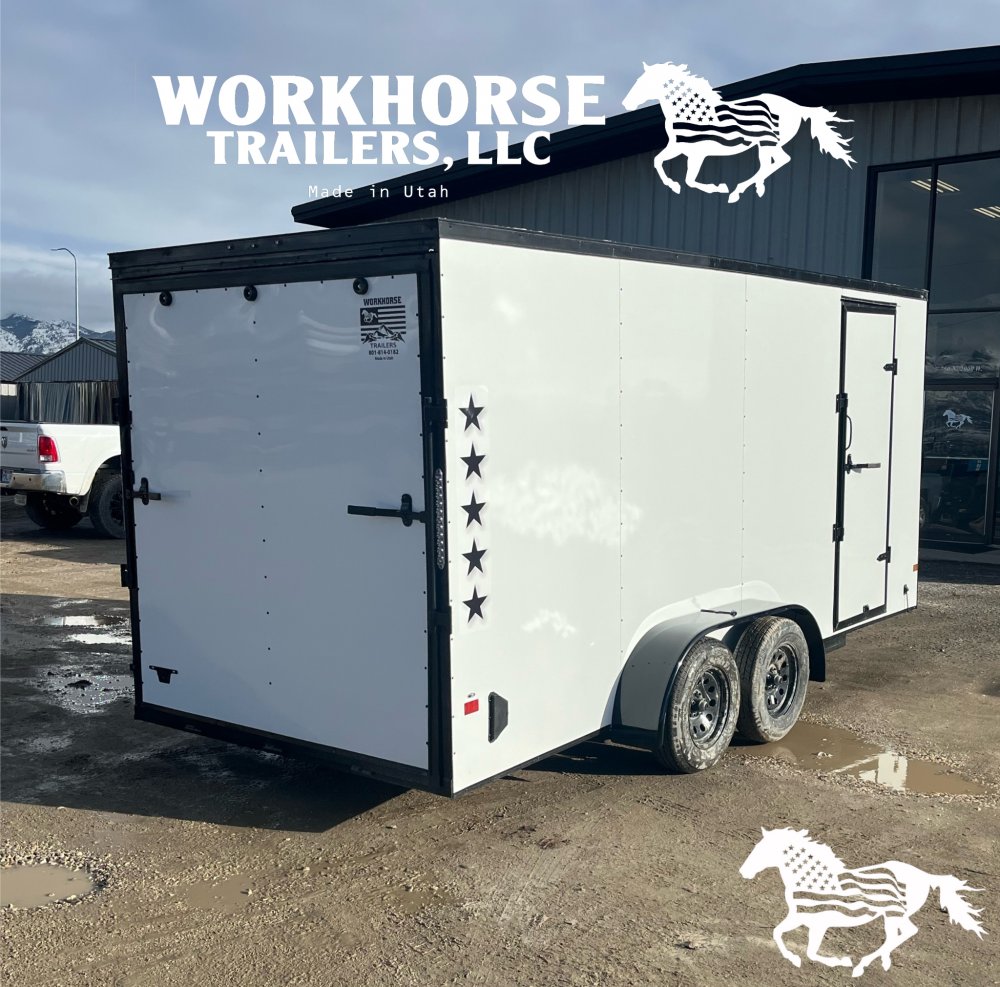
Ramp doors fold down to create a driven or rolled loading surface that extends behind the trailer. They work best for operators who load with wheeled equipment, hand trucks, or dollies on level ground where the ramp clearance behind the trailer is available. The supply yard parking lots and warehouse loading areas common along Cheyenne’s Westland Road and Industrial Avenue corridors typically provide adequate ramp deployment space.
Barn doors swing outward on hinges and provide a full-height opening without requiring clearance behind the trailer. They serve operators who hand-load boxed inventory, carry items in and out frequently during the workday, or park in tight spaces where a deployed ramp would block traffic or extend into an adjacent parking space. Service technicians making multiple stops per day across Cheyenne’s compact urban core find that barn doors match their access pattern better than the more time-consuming ramp deployment cycle.
Side entry doors positioned along the curbside wall provide walk-in access to organized interior shelving without opening the main rear doors. Cheyenne operators who carry categorized inventory and need to pull specific items multiple times per hour without disturbing the main cargo area find the side door indispensable. Its smaller opening also reduces heat loss during winter stops when opening the full rear entry would flood the interior with frigid air and negate whatever thermal protection the enclosed body provides.
Workhorse Trailers LLC Protects What Cheyenne Sends Down the Road
Every item loaded into an enclosed cargo trailer represents someone’s inventory, someone’s tools, someone’s livelihood, or someone’s passion. Workhorse Trailers LLC treats that reality as the starting point for every recommendation made to Cheyenne buyers. The team evaluates cargo sensitivity, trip frequency, storage constraints, and towing capability to identify the enclosed model that protects the goods and fits the operation. Customers visit from Burns, Carpenter, Albin, Hillsdale, Granite, Pine Bluffs, and from the neighborhoods and business districts that give Cheyenne its unique character, trusting that the Workhorse team will recommend a trailer built to handle the hail, the wind, the cold, and the dust that make this city one of the most challenging enclosed cargo environments in the American West. That trust delivers results in the form of trailers that protect their contents trip after trip, season after season, without giving the high plains a single opening to damage what is inside.