
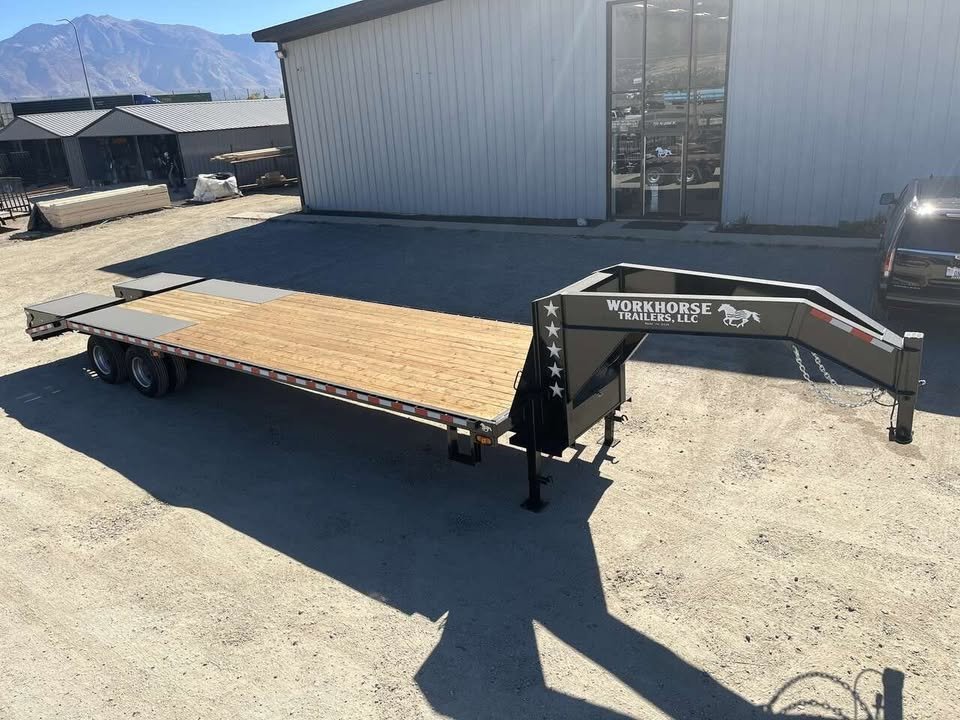
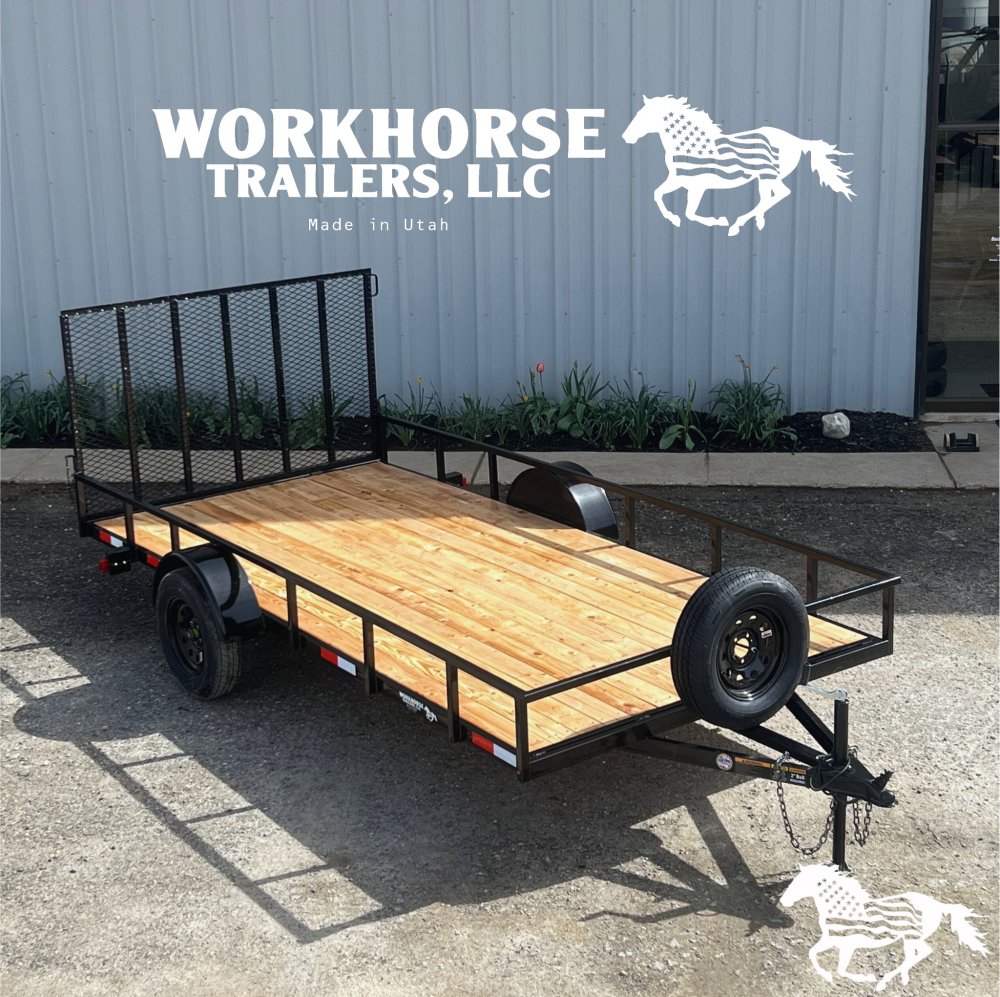
Billings Tilt Deck Trailers
All locationsEvery piece of equipment that arrives at a Billings job site has to get off the trailer before it can do any work. That transition from trailer to ground is where a surprising amount of time, frustration, and occasionally money gets lost. Ramps jam. Machines stall on steep inclines. Low-clearance equipment catches on the lip where ramp meets deck. Operators who’ve dealt with these issues across enough loading cycles start looking for a better system, and what they find is the tilt deck trailer. By tilting the entire bed to create a gentle, continuous slope from ground level to the front of the trailer, tilt decks turn what used to be the most aggravating part of the transport process into a thirty-second non-event. Workhorse Trailers LLC supplies tilt deck trailers to Billings buyers who move equipment frequently enough that loading efficiency directly affects their bottom line.
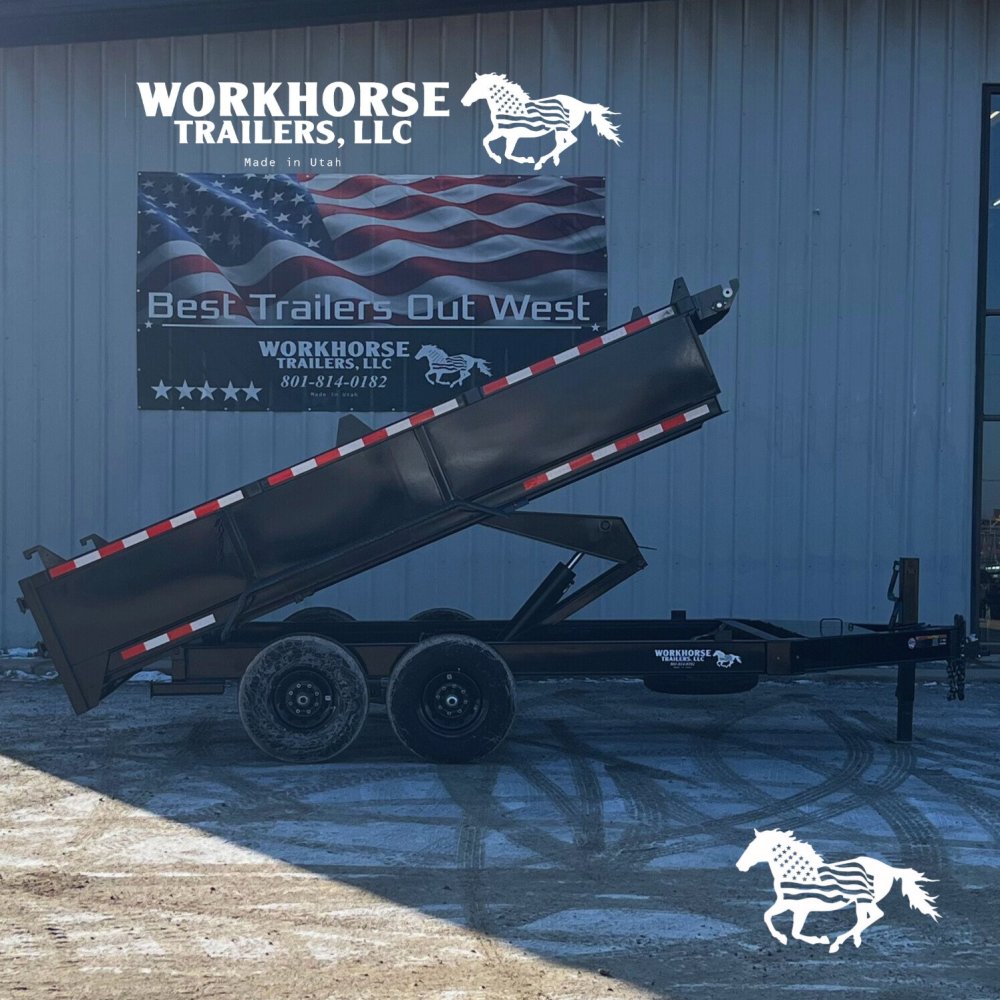
The tilt deck concept removes the ramp as a separate component. Instead of carrying dedicated ramp assemblies that bolt to the trailer’s rear, the deck itself pivots on a hinge point and rotates backward until the trailing edge rests on the ground. The result is a single unbroken surface from dirt to deck with a loading angle gentle enough for virtually any machine to traverse under its own power. When the cargo is aboard and secured, the deck returns to its flat traveling position through gravity, springs, or hydraulic assist, depending on the trailer’s design.
For Billings contractors, rental operations, and property service companies who load and unload equipment multiple times per day across scattered job sites, the cumulative value of that simplified loading process is substantial.
Operational Time Savings on Billings Job Sites
Time gets discussed in the abstract when manufacturers promote tilt deck trailers, but the math becomes concrete when you apply it to a Billings contractor’s actual schedule.
Consider a small excavation company running a single crew out of a yard off Broadwater Avenue. The crew repositions a mini excavator between residential dig sites an average of three times per day. On a conventional ramp trailer, each move requires deploying the ramps, driving the machine up the incline, securing the load, stowing the ramps, driving to the next site, deploying the ramps again, unloading the machine, and stowing the ramps once more. A conservative estimate for the combined ramp handling and loading time is 12 to 15 minutes per move.
On a tilt deck, the same cycle involves releasing the deck latch, tilting the bed, driving the machine on, returning the deck to flat, securing the load, and driving. At the destination, tilt, drive off, relatch. The realistic time per move drops to six to eight minutes. Across three daily moves, that’s a savings of roughly 20 minutes per day. Across a five-day work week, that’s over an hour and a half of recovered productive time. Across a 40-week operating season in Billings, it approaches 70 hours. That’s nearly two full work weeks recaptured annually from a single operational improvement.
For companies running multiple crews or repositioning equipment more frequently, the numbers scale accordingly.
Ground Conditions and Tilt Deck Performance
A tilt deck trailer performs its core function by placing the rear edge of the deck on the ground. This means the ground surface at the loading point directly affects how well the trailer works. Billings job sites present a range of ground conditions that tilt deck buyers should understand.
Hard, Level Surfaces
Paved parking lots, concrete slabs, and compacted gravel pads provide the ideal surface for tilt deck operation. The rear deck edge lands on a stable surface, the loading angle stays consistent across the full width of the deck, and tracked or wheeled equipment transitions smoothly from ground to trailer without the rear edge digging in or shifting. Many commercial job sites and equipment yards in the Billings industrial areas along Bench Boulevard and the Coulson Road corridor offer these conditions.
Soft or Uneven Ground
Residential dig sites, utility easements, and rural properties around the Billings periphery often feature softer ground that presents challenges for tilt deck operation. When the rear deck edge contacts soft soil, it can sink unevenly, creating a tilted or unstable loading surface. A machine driving onto a deck that’s canted to one side experiences uneven weight distribution that stresses the tilt mechanism and can cause the machine to track sideways during loading.
Experienced operators address soft ground by placing timber cribbing or steel plates beneath the deck’s contact points before tilting. This distributes the load across a larger surface area and prevents the sinking that causes problems. Carrying a pair of 2×10 planks cut to 36-inch lengths adds negligible weight to the trailer and solves the soft ground problem on the vast majority of Billings area sites.
Slopes and Grades
Billings terrain includes enough elevation variation that loading on a slope is a regular occurrence rather than an edge case. A tilt deck trailer parked on a grade behaves differently than one on level ground. If the trailer faces uphill, the deck tilts less aggressively because gravity is partially counteracted by the slope. If it faces downhill, the deck can tilt too quickly or with too much force.
The safest practice is to position the trailer on the most level section of ground available at the job site, even if that means pulling past the work area and walking back. For sites in the hilly neighborhoods south of Poly Drive or along the benches above Alkali Creek Road, finding a level loading zone sometimes requires planning ahead during the initial site visit.
Tilt Deck Safety in Urban Work Zones
Operating a tilt deck trailer on a public street or in a shared commercial area introduces safety variables that don’t exist on private job sites. Billings contractors working utility repairs, residential remodels, and infrastructure projects frequently load and unload equipment in spaces where pedestrians, other vehicles, and bystanders are present.
The tilting motion itself creates a hazard zone behind the trailer. As the deck rotates downward, the rear edge sweeps through an arc that can strike anyone standing too close. Before activating the tilt mechanism, the operator must verify that the area behind the trailer is clear. On a quiet residential street in the Skyview neighborhood, this might mean a quick glance. On a busy commercial block along Broadwater or near the Rimrock Road shopping areas, it requires actively managing the space and potentially using traffic cones or a spotter.
The deck latch that secures the bed in its flat traveling position is a safety-critical component. If the latch releases unintentionally while the trailer is parked on a grade with a loaded machine aboard, the deck can tilt and dump the equipment onto the ground. Pre-trip verification of latch engagement should be an automatic habit, not something the operator remembers occasionally. Quality tilt deck trailers include redundant latching systems with both a primary pin lock and a secondary safety catch for exactly this reason.
Clearance beneath the raised front end of the deck when tilted creates a pinch point. Anyone standing beside the trailer when the deck returns from its tilted position to flat can be caught between the rising deck and the trailer frame. Keeping all personnel clear of the trailer’s sides during tilt cycling prevents crush injuries that happen quickly and without warning.
Matching Tilt Deck Specifications to Billings Hauling Needs
Tilt deck trailers span a range of sizes and capacities. Billings buyers should match the trailer’s specifications to their equipment roster rather than buying based on a general sense of what seems adequate.
Deck Length Relative to Machine Dimensions
The loaded machine should fit entirely on the tilting deck surface with clearance fore and aft. A mini excavator in its transport configuration, with boom retracted and bucket curled, typically occupies 12 to 16 feet depending on the model. A compact track loader with a bucket measures roughly 10 to 13 feet. The trailer’s tilting deck section needs to exceed the machine’s transport length by at least 18 inches to allow room for positioning and securing.
On split tilt trailers where only the rear portion tilts, the fixed front section doesn’t contribute to the loading length for the primary machine. Buyers who plan to use the fixed section for auxiliary cargo need to ensure the tilting section alone accommodates the longest machine they’ll regularly haul.
Payload Capacity After Accounting for Trailer Weight
Tilt deck trailers with hydraulic systems, heavier pivot assemblies, and reinforced deck structures tend to weigh more than comparably sized ramp trailers. A tilt deck trailer rated at 14,000 pounds GVWR that weighs 3,800 pounds empty provides 10,200 pounds of payload. The same GVWR on a lighter ramp trailer weighing 3,000 pounds provides 11,000 pounds. That 800-pound difference matters when hauling machines that approach the trailer’s limit.
Billings buyers should request the actual empty weight of any tilt deck trailer under consideration, not just the GVWR. The payload calculation is straightforward subtraction, but it only works with accurate numbers.
Towing Compatibility With Billings Driving Conditions
A loaded tilt deck trailer towed through Billings encounters stop-and-go traffic on arterials like Broadwater and Rimrock, highway-speed merging on I-90, and grade changes across the city’s varied topography. The tow vehicle’s braking system must manage the loaded combination’s total weight safely in all of these conditions. A trailer with electric brakes needs a brake controller calibrated to the typical loaded weight, and the controller gain setting should be tested under controlled conditions before the first trip through downtown traffic.
Three-quarter-ton and one-ton pickups pair appropriately with most tilt deck trailers in the 10,000 to 20,000-pound GVWR range. Half-ton trucks can handle lighter tilt decks carrying compact equipment, but the margin between the truck’s rated capacity and the loaded trailer’s weight narrows quickly. Billings buyers who tow with a half-ton should calculate the fully loaded combination weight and confirm it falls below the truck’s GCWR with room to spare.
Tilt Deck Trailers in the Billings Rental and Dealer Market
Billings equipment rental companies have adopted tilt deck trailers for delivery and retrieval operations because the loading efficiency directly reduces the time each delivery driver spends at each stop. A driver making five equipment deliveries across the Billings metro in a single day reclaims a meaningful block of time when every load and unload cycle takes half as long as it would with ramp handling.
Equipment dealers in the Billings area who deliver sold machines to customer locations face the same calculus. A tilt deck trailer that saves ten minutes per delivery across four deliveries per day recovers almost an hour of driver time daily. Over the course of a year, that efficiency gain either reduces overtime hours or enables additional deliveries without extending the workday.
For individual buyers considering whether to purchase a tilt deck or a conventional ramp trailer, the decision turns on loading frequency. A homeowner who loads a compact tractor once a month doesn’t recover enough time to justify the tilt deck’s price premium over a simpler ramp model. A landscaping company that loads mowing equipment six times per day crosses the breakeven point within months.
Seasonal Factors for Billings Tilt Deck Owners
Billings weather introduces seasonal variables that affect tilt deck operation and maintenance.
Winter ice accumulation on the deck surface makes the tilted bed dangerously slippery for equipment trying to climb on. A thin layer of ice on treated pine decking provides almost zero traction for rubber tires and even less for steel tracks. Scattering coarse sand or non-corrosive ice melt on the deck surface before loading restores enough grip for safe operation. Keeping a five-gallon bucket of sand on the trailer’s fixed section or in the truck bed ensures it’s available when needed during cold weather jobs.
Spring thaw creates the soft ground conditions discussed earlier, as frozen soil in the Billings area transitions to saturated, compressible surfaces during March and April. This is the season when cribbing material becomes most important for tilt deck operators working residential and agricultural sites outside the paved metro core.
Summer heat doesn’t directly impair tilt deck function, but UV exposure and thermal cycling accelerate the degradation of hydraulic hoses, rubber bushings, and deck board finishes. Storing the trailer under cover or applying UV-protective treatments to exposed rubber and wood components extends service life in Billings’ high-altitude sun exposure.
Workhorse Trailers LLC and Billings Tilt Deck Buyers
Workhorse Trailers LLC helps Billings tilt deck buyers navigate the relationship between loading frequency, equipment weight, job site conditions, and budget to arrive at a trailer that delivers genuine daily value. The worst outcome in a tilt deck purchase is paying the premium for tilting capability and then discovering the specifications don’t match the equipment being hauled. Workhorse prevents that by working from the equipment roster and the operating reality backward to the trailer recommendation.
Billings buyers evaluating tilt deck options across the weight classes and configurations that local contractors, rental companies, and property service operators need can visitBillings Tilt Deck Trailers to see current availability and connect with the team for specific guidance.
The tilt deck trailer earns its place by making loading effortless and fast. For Billings buyers whose daily schedule depends on moving equipment efficiently between scattered job sites, that’s not a marginal improvement. It changes how the day works.