Billings Gooseneck Trailers
All locationsBillings sits at the intersection of hauling demands that few Montana cities can match. Agricultural operations surrounding the city move livestock and feed in volumes that keep trailers rolling daily. Construction crews working the steady stream of residential and commercial projects throughout the metro need to reposition heavy machinery between sites separated by crosstown drives and highway stretches. Auto dealers, equipment rental yards, and hotshot operators based along the I-90 and I-94 corridors depend on trailers that handle serious weight without compromising road manners. For all of these buyers, gooseneck trailers have become the default choice when the loads outgrow what a bumper pull can safely manage. Workhorse Trailers LLC supplies gooseneck trailers to Billings buyers who need the towing stability, payload capacity, and hitch-point efficiency that only the gooseneck configuration delivers at this weight class.
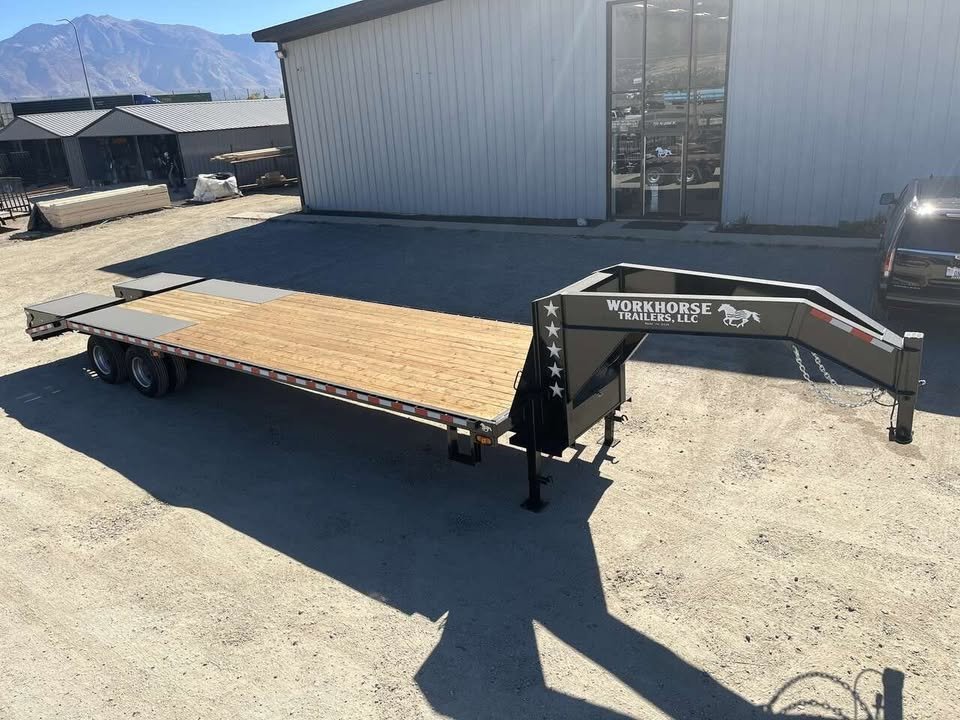
The gooseneck name comes from the curved neck structure that arches forward from the trailer frame and drops down to a ball coupler positioned in the truck bed, directly above the rear axle. That coupling geometry places the trailer’s tongue weight at the strongest point of the truck’s chassis rather than cantilevering it behind the rear bumper. The practical result is a tow rig that tracks predictably at highway speed, resists crosswind destabilization, and maintains responsive steering even under loads that would make a bumper pull setup feel loose and unpredictable.
For Billings buyers pulling anything above 12,000 to 14,000 pounds regularly, the gooseneck is less a preference and more a structural necessity.
How Billings Buyers Use Gooseneck Trailers Differently Than Rural Operators
Gooseneck ownership in Billings carries different daily realities than it does for a rancher working open country 80 miles from the nearest stoplight. Urban and suburban towing introduces constraints that rural operators rarely encounter, and Billings buyers should factor these into their purchase decision.
Maneuverability in Tight Spaces
Billings job sites, commercial loading zones, and residential streets weren’t designed with 30-foot trailers in mind. A gooseneck trailer pivots more sharply than a bumper pull of the same length because the hitch point sits further forward in relation to the trailer’s rear axle. This gives gooseneck rigs a tighter turning radius and better backing control in confined spaces. A contractor threading a loaded gooseneck equipment trailer through the alley behind a commercial renovation on Montana Avenue can make turns that a bumper pull of identical length physically cannot execute.
That said, the overall length of a truck-plus-gooseneck combination still demands awareness in Billings traffic. Merging onto I-90 from the 27th Street interchange with a loaded 24-foot gooseneck requires planning the merge gap before reaching the on-ramp, not during it. Fueling at stations along State Avenue or King Avenue West means choosing a pull-through lane or being willing to unhitch in the lot.
Daily Truck Functionality
Many Billings gooseneck owners use the same truck for towing and everyday tasks. A three-quarter-ton pickup that pulls a gooseneck stock trailer to the Billings Livestock Commission on Tuesday carries the kids to school on Wednesday and picks up building materials at a Central Avenue supply house on Thursday. The truck bed needs to function for all of those tasks.
This dual-use reality makes the choice of gooseneck hitch system more consequential for Billings buyers than it is for someone whose truck serves exclusively as a tow vehicle. A permanently mounted ball protruding from the bed floor interferes with loading plywood sheets, sliding toolboxes, and any task that requires a flat bed surface. Removable ball systems and flush-mount turnover designs solve this by disappearing below the bed floor when the trailer isn’t attached, restoring full bed functionality between towing days.
Frequency and Duration of Trips
Rural gooseneck use often involves long, infrequent hauls across open highway. Billings gooseneck use frequently looks different: shorter trips repeated many times per week. A rental company delivering and retrieving a skid steer across town four times in a single day puts different wear patterns on the hitch, coupler, and safety systems than a single 200-mile highway run. The repeated coupling and uncoupling, the constant engagement and disengagement of electrical connectors, and the cumulative stress of frequent loading cycles accelerate component wear in ways that mileage alone doesn’t reflect.
Gooseneck Trailer Categories for Billings Buyers
The gooseneck hitch platform supports virtually every trailer category. Billings buyers typically shop across four primary types, each serving distinct hauling demands.
Gooseneck Flatbeds
The most versatile gooseneck configuration. A flat deck with side rails, stake pockets, and tie-down hardware accommodates lumber, steel, palletized materials, equipment, vehicles, and mixed loads. Billings contractors who need one trailer to handle whatever the week throws at them gravitate toward gooseneck flatbeds in the 20 to 30-foot range with GVWRs between 14,000 and 25,000 pounds.
The open deck invites loading from any angle: rear ramps for driven equipment, side access via forklift or crane, and manual placement for bundled or loose materials. That flexibility justifies the gooseneck flatbed’s position as the single most popular gooseneck trailer type sold in the Billings market.
Gooseneck Stock Trailers
Yellowstone County and the surrounding agricultural areas support a substantial cattle industry, and the Billings Livestock Commission operates one of the largest livestock auction facilities in the northern Rockies. Ranchers, feedlot operators, and livestock haulers passing through Billings move cattle, horses, and other animals on gooseneck stock trailers built to manage live, shifting weight safely.
Stock trailers designed for gooseneck hitching typically range from 20 to 28 feet in body length, with interior configurations that include center gates, sliding rear gates, and adjustable pen dividers. Aluminum construction has gained popularity for stock trailers because the weight savings increases the number of head that can be loaded before reaching the trailer’s GVWR, and aluminum resists the corrosive effects of animal waste more effectively than painted steel over the long term.
Gooseneck Equipment Haulers
Billings equipment haulers built on gooseneck frames carry the mid-size and heavy machinery that construction and excavation companies need to move between projects. These trailers feature reinforced decks, heavy-duty ramps, and weight ratings from 16,000 to 30,000 pounds or higher. The gooseneck hitch distributes the concentrated tongue weight from a loaded excavator or track loader through the truck’s rear axle rather than leveraging it against the bumper, which is essential for maintaining control when the cargo weighs as much as or more than the tow vehicle.
Gooseneck Enclosed Trailers
Enclosed gooseneck trailers combine the weather protection and security of a cargo box with the payload capacity and stability of the gooseneck platform. Billings auto transport companies, mobile service operators, and race teams use enclosed goosenecks for high-value cargo that needs both capacity beyond what a bumper pull enclosed trailer provides and full protection from the elements and theft.
These trailers range from 24 to 40 feet and can carry payloads that would exceed the safe operating limits of a bumper pull enclosed unit. The trade-off is overall size, height, and wind resistance, all of which require a capable tow vehicle and attentive driving, especially on Billings’ exposed highway approaches.
Tongue Weight Management on Billings Roads
Tongue weight is the single most important variable in gooseneck towing safety, and it deserves more attention than most buyers give it. Tongue weight is the downward force the trailer exerts on the truck’s hitch point. On a gooseneck, this force pushes directly into the truck’s rear axle, which is ideal from a stability standpoint but creates problems if the percentage falls outside the recommended range.
The target tongue weight for a gooseneck trailer is typically 20 to 25 percent of the loaded trailer’s total weight. A trailer and cargo weighing 16,000 pounds should place 3,200 to 4,000 pounds on the hitch ball. Below this range, the trailer becomes tail-heavy, which promotes sway and can lift weight off the truck’s rear axle during deceleration. Above this range, the truck’s rear suspension bottoms out, the front end lightens, and steering precision degrades.
Load placement on the trailer deck determines tongue weight. Cargo positioned forward of the trailer’s axle group increases tongue weight. Cargo positioned behind the axles decreases it. Billings buyers who haul varied loads should develop a habit of estimating where the load’s center of gravity falls relative to the axles and adjusting placement accordingly.
This matters on Billings-area roads because the terrain provides limited forgiveness for an improperly balanced rig. The descent from the Rims on Highway 3 toward Molt puts sustained braking demands on a loaded gooseneck. An underloaded tongue weight on that grade amplifies any tendency toward trailer sway at exactly the moment the driver needs maximum stability. Similarly, the crosswind exposure on the elevated sections of Hilltop Road and along the I-90 interchange system near Lockwood tests lateral stability in ways that flat, sheltered urban streets do not.
Electrical and Brake System Considerations
Gooseneck trailers use a seven-pin electrical connector as the standard interface between the truck and trailer. This connector carries power for running lights, brake lights, turn signals, electric brake activation, 12-volt auxiliary power, and ground. The seven-pin system is universal across gooseneck trailers, but the quality of the connector and wiring varies enormously between manufacturers.
Billings buyers should inspect the wiring harness routing on any gooseneck trailer before purchasing. Harnesses that run along the trailer frame without adequate protection from road debris, water spray, and abrasion develop faults that cause intermittent lighting failures and brake malfunctions. Properly routed harnesses use conduit or split loom protection and keep connections inside sealed junction boxes positioned away from direct water exposure.
Electric vs. Hydraulic Surge Brakes
Most gooseneck trailers under 26,000 pounds GVWR use electric brakes controlled by a brake controller mounted in the tow vehicle’s cab. The driver adjusts brake gain to match the load, and the controller modulates braking force proportionally during stops. This system provides excellent control and is compatible with aftermarket controllers from Tekonsha, Curt, and other manufacturers widely available at Billings auto parts retailers.
Hydraulic surge brakes, which activate automatically through a surge actuator at the coupler when the trailer pushes against the truck during deceleration, appear on some gooseneck trailers but are less common than electric setups. Surge brakes require no in-cab controller and function independently, but they don’t allow the driver to modulate braking force manually, which limits control during downhill driving and emergency stops.
For Billings buyers towing on grades regularly, electric brakes with a quality controller offer meaningfully better control than surge alternatives.
Pre-Trip Habits That Prevent Problems
A loaded gooseneck trailer that fails mechanically during transit creates problems disproportionate to the effort required to prevent them. Building a brief pre-trip routine into each towing day catches issues before they become roadside emergencies or accidents.
Verify the coupler is fully seated on the ball and the latch is engaged. Test this by raising the truck’s tailgate (if applicable) and attempting to lift the coupler with the trailer jack. It should not separate from the ball. Connect both safety chains in an X-pattern beneath the coupler, short enough to catch the tongue if the coupler fails but long enough to allow full turning articulation.
Plug in the electrical connector and walk behind the trailer to confirm all lights function. Apply the truck’s brakes and verify that the trailer brakes engage. This takes thirty seconds and reveals wiring failures that would otherwise go unnoticed until a following driver or a Yellowstone County sheriff’s deputy provides less pleasant notification.
Check tire pressure on the trailer and the tow vehicle. Underinflated trailer tires run hotter, wear faster, and increase the risk of blowouts on sustained highway runs. Tires at proper pressure also improve fuel economy measurably over a full day of Billings-area towing with multiple stops.
Confirm that the load is secured and that nothing has shifted since the last stop. This applies during multi-stop days when the trailer gets partially unloaded at one site and continues to the next. A partial load that was balanced when fully loaded may produce a dramatically different tongue weight after half the cargo comes off.
Working With Workhorse Trailers LLC in Billings
Gooseneck trailers represent a meaningful investment, and the range of trailer types, weight ratings, and configurations available can make the selection process feel more complicated than it needs to be. Workhorse Trailers LLC simplifies that process for Billings buyers by starting with the loads, the routes, and the truck, then recommending the gooseneck configuration that aligns with all three.
Billings buyers interested in comparing gooseneck trailers across the flatbed, stock, equipment, and enclosed categories can visitBillings Gooseneck Trailers to review specifications and connect with the Workhorse team for guidance matched to their specific hauling situation.
The commitment is straightforward: a gooseneck trailer that handles your heaviest realistic load, fits your tow vehicle’s ratings, and performs reliably across the terrain and conditions that define hauling in and around Billings. Workhorse Trailers LLC delivers on that commitment with every sale.