
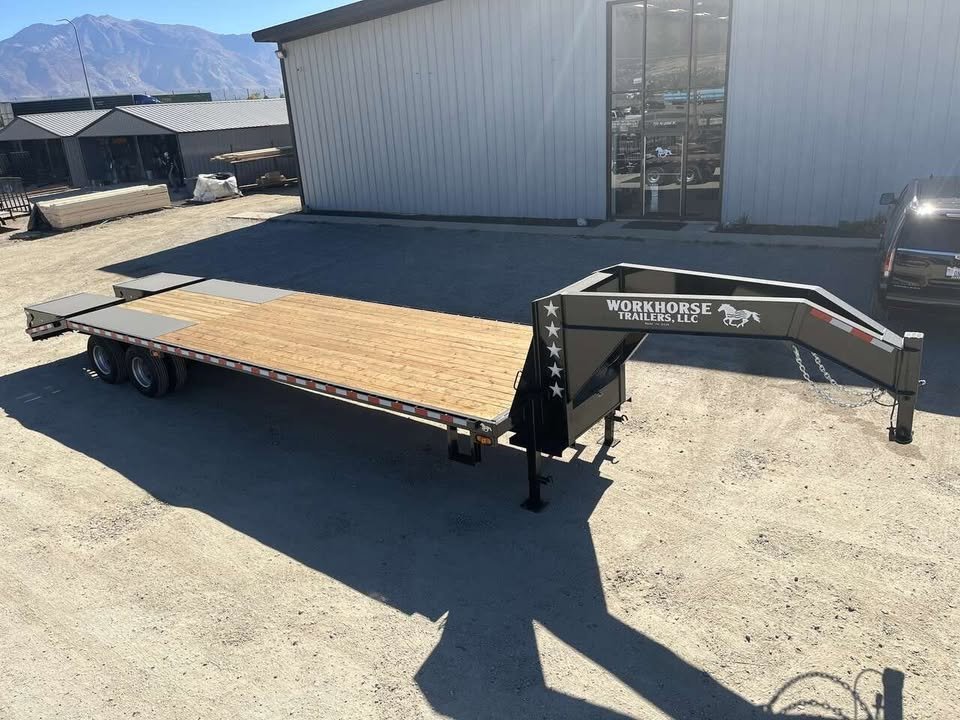
Montana Tilt Deck Trailers
All locationsLoading a piece of equipment onto a trailer shouldn’t be the hardest part of the job. But anyone who has wrestled with steep ramps, fought with a machine that won’t climb the incline, or watched a low-clearance vehicle bottom out on the transition point between ramp and deck knows how much time and frustration the loading process can consume. Tilt deck trailers solve that problem through mechanical simplicity. The entire deck tilts to meet the ground, creating a shallow loading angle that lets equipment roll, drive, or slide on with minimal effort. Workhorse Trailers LLC supplies tilt deck trailers to Montana buyers who need a faster, safer way to load and transport machinery, vehicles, and heavy materials across a state where the next job site might be two mountain passes away.
The tilt mechanism works on a pivot point positioned near the rear of the trailer’s frame. When released, the deck tips backward under the influence of gravity and the load’s weight until the rear edge contacts the ground. Once loaded, the weight of the cargo combined with a hydraulic cylinder, spring assist, or manual latch system returns the deck to its flat traveling position. No separate ramps to carry, store, or deploy. No steep climb for equipment with limited horsepower or traction. The ground itself becomes the loading surface.
For Montana operations where time spent loading and unloading translates directly into money earned or lost, that efficiency is not a minor convenience. It reshapes how you plan your day.
How Tilt Deck Trailers Compare to Ramp-Style Trailers
Every equipment trailer provides a way to get cargo on and off the deck. The differences lie in how that process works and what trade-offs come with each approach.
The Ramp Problem
Traditional equipment trailers use fold-down or removable ramps at the rear. On a standard flatbed or equipment trailer, those ramps create an incline that the operator must drive up or pull cargo across. The steeper the angle, the more power required and the greater the risk of the load shifting, the machine losing traction, or the operator losing control on the incline. Ramp angle is a function of deck height and ramp length. A trailer with a 24-inch deck height and 5-foot ramps creates a grade that many compact machines and wheeled equipment handle without issue. But heavier equipment with limited ground clearance, tracked machines that don’t climb well on smooth steel, and items being loaded with a forklift or winch all struggle with steep ramp transitions.
The breakover angle where the ramp meets the deck is another pain point. Equipment with long wheelbases or low-hanging components can high-center at that transition, leaving the machine stuck with its undercarriage resting on the deck edge. Dovetail designs reduce this somewhat by lowering the rear portion of the deck, but they add complexity and don’t eliminate the issue entirely.
The Tilt Advantage
A tilt deck trailer removes the ramp variable altogether. When the deck tilts, it creates a continuous loading surface from ground level to the front of the trailer with no abrupt angle change and no breakover point. The loading angle on a full tilt deck trailer typically ranges between 8 and 14 degrees depending on deck length and pivot placement, which is gentle enough for virtually any piece of equipment to traverse under its own power.
This matters particularly for tracked machines like mini excavators, compact track loaders, and skid steers with track undercarriages. Tracks don’t grip smooth steel ramps the way rubber tires do, especially when those ramps are wet, muddy, or icy. A tilt deck resting against the ground gives the tracks a stable, low-angle surface to climb, and the natural ground contact at the loading edge means the machine transitions from dirt to deck without a jarring step.
Who Uses Tilt Deck Trailers in Montana
The tilt deck design appeals to a specific set of users whose daily work involves frequent loading and unloading of equipment that doesn’t cooperate well with ramps.
Excavation and Site Work Contractors
Montana’s construction season pushes contractors to move equipment between sites quickly. An excavation company running jobs in the Bozeman area might reposition a mini excavator two or three times in a single day. Each move means loading, strapping, driving, unloading, and unstrapping. On a ramp-style trailer, that cycle eats 15 to 20 minutes per move just for the loading and unloading steps. A tilt deck cuts that time roughly in half because there are no ramps to deploy, no steep climb for the machine, and no ramps to stow before driving away. Over a week of frequent moves, the accumulated time savings are substantial.
Rental Companies and Equipment Dealers
Businesses that deliver and pick up rental equipment across Montana’s vast distances need trailers that make the handoff simple. Not every customer receiving a rented skid steer or plate compactor has experience operating equipment on steep ramps. A tilt deck lets the delivery driver load and unload the machine quickly and safely, even at customer sites with uneven ground or limited maneuvering space. Equipment dealers transporting sold machines to buyers throughout the state face similar logistics, and the tilt deck simplifies every delivery.
Landscaping and Property Maintenance
Commercial landscaping crews in the Helena, Kalispell, and Missoula markets load and unload mowers, trenchers, stump grinders, and utility vehicles dozens of times per week. The repetitive nature of that work makes loading efficiency a genuine operational factor. A tilt deck lets a zero-turn mower roll off under its own power in seconds, which adds up to hours saved across a season. Some landscaping operations also appreciate that tilt decks don’t have separate ramp pieces that can be lost, stolen, or left behind at a job site.
Agricultural Operations
Montana ranchers use tilt deck trailers to transport compact tractors, skid steers, and implements between fields and outbuildings. The ability to tilt the deck and drive a tractor on without assistance is valuable for single-operator situations, which describes most family ranch operations. When you’re working alone and need to relocate a machine, anything that simplifies the loading process is a practical improvement.
Full Tilt vs. Split Tilt Configurations
Tilt deck trailers come in two primary configurations, and the choice between them depends on how you use the trailer.
Full Tilt
On a full tilt trailer, the entire deck pivots from front to rear. When activated, the full surface tilts backward to the ground. This provides the longest possible loading surface and the shallowest angle, which is ideal for longer equipment or machinery that benefits from a gradual incline. The downside is that everything on the deck tilts when the mechanism is engaged. You cannot carry a secondary load on the front of the deck while tilting the rear to load or unload a machine.
Full tilt designs are most popular among buyers who primarily haul a single piece of equipment at a time and want the smoothest possible loading experience.
Split Tilt (Stationary Front, Tilting Rear)
A split tilt, sometimes called a partial tilt, divides the deck into a fixed front section and a tilting rear section. The front portion remains stationary and level while the rear tilts. This configuration lets you secure toolboxes, fuel cans, chains, or smaller items on the fixed front deck while using the tilting rear section to load equipment.
Split tilt trailers are common among contractors who carry a support load alongside their primary machine. An excavation contractor might strap a generator and a hydraulic breaker attachment to the fixed front section while tilting the rear to load the mini excavator. That dual-purpose capability makes the split tilt the more versatile option for buyers whose loads vary from trip to trip.
Key Specifications to Evaluate
Tilt deck trailers span a range of sizes and weight ratings. Getting the right match requires attention to a few specific numbers.
GVWR and Payload
The gross vehicle weight rating includes the trailer’s own weight plus the maximum allowable payload. Tilt deck trailers in the 10,000 to 14,000 pound GVWR range serve the compact equipment and light machinery market well. For mid-size excavators and heavier skid steers, look at ratings from 14,000 to 20,000 pounds. Always calculate the actual weight of your heaviest typical load, add the weight of any secondary items you carry, and confirm that the total stays within the trailer’s rated payload after subtracting the trailer’s empty weight.
Deck Dimensions
Standard widths for tilt deck trailers run 80 to 102 inches between fenders or, on fenderless designs, across the full deck surface. Length depends on configuration, with single-axle tilt decks as short as 12 feet and tandem-axle models reaching 22 feet or more. Measure the longest machine you plan to haul, including any buckets or attachments in their transport position, and add at least 18 inches of clearance to determine minimum deck length.
Tilt Mechanism Type
Gravity tilt systems rely on the load’s weight to tip the deck when the latch is released. These are simple and reliable but require a load heavy enough to initiate the tilt. For empty tilting, some operators stand on the rear of the deck to provide enough weight.
Hydraulic tilt systems use a 12-volt pump and cylinder to control the tilting action in both directions. These offer more precise control, work regardless of load weight, and can hold the deck at intermediate angles during loading. The added cost and maintenance of a hydraulic system is justified for buyers who tilt frequently or need to position the deck angle carefully for low-clearance equipment.
Spring-assisted systems use heavy-duty springs to aid the return of the deck to its flat position. These fall between gravity and hydraulic systems in both cost and capability.
Towing and Road Considerations in Montana
Tilt deck trailers follow the same Montana registration and road-use requirements as other trailer types. Registration is handled through the county treasurer’s office, and Montana’s absence of a sales tax keeps the purchase cost lower than equivalent trailers bought in most bordering states.
Braking requirements apply to any trailer over 3,000 pounds GVWR, with brakes required on all wheels and a breakaway system mandatory by state law. Electric brakes are standard on tilt deck trailers in the common weight classes, and the brake controller in the tow vehicle should be adjusted to account for the weight shift that occurs when the deck is loaded versus empty.
CDL requirements apply when the combined gross weight of the truck and loaded trailer exceeds 26,001 pounds. Most tilt deck trailers used for compact and mid-size equipment stay below this threshold when paired with a one-ton pickup, but buyers should verify the math with their specific truck ratings and typical load weights.
Montana’s varying road conditions present some practical towing notes for tilt deck trailers. The pivot mechanism and latch system should be checked before every trip to confirm that the deck is fully secured in the flat position. A deck that shifts to a partial tilt at highway speed creates an immediate and severe handling problem. Quality tilt trailers include redundant locking mechanisms, but visual confirmation is a habit worth building.
Maintaining the Tilt Mechanism
The moving parts that distinguish a tilt deck from a standard flatbed require periodic attention. The pivot bushings or bearings should be greased on a regular schedule based on usage frequency. Dry pivots develop slop and wear that eventually results in the deck sitting unevenly or the tilt action becoming jerky and unpredictable.
Latch hardware, including pins, catches, and spring-loaded detents, should be inspected for wear and proper engagement. A latch that doesn’t seat fully can release under load vibration during transit. Replace worn latch components immediately rather than waiting for a failure.
Hydraulic tilt systems need periodic fluid level checks, hose inspection for chafing or cracking, and cylinder rod inspection for pitting or corrosion. Montana’s temperature swings from subzero winters to hot summers stress hydraulic seals, and a slow leak that goes unnoticed will eventually leave you unable to return the deck to traveling position at a job site.
Working With Workhorse Trailers LLC
Workhorse Trailers LLC helps Montana buyers navigate the differences between tilt deck configurations, weight ratings, and mechanism types without the pressure tactics that make trailer shopping unpleasant. The company stocks tilt deck trailers across the capacity range that Montana contractors, ranchers, landscapers, and equipment operators most commonly need. Buyers ready to compare specific models and options can visitMontana Tilt Deck Trailers to review current availability and specifications.
What makes the buying experience work is the willingness to start from your operation’s actual requirements. A landscaper running three crews in the Flathead Valley has different tilt deck needs than a solo excavation operator covering jobs from Billings to Lewistown. Workhorse accounts for those differences and recommends accordingly, because a trailer that fits your work pays for itself faster and lasts longer than one that was sold to you because it was sitting on the lot.
Reach out to start the conversation, and you’ll find the process as efficient as the trailer you’re shopping for.