Utah County Gooseneck Trailers
All locationsThere comes a point in every heavy hauling operation where a bumper pull trailer simply runs out of capacity. The loads get heavier, the decks need to stretch longer, and the towing dynamics demand a connection point that keeps the truck planted and the trailer tracking straight. That point is exactly where gooseneck trailers take over. Workhorse Trailers LLC provides Utah County with gooseneck trailers built for the serious end of the hauling spectrum, equipping contractors, ranchers, fleet operators, and commercial haulers from Eagle Mountain to Elk Ridge with platforms that handle payloads no receiver hitch was ever designed to manage.
Utah County's economic expansion has pushed hauling demands well beyond what many operators anticipated even five years ago. New housing developments consume hundreds of equipment loads per month. Agricultural operations spread across the southern valley floor require implements and livestock moved on tight seasonal schedules. Commercial enterprises headquartered along the I-15 corridor ship products, stage events, and deploy service fleets across a county that stretches more than 50 miles from north to south. Gooseneck trailers serve as the backbone of these heavy transport operations, and Workhorse Trailers LLC has positioned itself as the source Utah County buyers trust when the stakes and the payloads are at their highest.
The Engineering Logic of the Gooseneck Connection
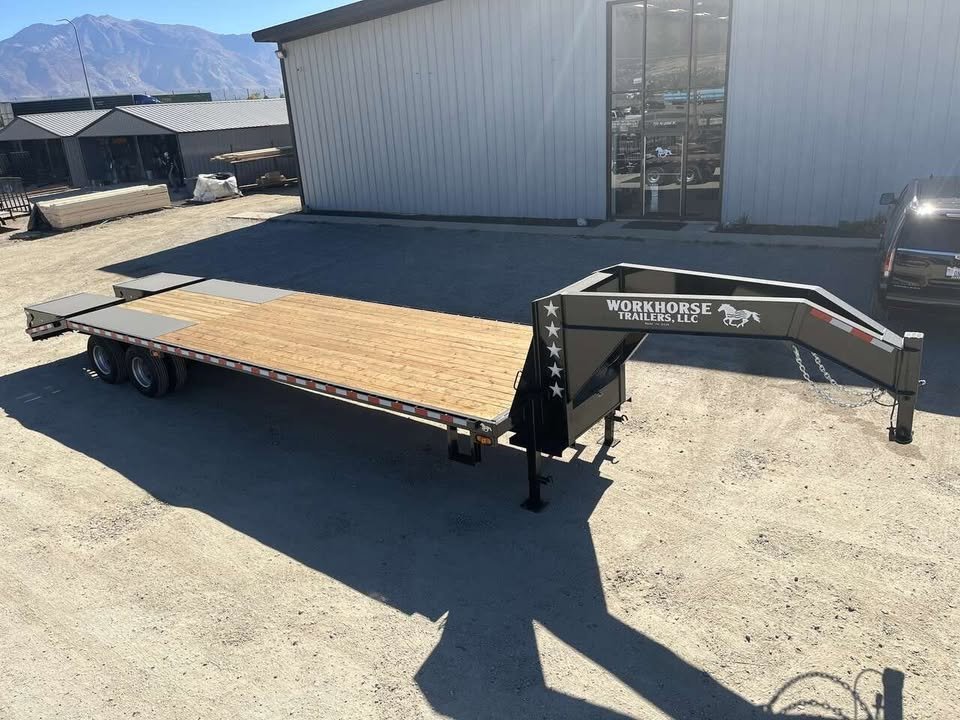
The gooseneck hitch arrangement is defined by a raised coupler that extends forward from the trailer and connects to a ball recessed in the tow truck's bed. This geometry places the attachment point roughly two to three feet ahead of where a bumper pull hitch would sit, positioning the load's pivot directly above the truck's rear axle rather than behind the bumper.
That repositioning produces cascading benefits throughout the towing system. The truck's rear springs bear the tongue load at their strongest point, keeping the chassis level and the front tires firmly weighted for steering authority. The shortened distance between the hitch and the trailer's center of mass reduces the pendulum arm that amplifies sway forces during wind gusts and emergency maneuvers. And the forward hitch location allows the trailer frame to begin further ahead relative to the truck, enabling substantially longer deck lengths without the tail-heavy balance problems that plague extended bumper pull rigs.
For Utah County operators who have maxed out the capabilities of their current bumper pull setup and recognize that the next step requires a fundamentally different towing configuration, the gooseneck platform delivers that step without requiring a jump to a full commercial semi-tractor arrangement.
Determining Whether a Gooseneck Trailer Is the Right Choice
Not every Utah County hauling job warrants a gooseneck trailer. Understanding the threshold where a gooseneck becomes the appropriate solution prevents both underspending on an inadequate bumper pull and overspending on capability that will go unused.
Payload Weight as the Primary Indicator
Gooseneck trailers become the practical choice when loaded trailer weights consistently exceed 10,000 to 12,000 pounds. Below that range, a quality tandem axle bumper pull handles the load with adequate stability and braking performance. Above that range, the tongue weight transferred to a bumper-mounted receiver begins to challenge the tow vehicle's rear suspension, approach angle, and hitch structural ratings. A gooseneck coupler distributes that same tongue weight through the truck's bed floor and directly into the frame over the rear axle, absorbing forces that would overwhelm a receiver hitch arrangement.
Utah County buyers should calculate their maximum anticipated loaded weight before shopping and use that number as the primary filter when evaluating whether a gooseneck is necessary. Workhorse Trailers LLC provides straightforward guidance on where the bumper pull ceiling sits for each customer's specific truck and helps identify the crossover point at which upgrading to a gooseneck delivers a measurable improvement in safety and performance.
Deck Length Requirements
Payload weight is not the only factor. Some Utah County operators need extended deck lengths to accommodate long equipment, multiple vehicles, or cargo arrangements that require 24 feet or more of continuous platform. Bumper pull trailers become increasingly difficult to tow safely as deck length extends beyond 20 feet because the distance between the hitch point and the trailer's center of gravity grows proportionally, magnifying sway tendencies and degrading directional stability.
Gooseneck trailers accommodate long decks naturally because the forward hitch position shortens the effective lever arm even on a 30-foot platform. Utah County flatbed operators, car haulers, and livestock transporters who need that extended floor space find that a gooseneck is the only configuration that delivers the length without sacrificing towing confidence.
Frequency and Intensity of Use
Occasional heavy hauling can sometimes be managed by renting a gooseneck trailer or hiring a transport service. But Utah County operators who move heavy loads weekly or daily quickly discover that ownership eliminates scheduling constraints, per-trip rental fees, and the risk of receiving a rented trailer in questionable mechanical condition. The break-even point between renting and owning depends on the specific rental rates and hauling frequency, but most Utah County buyers who commission Workhorse Trailers LLC for a gooseneck trailer have already crossed that threshold well before they walk through the door.
Gooseneck Trailer Applications Across Utah County Industries
The gooseneck platform serves an unusually wide range of professional and agricultural applications within Utah County. Its combination of high weight capacity, long deck options, and stable towing characteristics makes it adaptable to industries with very different cargo profiles.
Heavy Civil and Site Development
Road construction, utility installation, and large-scale grading projects throughout Utah County rely on machinery that exceeds the capacity of any bumper pull trailer on the market. Motor graders, loaded dump trucks being repositioned between projects, paving equipment, and large hydraulic excavators all require gooseneck haulers in the 20,000-pound-plus GVWR range. The multi-axle gooseneck flatbeds and equipment haulers at Workhorse Trailers LLC are built for exactly these applications, with I-beam frames, heavy-gauge crossmembers, and braking systems calibrated for the deceleration forces generated by fully loaded machinery in motion.
Horse and Livestock Operations
Utah County's equestrian community is one of the most active in the state. Training facilities in Heber City draw riders from across the county, show circuits rotate through venues in Spanish Fork and Lehi, and recreational trail access in Hobble Creek, Payson Canyon, and the Uinta foothills requires transporting horses to remote staging areas. Gooseneck livestock trailers are the universal standard for equine transport because the combined weight of multiple horses, saddles, tack, and feed stores easily surpasses bumper pull limits.
Beyond horses, cattle ranchers moving herds between seasonal grazing allotments, sheep producers delivering animals to processing facilities, and small-scale farmers transporting goats and pigs to county sales all rely on gooseneck stock trailers rated for the live weight and dynamic movement of animals in transit. Workhorse Trailers LLC carries gooseneck livestock models with interior divider configurations, non-slip aluminum flooring, and ventilation systems designed to maintain animal welfare during transport across Utah County's variable terrain and seasonal temperature ranges.
Flatbed Hauling for Construction Supply and Manufacturing
Construction supply yards in Lindon, Pleasant Grove, and Payson load gooseneck flatbed trailers with steel beams, precast concrete elements, bundled rebar, and oversized mechanical components that are too heavy or too long for any other trailer format. Manufacturing operations distributed across Utah County's industrial zones also use gooseneck flatbeds to shuttle raw materials inbound and finished products outbound between facilities and regional distribution points.
The gooseneck flatbed's ability to accept forklifted loads from either side, accommodate crane-placed items from above, and secure irregularly shaped cargo using stake pockets, chain hooks, and adjustable strapping points makes it the most versatile heavy hauling platform available. Workhorse Trailers LLC stocks gooseneck flatbeds in multiple deck lengths and weight ratings so that Utah County industrial buyers can match the trailer precisely to their commodity flow.
Enclosed Gooseneck Trailers for High-Value Cargo
When heavy cargo also requires weather protection, security, and concealment during transit, enclosed gooseneck trailers merge the carrying capacity of the gooseneck hitch with the sealed compartment of an enclosed body. Utah County motorsport teams transport race cars and support equipment inside enclosed gooseneck trailers that shield their investment from road debris and weather while providing interior workspace for trackside preparation.
Large-scale mobile retail operations, medical equipment deployment teams, and disaster response organizations staged in Utah County also utilize enclosed gooseneck trailers for their combination of volume, protection, and towing stability. The elevated gooseneck neck section creates a bonus storage loft or sleeping compartment above the truck bed that maximizes the usable interior space within the trailer's overall footprint.
Truck and Hitch Requirements for Gooseneck Towing in Utah County
A gooseneck trailer performs only as well as the truck and hitch system supporting it. Utah County buyers should verify several vehicle specifications before purchasing a gooseneck trailer to ensure that the complete towing combination operates within safe and legal parameters.
Confirming Truck Ratings
Two ratings govern gooseneck towing capability. The truck's maximum towing capacity defines the heaviest loaded trailer it can pull, and the payload capacity defines the maximum weight it can carry in the bed and cab combined. Gooseneck tongue weight counts against the payload rating because it loads directly into the truck bed. A trailer carrying 18,000 pounds of total weight might place 3,500 pounds of tongue weight in the bed, and that figure must fit within the truck's payload allowance alongside passengers, fuel weight, toolboxes, and any other bed-carried items.
Workhorse Trailers LLC calculates tongue weight estimates for every gooseneck trailer model based on typical load configurations and cross-references those figures against the buyer's specific truck ratings. This analysis prevents the overloading situations that compromise braking distances, accelerate suspension and tire wear, and create liability exposure for Utah County operators hauling on public roads.
Hitch Selection and Installation
Gooseneck hitches are available in permanently mounted, removable, and under-bed concealed configurations. Permanently mounted hitches provide the most rigid connection and are preferred for high-frequency commercial use. Removable systems allow the ball to be extracted when the truck bed needs full clearance for non-towing duties. Under-bed concealed systems retract the ball below the bed surface and deploy it through a flip or turn mechanism when towing is required.
The hitch must be bolted directly to the truck's frame using hardware rated for the maximum gross trailer weight the owner plans to pull. Professional installation is worth the investment for Utah County buyers because a properly torqued, frame-mounted gooseneck hitch eliminates the flex, noise, and potential failure points that result from shortcuts in the mounting process.
Brake Systems and Electrical Integration
Every gooseneck trailer sold by Workhorse Trailers LLC includes a braking system that requires a controller mounted inside the tow truck cab. Proportional controllers that modulate trailer braking force in response to the truck's deceleration rate deliver the smoothest stops and the most natural pedal feel. Time-delayed controllers apply a preset braking force after a brief lag and work adequately but lack the refined response that proportional units provide under variable braking conditions.
A seven-way electrical connector links the truck's brake signal, turn signals, running lights, reverse lights, and auxiliary power circuit to the trailer's wiring harness. Utah County buyers should test all seven circuits with a plug-in tester before each trip to confirm that every function communicates correctly between truck and trailer. Corroded pins, loose grounds, and damaged wiring insulation are common causes of intermittent lighting failures that create safety hazards and invite roadside citations.
Towing a Gooseneck Trailer Across Utah County's Geography
Utah County's terrain offers a manageable towing environment for most gooseneck operations, but certain geographic features deserve deliberate attention from loaded trailer operators.
The Point of the Mountain corridor between Lehi and Draper funnels prevailing westerly winds into concentrated gusts that can push laterally on a loaded gooseneck trailer. Maintaining moderate speeds and keeping a firm grip on the steering wheel through this section prevents the sudden corrections that amplify trailer oscillation rather than damping it.
Mountain canyon routes accessing recreation areas east of the valley gain elevation rapidly and feature grades that test engine cooling, transmission endurance, and brake capacity. Use low-range gearing during extended descents to let engine compression share the workload with the trailer's service brakes. Monitor brake temperature by touch on the drums or discs at pullout stops and allow cooling time if excessive heat is detected before continuing downhill.
Agricultural and construction access roads across the southern half of Utah County often transition from paved surfaces to packed gravel or dirt. Reduce speed on these transitions to avoid jarring the trailer frame and cargo. The additional articulation provided by the gooseneck coupling helps the trailer navigate washboard surfaces and shallow ruts that would transmit harsher impacts through a rigid bumper pull connection.
Caring for a Gooseneck Trailer in Utah County
Routine maintenance keeps a gooseneck trailer safe, legal, and ready to accept its next load without delay.
Clean the gooseneck coupler and ball after every trip to remove grit that accelerates wear on the mating surfaces. Apply a thin coat of lithium grease to the ball before each hookup to reduce friction and prevent the seized couplers that occur when metal surfaces gall together under heavy tongue loads.
Examine the gooseneck neck structure at each weld joint and along the curved sections where bending stress concentrates during braking and acceleration. Hairline cracks caught early require only a brief repair, while cracks allowed to propagate can result in catastrophic neck failure that separates the trailer from the truck.
Service wheel bearings, inspect brake components, and verify tire condition on a mileage-based schedule rather than a calendar interval. A gooseneck trailer that accumulates 10,000 loaded miles per year demands far more frequent attention than one covering 2,000 miles. Workhorse Trailers LLC can establish a service schedule calibrated to each Utah County buyer's actual usage rate to ensure that maintenance intervals align with real-world component wear.
Begin Your Gooseneck Trailer Search at Workhorse Trailers LLC
A gooseneck trailer is the platform that turns a capable truck into a heavy hauling system able to move the loads that define Utah County's most demanding industries. The right gooseneck trailer matched to the right truck creates a towing combination that operates with stability, efficiency, and legal compliance across every mile of highway, canyon road, and construction access in the county.
View the full inventory of gooseneck models and configurations by visitingUtah County Gooseneck Trailers for current specifications and pricing from Workhorse Trailers LLC. The team welcomes Utah County buyers at every experience level and stands ready to match your payload requirements, truck capabilities, and budget with a gooseneck trailer engineered to perform without compromise.