
Utah County Enclosed Cargo Trailers
All locationsOpen trailers get the job done when the cargo can handle sun, rain, wind, and the curious eyes of everyone sharing the road. But when the payload is valuable, sensitive, or central to a business that depends on showing up prepared and professional, an enclosed cargo trailer becomes the only option that makes sense. Workhorse Trailers LLC serves buyers across Utah County with enclosed cargo trailers that seal out the elements, lock out theft, and present a polished image on every highway between Lehi and Santaquin.
Utah County generates an extraordinary volume of commercial activity relative to its geography. Technology firms in the northern corridor, construction outfits operating from yards in Springville and Spanish Fork, mobile service entrepreneurs launching new ventures in Orem and Provo, and event specialists staging gatherings from Thanksgiving Point to the SCERA Shell all move goods that benefit from the protected environment an enclosed trailer provides. Workhorse Trailers LLC has built its enclosed cargo trailer program around the specific demands these Utah County operators bring through the door, stocking configurations that address real-world hauling scenarios rather than theoretical ones.
What Sets Enclosed Cargo Trailers Apart from Open Alternatives
The fundamental difference between an enclosed cargo trailer and an open platform is containment. An enclosed trailer wraps the payload in walls, a roof, and a sealed floor, creating a self-contained compartment that isolates its contents from everything happening outside. That barrier delivers benefits across multiple dimensions that open trailers simply cannot replicate.
Environmental Isolation
Rain, snow, dust, gravel spray, and ultraviolet radiation all degrade unprotected cargo over the course of a trip. A sheet of cabinetry-grade plywood absorbs moisture and warps. Electronic components corrode when road mist coats their connectors. Freshly painted surfaces dull under UV bombardment during a two-hour drive across the valley. An enclosed cargo trailer prevents every one of these outcomes by creating a sealed environment where temperature, humidity, and contamination exposure remain within manageable ranges throughout the journey.
Utah County's climate intensifies these concerns. Summer pavement temperatures on I-15 can push air temperatures inside an open trailer bed well above 100 degrees, while winter road treatments spray a corrosive mix of brine and particulate onto every exposed surface behind the tow vehicle. Enclosed cargo trailers from Workhorse Trailers LLC shield their contents from both extremes, arriving at the destination in the same condition they left the origin.
Theft Deterrence and Cargo Concealment
Visibility invites risk. Power tools left overnight on a flatbed at a hotel parking lot in American Fork, retail inventory staged on an open trailer at a Saturday market in Pleasant Grove, or audio equipment parked outside a venue in Provo all present tempting targets when they are in plain sight. An enclosed cargo trailer hides its contents completely, and a quality locking system adds a physical barrier that discourages opportunistic theft.
Workhorse Trailers LLC outfits its enclosed cargo trailers with reinforced door frames, commercial-grade latch assemblies, and lock receivers that accept high-security padlocks. Utah County buyers who store high-value tools, electronics, or inventory inside their trailers overnight gain a meaningful layer of protection that open trailers are inherently unable to provide.
Load Containment Without External Strapping
Open trailers require extensive strapping, netting, or banding to prevent cargo from shifting or departing the deck during transit. Loose items, lightweight materials, and stacked goods all need individual attention before the trailer can move. An enclosed cargo trailer contains these items within four walls and a roof, allowing the operator to load quickly and depart without building an elaborate restraint system for every piece of cargo. Internal E-track rails and wheel chocks handle securement for items that require positive restraint, but much of the cargo in a typical enclosed trailer load stays in place simply because the walls prevent lateral movement.
Enclosed Cargo Trailer Dimensions and Layouts for Utah County Needs
Workhorse Trailers LLC organizes its enclosed cargo trailer selection by interior volume, which is the measurement that determines how much cargo the trailer can actually carry. Utah County buyers shopping across the lineup will find options ranging from compact units suited to solo operators up through full-length commercial platforms built for high-volume transport.
Compact Enclosed Trailers for Individual Operators
Interior lengths from 8 to 12 feet and widths of 5 to 6 feet define the compact segment. These trailers serve Utah County buyers who carry a defined and consistent set of items that fit within a modest footprint. A mobile locksmith hauling key machines, blank inventory, and hand tools needs no more space than a compact enclosed trailer provides. A photographer transporting lighting rigs, backdrops, and camera cases to portrait sessions around the county fits comfortably in this category.
Compact enclosed trailers tow behind a wide variety of vehicles including half-ton trucks, full-size SUVs, and even some V6-powered midsize pickups, which makes them accessible to Utah County buyers who do not own a heavy-duty tow vehicle. Their short overall length simplifies parking at residential addresses, strip mall lots, and crowded event venues where maneuvering space is limited.
Mid-Length Enclosed Trailers for Growing Operations
The 14-to-18-foot range represents the most popular segment among Utah County commercial buyers. These trailers offer enough interior volume to carry substantial tool inventories, multiple pieces of rolling equipment, or product loads that fill standard warehouse pallets. Tandem axle configurations provide the weight capacity and highway stability needed for loaded weights between 5,000 and 10,000 pounds.
Plumbing companies staging out of American Fork, electrical contractors based in Lehi, and cleaning service operators working the Provo-Orem metro area all find their sweet spot in this mid-length category. The interior is large enough to install shelving systems, mount workbenches, and designate separate zones for tools, consumables, and personal gear without feeling cramped. Workhorse Trailers LLC stocks mid-length enclosed trailers with both flat rear cargo doors and ramp doors to accommodate different loading methods preferred by Utah County trades.
Full-Length Enclosed Trailers for High-Volume Commercial Use
Enclosed trailers measuring 20 feet and beyond serve Utah County businesses that move large quantities of goods, stage elaborate event setups, or operate mobile retail and service ventures that require significant onboard workspace. At this scale, the trailer functions less like a cargo container and more like a mobile extension of the business itself.
Concert and festival production teams, trade show exhibitors, mobile medical screening services, and large-scale catering operations all operate from full-length enclosed trailers across Utah County. The interior volume supports walk-in access, equipment installation on both walls, overhead storage, and enough remaining floor space to load additional cargo pallets or rolling racks. Workhorse Trailers LLC consults with Utah County commercial buyers to verify that interior height, door opening dimensions, and floor load ratings align with the specific demands of high-volume operations.
Construction Quality Indicators Utah County Buyers Should Examine
The enclosed cargo trailer market includes products spanning a wide quality range, and exterior appearance alone does not reveal the differences that determine long-term durability. Workhorse Trailers LLC educates Utah County buyers on the construction details that separate a trailer built to last from one designed merely to sell.
Wall Panel Bonding and Fastening Methods
The method used to attach exterior wall panels to the frame skeleton affects weather resistance, panel longevity, and exterior appearance. Riveted panels are common on economy trailers and provide adequate attachment strength, but each rivet creates a potential entry point for moisture over time as vibration loosens the connection and sealant degrades.
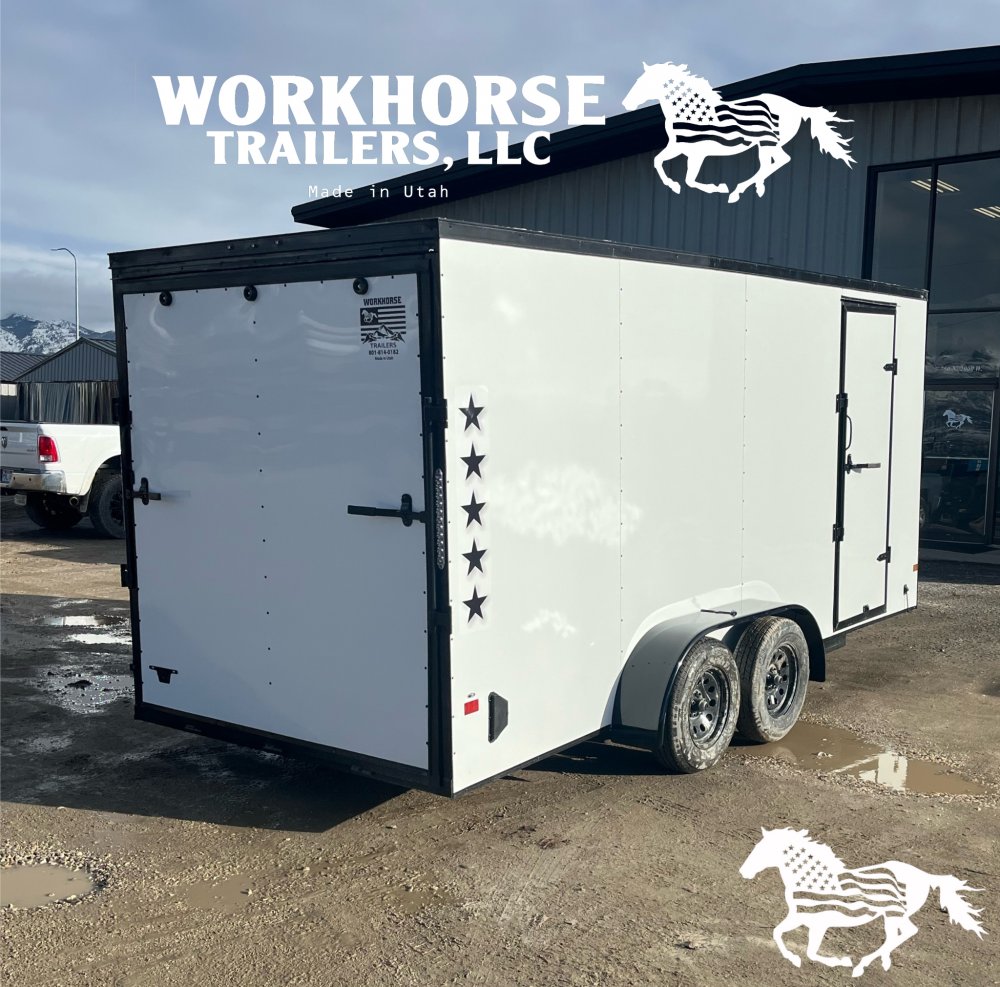
Bonded panel systems use structural adhesive to attach the exterior skin to the frame, creating a smooth, rivet-free surface with fewer penetration points and a cleaner look that accepts vinyl graphics without interference from rivet heads. Several of the enclosed cargo trailer brands carried by Workhorse Trailers LLC use bonded exterior construction, and the team can show Utah County buyers the tangible difference in surface finish and long-term leak resistance between bonded and riveted models side by side on the lot.
Roof Architecture and Water Management
A trailer roof must shed water efficiently while supporting the snow loads that accumulate during Utah County winters. One-piece aluminum roofs eliminate the seams where multi-panel assemblies are most likely to develop leaks as sealant ages and thermal cycling opens gaps between panels. The roof should incorporate a visible crown or radius that directs water laterally toward the edges rather than allowing it to pool in flat areas where standing moisture accelerates corrosion and eventually penetrates to the interior.
Workhorse Trailers LLC inspects roof construction on every enclosed trailer before adding it to the Utah County inventory. Buyers are encouraged to look at the roof from the side during their shopping visit to confirm adequate crown height and examine seam treatment on any multi-panel designs.
Floor System Strength and Moisture Resistance
The floor bears the direct weight of every item loaded into the trailer and absorbs impact forces from cargo dropped during loading or shifting during transit. Marine-grade plywood in three-quarter-inch or greater thickness is the industry standard for enclosed cargo trailer floors. This material resists moisture penetration better than standard construction plywood and maintains its structural integrity under the cyclic loading that commercial use imposes.
Some Utah County operators upgrade to rubber-coated or epoxy-sealed floors that add a waterproof barrier and a non-skid surface to the plywood substrate. This treatment is especially valuable for trailers used in food service, mobile grooming, cleaning operations, or any application where liquid spills are likely. Workhorse Trailers LLC can identify which floor treatments are factory-installed on specific models and advise Utah County buyers on aftermarket coating options for trailers that ship with untreated plywood floors.
Outfitting an Enclosed Cargo Trailer for Utah County Business Use
The empty interior of a new enclosed cargo trailer is a blank canvas. How that space is organized determines whether the trailer becomes a productivity multiplier or a disorganized storage box on wheels. Workhorse Trailers LLC helps Utah County buyers think through interior configuration before the trailer enters service so that the layout supports efficient workflows from the first day.
Tool and Material Organization Systems
Wall-mounted racking, drawer cabinets, overhead bins, and floor-anchored shelving units transform an enclosed trailer into a mobile workshop where every item has a designated location. The goal is to eliminate search time. A Utah County HVAC technician who opens the trailer door and immediately locates the correct refrigerant gauge, fitting kit, and diagnostic tool saves minutes on every service call. Across a full day of appointments, those minutes compound into an additional job that generates revenue instead of being consumed by disorganization.
E-track rail systems mounted along both sidewalls at multiple heights accept interchangeable hooks, straps, and brackets that allow the interior layout to be reconfigured as the operator's cargo mix evolves. This adaptability is valuable for Utah County businesses whose service offerings expand over time, introducing new tools and materials that require storage space the original layout did not anticipate.
Power and Connectivity Installations
Electrical circuits inside an enclosed trailer enable lighting, battery charging, tool operation, and communication device power that keep the operator productive at any location regardless of whether shore power is available. A basic 12-volt system fed by the tow vehicle alternator supports LED interior lights and USB charging ports. More capable installations incorporate a deep-cycle auxiliary battery, an inverter for 110-volt AC output, and a dedicated breaker panel that manages multiple circuits safely.
Utah County mobile service businesses that perform work inside or immediately adjacent to their trailers benefit from power installations that support corded tools, laptop computers, label printers, and small appliances. Workhorse Trailers LLC can recommend pre-wired enclosed trailer models or connect buyers with certified Utah County electricians who specialize in trailer electrical buildouts.
Climate Management for Sensitive Cargo
Certain products and materials cannot tolerate the temperature extremes encountered inside an uninsulated metal box parked in a Utah County parking lot. A sealed enclosed trailer absorbs solar radiation during summer months and loses heat rapidly during winter nights, subjecting its contents to temperature swings that damage adhesives, warp plastic components, degrade chemical products, and stress electronic assemblies.
Insulated wall panels combined with a thermostatically controlled heater or air conditioning unit maintain interior conditions within acceptable limits for temperature-sensitive cargo. Floral delivery services, pharmaceutical couriers, cosmetics vendors, and specialty food operations throughout Utah County invest in climate-managed enclosed trailers to protect inventory that would suffer financial losses from uncontrolled temperature exposure.
Towing an Enclosed Cargo Trailer Across Utah County
Enclosed trailers present a larger frontal area to oncoming air than open trailers of identical deck dimensions. This aerodynamic profile increases fuel consumption and amplifies the effect of crosswinds on the towing combination. Utah County drivers can manage these characteristics effectively with a few intentional practices.
Maintain highway speeds at or slightly below the posted limit when towing a loaded enclosed trailer. Aerodynamic drag increases with the square of velocity, meaning that a modest speed reduction produces a disproportionate improvement in fuel efficiency and a noticeable decrease in wind sensitivity. The stretch of I-15 between Point of the Mountain and the Lehi interchange frequently channels strong westerly gusts through the gap between the Traverse Mountains and the Oquirrh Range, and reducing speed through this corridor during windy conditions prevents the unsettling lateral push that catches many enclosed trailer operators off guard.
Distribute cargo weight so that the heaviest items sit on the floor near the front wall of the trailer. This forward loading bias ensures proper tongue weight, which stabilizes the hitch connection and reduces the tendency for the trailer to oscillate during lane changes or when buffeted by passing trucks. Avoid stacking heavy items high against the rear doors, as this concentrates weight behind the axles and above the center of gravity, both of which degrade handling.
Verify tire pressures on both the trailer and tow vehicle before each trip. Enclosed trailers carry significant loads that amplify the handling consequences of underinflated or mismatched tire pressures. Utah County's elevation and seasonal temperature swings cause tire pressures to fluctuate more dramatically than in lower, milder climates, making a pre-trip pressure check an essential habit rather than an occasional courtesy.
Seasonal Care for Enclosed Cargo Trailers in Utah County
Protecting an enclosed cargo trailer through Utah County's seasonal transitions requires attention to components that are unique to the enclosed format.
Inspect all door seals and weatherstripping at the start of each season. Rubber seals compress, crack, and lose elasticity over time, particularly when exposed to the UV intensity and temperature extremes common in Utah County. Replace any seal that no longer makes firm contact with the door frame when closed, as compromised seals allow rain, dust, and road spray to infiltrate the cargo area and damage interior contents.
Open the trailer doors periodically during extended storage periods to allow air circulation and prevent moisture buildup that can promote mold growth on plywood floors and fabric-covered interior surfaces. Utah County's generally low humidity helps mitigate this risk, but trailers stored with damp cargo residue or parked on irrigated ground can develop interior moisture problems if left sealed for weeks without ventilation.
Clean the exterior walls annually to remove oxidation, road film, and any chemical deposits from winter towing. A clean exterior maintains the professional appearance that branded trailers project to customers and preserves the adhesion of vinyl graphics and wraps that many Utah County businesses apply to their enclosed trailers as mobile advertising.
Find Your Enclosed Cargo Trailer at Workhorse Trailers LLC
An enclosed cargo trailer protects the tools, products, and equipment that drive a Utah County business forward while presenting a professional face to every customer and community the trailer passes through. It is both a security system and a marketing asset wrapped around a practical hauling platform.
Explore the complete range of sizes, features, and configurations available to Utah County buyers by visitingUtah County Enclosed Cargo Trailers for current inventory and pricing from Workhorse Trailers LLC. The team is prepared to match your cargo requirements, tow vehicle capabilities, and operational goals with an enclosed trailer that earns its place in your fleet from the very first load.