
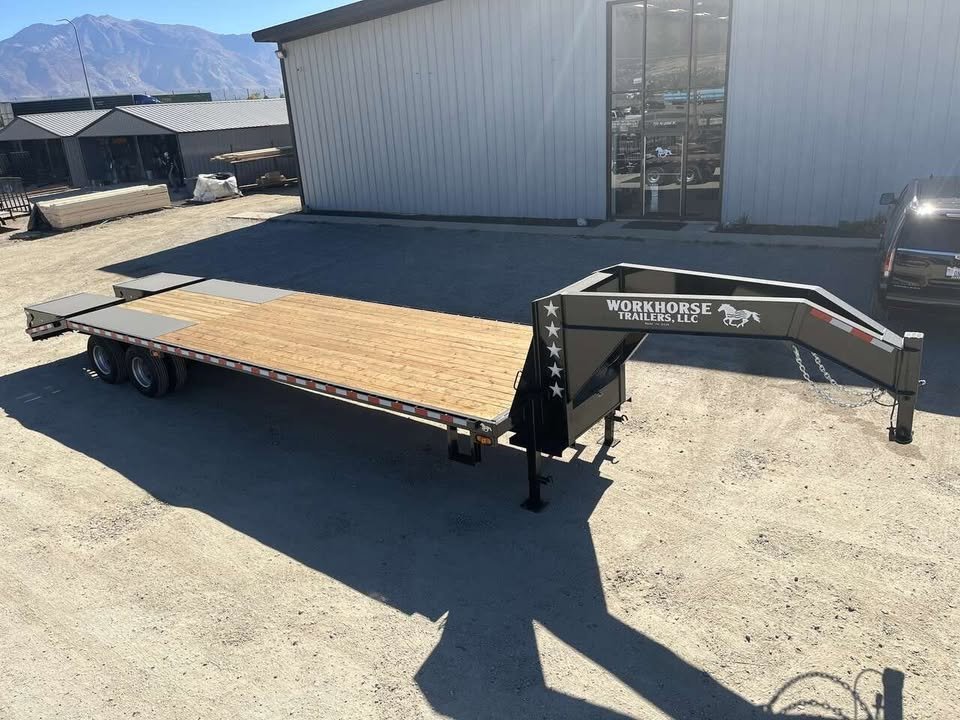
Nevada Tilt Deck Trailers
All locationsLoading equipment in Nevada often happens in places where nothing about the surroundings cooperates. The ground is rocky hardpan that won’t accept a stake or anchor. The staging area is an unpaved solar field access road where fine alkali dust coats everything within minutes. The clock is working against you because the crew started at dawn to beat the afternoon heat, and every minute spent wrestling with ramp deployment is a minute of productive work lost before temperatures force a shutdown. Tilt deck trailers thrive in these conditions because they eliminate the ramp variable entirely. The deck tilts, the machine drives on, the deck returns to flat, and the rig moves to the next location. For Nevada contractors, equipment rental operators, and industrial service companies who load and unload machinery across the state’s demanding terrain and compressed work schedules, the tilt deck trailer converts a repetitive operational bottleneck into a non-issue. Workhorse Trailers LLC supplies tilt deck trailers to Nevada buyers who need loading efficiency that matches the pace their operations demand.
The tilt mechanism replaces separate ramp assemblies with a deck that pivots on a structural hinge point near the trailer’s balance center. Releasing the latch allows the deck to rotate rearward until the trailing edge meets the ground, creating a single continuous incline from ground level to the front of the trailer. Machines drive up this gentle slope under their own power, the deck is returned to its flat transport position through gravity, hydraulic, or spring-assisted action, and the load is secured for travel. No ramp handling. No alignment of separate ramp pieces with the trailer frame. No storage of heavy ramp assemblies that consume deck space during transit.
Why Nevada’s Work Patterns Amplify the Tilt Deck Advantage
The efficiency gains a tilt deck provides exist in any state. But Nevada’s operating conditions multiply those gains in ways that make the return on investment steeper than it would be in milder, more compact markets.
Heat-Compressed Work Windows
Nevada construction, mining, and industrial operations frequently shift their schedules to avoid peak heat exposure. Crews working outdoor sites in the Las Vegas area, the Pahrump basin, or the desert flats surrounding Fernley often begin at 5 AM and wrap by early afternoon during summer months. That compressed window means every task performed during the cool morning hours carries more value than the same task performed in an all-day work schedule. Loading and unloading equipment consumes a fixed block of time on every site move. A tilt deck that shaves five to eight minutes off each loading cycle compared to conventional ramps recovers time that goes directly into the productive portion of a heat-limited workday.
A contractor making three site moves during a seven-hour summer shift recovers roughly 20 minutes of productive time by using a tilt deck instead of a ramp trailer. That’s nearly five percent of the available work window returned to revenue-generating activity. Across a full summer season, the accumulated savings represent a meaningful economic advantage.
Multi-Site Operations Across Vast Distances
Nevada job sites are rarely clustered conveniently. An excavation company based in Sparks might run morning work at a residential development in Cold Springs, reposition to a commercial project in Lemmon Valley after lunch, and return a machine to the yard in the McCarran industrial area before quitting time. Each repositioning event includes a load and an unload cycle. The tilt deck compresses each cycle, and across a day with multiple moves and significant drive time between them, the compound time savings prevents the kind of schedule overrun that pushes work into dangerous afternoon heat or forces a task to carry over to the following day.
Solo Operator Loading
Many Nevada equipment operators work without a ground crew to assist with loading. A single operator running a skid steer or mini excavator handles the machine controls and the trailer preparation alone. Conventional ramp trailers require the operator to exit the machine, walk to the rear of the trailer, deploy both ramps, walk back to the machine, drive it on, exit again, stow the ramps, and secure the load. A tilt deck allows the operator to release the deck latch from a single point, walk to the machine, drive it on, return the deck to flat, and secure. The elimination of ramp handling removes the most physically demanding and time-consuming portion of the solo loading sequence.
In Nevada’s heat, reducing the physical exertion involved in each loading cycle also reduces heat stress on the operator. Carrying a 75-pound ramp in 105-degree ambient temperature is genuinely hazardous. A tilt deck eliminates that exertion entirely.
Desert Surface Conditions and Tilt Deck Contact
The rear edge of a tilting deck contacts the ground surface during every loading cycle. Nevada’s terrain presents ground conditions that vary dramatically from the packed gravel or asphalt that tilt deck manufacturers typically envision during design.
Hardpan and Caliche
Much of Nevada’s desert floor consists of compacted alkaline soil cemented with caite minerals into a surface called caliche. This material is rock-hard when dry, which provides a stable platform for the tilt deck’s rear edge. Machines driving over the ground-to-deck transition on caliche encounter minimal sinking or unevenness. The challenge with caliche is that its hardness transmits impact force directly into the deck edge and hinge assembly without the cushioning effect that softer soils provide. Over hundreds of loading cycles on hard desert surfaces, the rear deck edge can develop deformation and the hinge pins can wear faster than they would on yielding ground.
Inspecting the rear deck edge for bending, cracking, or deformation should be a regular maintenance item for Nevada tilt deck operators working primarily on hardpan sites. Reinforcing the deck edge with a welded wear plate or replaceable sacrificial strip extends the interval between repairs.
Loose Sand and Decomposed Granite
Portions of the Las Vegas valley, the Amargosa Desert, and the terrain surrounding many Nevada solar and mining sites feature loose sandy surfaces or decomposed granite that provide poor bearing capacity. A tilt deck’s rear edge can sink into these surfaces when the machine drives onto the incline, burying several inches of deck material below grade. This creates a lip that the machine must climb over rather than rolling smoothly onto the deck, defeating the purpose of the low-angle loading that tilt decks are designed to provide.
Carrying a pair of steel plates or heavy timber pads to place beneath the deck edge before tilting prevents sinking on sandy sites. The plates distribute the combined weight of the deck edge and the loading machine across a wider area, keeping the transition smooth. Nevada tilt deck operators who work remote desert sites quickly learn that these ground plates are as essential as tie-down chains in the trailer’s equipment inventory.
Gravel and Crushed Aggregate
Prepared staging areas and equipment yards across Nevada typically use compacted gravel or crushed aggregate surfaces. These provide good bearing capacity and reasonable stability for tilt deck operation. The main consideration is that sharp aggregate fragments embed in the deck surface during the tilting motion and can damage equipment tires or tracks as the machine drives across them. Sweeping the deck after loading on gravel sites prevents this transfer of debris.
Hydraulic Tilt Systems in Desert Heat
Tilt deck trailers equipped with hydraulic cylinders for deck actuation face specific challenges in Nevada’s thermal environment that gravity and spring-assisted systems do not share.
Fluid Viscosity and Seal Life
Hydraulic fluid operating inside a cylinder assembly exposed to Nevada sun reaches temperatures that exceed the recommended operating range for standard hydraulic oils. The cylinder body itself, typically bare steel mounted beneath the trailer frame, absorbs radiant heat from the ground below and conducted heat from the frame above. Fluid temperatures inside the cylinder can exceed the ambient air temperature by 30 degrees or more during stationary periods in direct sun.
At elevated temperatures, hydraulic fluid loses viscosity. Thinner fluid leaks past worn seals more readily, reducing system pressure and slowing the deck’s return stroke. Seal materials accelerate their degradation cycle, hardening and cracking faster than they would in cooler environments. Nevada tilt deck owners with hydraulic systems should specify high-temperature hydraulic fluid and plan for seal replacement on a shorter interval than the manufacturer’s standard recommendation.
Cylinder Rod Corrosion
Nevada’s alkaline dust and dry atmosphere don’t create the moisture-driven corrosion that coastal states produce, but they do create a different surface degradation pattern on exposed hydraulic cylinder rods. Fine particulate material settling on the rod surface acts as an abrasive when the rod retracts through the wiper seal, scoring the chrome surface and creating leak paths. A scored rod accelerates seal failure in a compounding cycle: the scored surface damages the seal, the damaged seal allows more dust intrusion, and the additional dust scores the rod further.
Wiping the exposed cylinder rod surface clean before each actuation cycle interrupts this degradation pattern. A shop rag passed over the rod takes five seconds and saves hundreds of dollars in premature seal and rod replacement costs.
Choosing Between Gravity, Spring, and Hydraulic Tilt Systems for Nevada
Each tilt mechanism type presents trade-offs that Nevada’s conditions weight differently than buyers in temperate states might experience.
Gravity Tilt
Gravity systems use the load’s weight to initiate the tilting motion when the latch releases. They are mechanically simple, with no hydraulic fluid to overheat, no seals to degrade, and no powered components to maintain. For Nevada, the simplicity translates directly into reliability. A gravity tilt system doesn’t care about ambient temperature or dust contamination because it has no fluid passages or close-tolerance components for those elements to compromise.
The limitation is control. A gravity tilt deck drops at a rate determined by the load’s weight and the mechanical resistance in the pivot. Heavy loads cause faster, more forceful tilting. Light loads or an empty deck may not generate enough force to initiate the tilt at all, requiring the operator to stand on the rear edge to add weight. Nevada operators who tilt the deck empty at every unloading stop should factor this into their system choice.
Spring-Assisted Tilt
Spring-assisted systems add coil or torsion springs that store energy when the deck tilts down and release it to help return the deck to flat after loading. These systems reduce the physical effort needed to return a loaded deck and provide a more controlled tilting action than pure gravity. The springs themselves are robust components that tolerate Nevada’s heat without performance degradation. Maintenance is limited to periodic inspection for fatigue cracking and proper tension verification.
Spring-assisted tilt represents the best balance of simplicity, reliability, and operator convenience for most Nevada applications.
Hydraulic Tilt
Hydraulic systems offer precise control over tilting speed, angle, and deck return force. They operate independently of load weight, meaning the deck tilts and returns under hydraulic power regardless of whether a machine is aboard. For operations that require partial-angle tilting, controlled lowering speed on slopes, or frequent empty cycling, hydraulic systems provide capability that gravity and spring systems cannot match.
The maintenance requirements and heat sensitivity discussed above represent real costs in Nevada’s climate. Buyers should choose hydraulic tilt only when the operational advantages justify the additional upkeep that desert conditions demand.
Nevada Compliance and Road Requirements
Tilt deck trailers registered in Nevada follow the state’s standard DMV process for titling and registration. Sales tax at county-variable rates applies at purchase. Annual registration fees are based on the trailer’s declared gross vehicle weight.
The tilt mechanism’s locking system carries particular regulatory relevance in Nevada because the state’s highway patrol enforces load securement standards during roadside inspections. A tilt deck that isn’t positively locked in the flat position during transit constitutes an unsecured load condition, regardless of whether cargo is aboard. The primary latch and any secondary safety catches must both engage before the trailer moves. Inspectors verify this by checking for latch engagement and may test the deck’s resistance to movement by pushing against the trailer’s rear edge.
Trailers above 3,000 pounds GVWR require brakes on all wheels, and the brake controller gain should be calibrated to the loaded weight. The weight shift that occurs between an empty tilt deck and one carrying a 10,000-pound machine changes the optimal brake gain setting substantially. Nevada operators who switch between loaded and empty towing should adjust their brake controller at each transition rather than leaving it fixed at a single setting.
Workhorse Trailers LLC and Nevada Tilt Deck Buyers
Workhorse Trailers LLC serves Nevada tilt deck buyers with practical guidance grounded in desert operating experience. The company helps buyers evaluate which tilt mechanism suits their loading frequency, heat exposure, and maintenance tolerance, then matches that to a trailer sized for the equipment roster and routes the buyer actually runs.
Nevada buyers comparing tilt deck options across weight ratings and mechanism types can visitNevada Tilt Deck Trailers to review available models and connect with the Workhorse team for desert-specific recommendations.
A tilt deck trailer built for Nevada’s conditions turns every loading cycle into a faster, simpler operation. Workhorse Trailers LLC ensures the one you select is ready for the terrain, heat, and pace that this state demands.