
Nevada Enclosed Cargo Trailers
All locationsAn enclosed cargo trailer parked in the Nevada sun becomes an oven. Without intervention, interior temperatures inside a sealed aluminum or steel box sitting on asphalt in Las Vegas, Reno, or anywhere between them can exceed 160 degrees on a summer afternoon. That thermal reality shapes every aspect of how Nevada buyers should think about purchasing, outfitting, and operating an enclosed cargo trailer. The protection these trailers offer from theft, weather, and road debris is the same as anywhere else in the country. But the challenge of managing what happens inside that sealed space when the outside air hits 115 degrees separates Nevada enclosed trailer ownership from the experience in milder states. Workhorse Trailers LLC provides enclosed cargo trailers to Nevada buyers with guidance that accounts for the desert’s specific demands on sealed trailer environments, helping buyers select configurations that protect cargo without cooking it.
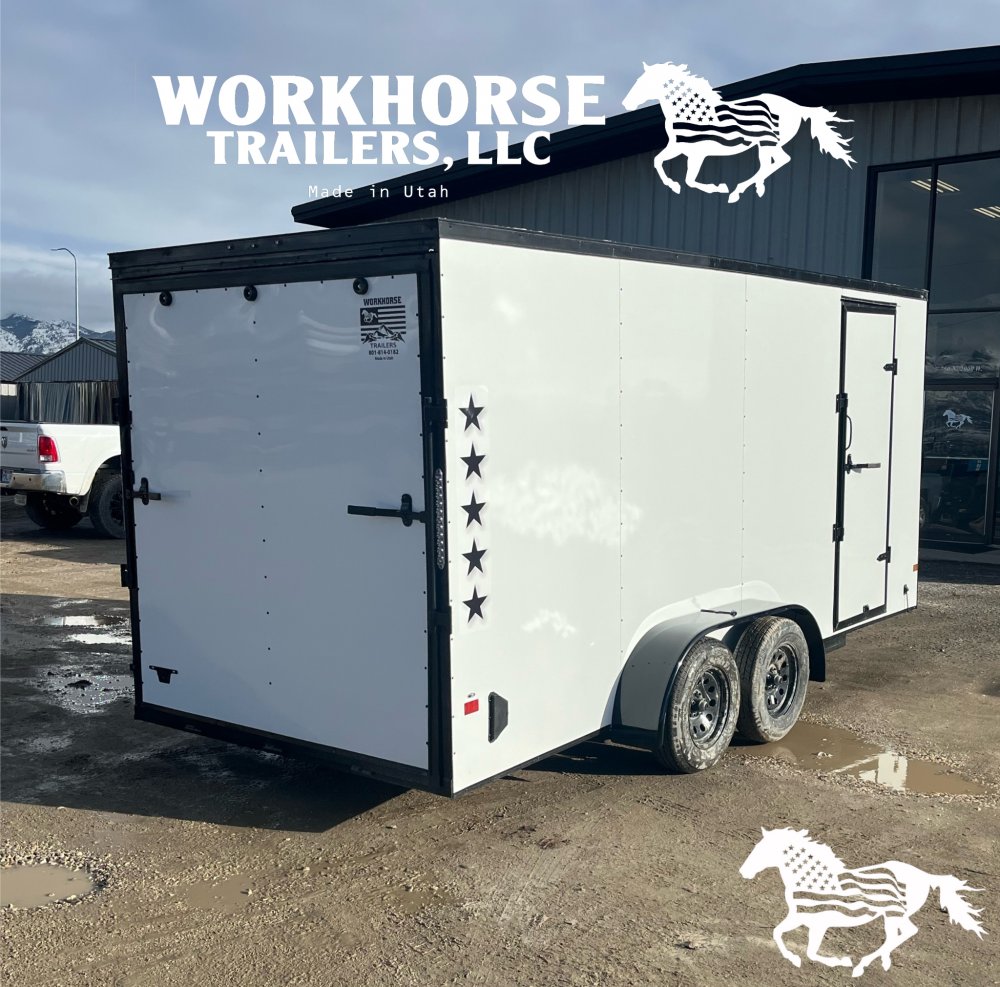
Enclosed cargo trailers remain among the most versatile trailer types sold in Nevada. They lock. They seal. They hide their contents from view. They transport everything from trade show displays to construction tools to personal belongings without exposing any of it to the highway environment. Their popularity across Nevada’s commercial, residential, and recreational markets is driven by the same practical logic that makes them popular elsewhere: a rolling, secure, weatherproof box solves an enormous range of hauling and storage problems with a single piece of equipment.
The difference in Nevada is that the box needs to be managed, not just loaded.
Interior Heat Buildup and Cargo Vulnerability
The physics of heat accumulation inside an enclosed trailer are straightforward. Solar radiation heats the exterior skin. The heated skin radiates into the enclosed air space. The sealed environment traps that heat, and with no ventilation, the interior temperature climbs until it reaches equilibrium with the solar input, which in Nevada’s summer means temperatures that damage or destroy heat-sensitive cargo.
Electronics and Technology Equipment
IT service companies, audio-visual rental operations, and technology installers based in the Las Vegas metro transport equipment valued at tens of thousands of dollars per load. Servers, networking hardware, display screens, projectors, and control systems all carry maximum storage temperature ratings that an unventilated enclosed trailer in Nevada summer exceeds routinely. Lithium batteries in laptops, power tools, and portable electronics present a more acute risk: sustained temperatures above 140 degrees can trigger thermal runaway in lithium cells, creating fire hazards inside a sealed trailer loaded with flammable packing materials and other equipment.
Nevada technology transport operators must treat interior temperature management as a safety requirement, not a preference. The solutions range from passive ventilation upgrades to active climate control, depending on the cargo’s sensitivity and the duration of exposure.
Paint, Adhesives, and Chemical Products
Contractors and supply companies hauling paint, caulking, sealants, adhesive products, and chemical supplies face material degradation when interior temperatures climb. Latex paint separates irreversibly above certain thresholds. Adhesive products lose bonding strength. Aerosol cans pressurize beyond their rated limits and can rupture. A painting contractor based in Summerlin who loads a day’s materials into an enclosed trailer at 6 AM and parks at the job site until the afternoon break may return to find product that’s unusable.
Food and Beverage Transport
Nevada’s hospitality and catering industries generate constant movement of food products, beverages, and serving supplies between commercial kitchens, event venues, and retail locations. Health department regulations in Clark County and Washoe County specify temperature control requirements for food transport, and an enclosed trailer without climate management doesn’t meet those standards during warm months. Catering companies serving the convention center district, Strip hotels, and corporate event venues in the Summerlin and Green Valley areas must address interior temperatures to maintain food safety compliance and product quality.
Ventilation and Climate Control Strategies
Managing interior heat in a Nevada enclosed cargo trailer involves a spectrum of approaches scaled to the cargo’s sensitivity and the owner’s budget.
Passive Roof Vents
The most basic intervention is installing roof-mounted ventilation that allows hot air to escape through natural convection. As heated air rises inside the trailer, it exits through the roof vent and draws cooler air in through lower openings, typically the gap beneath the rear door or dedicated low-wall intake vents. This passive system reduces peak interior temperatures by 15 to 25 degrees compared to a fully sealed trailer, which is sufficient for cargo that tolerates warm conditions but not extreme heat.
Passive vents require no power source and add minimal cost. Their limitation is that they cannot bring interior temperatures below ambient. On a 115-degree day, passive ventilation might hold the interior at 120 to 130 degrees rather than the 160 degrees a sealed trailer would reach. For many cargo types, that reduction is meaningful. For temperature-critical loads, it’s insufficient.
Powered Exhaust Fans
Adding 12-volt exhaust fans to the roof vent openings accelerates the convection cycle and pulls heated air out more aggressively than passive vents alone. Powered ventilation can reduce interior temperatures an additional 5 to 10 degrees beyond what passive systems achieve. The fans draw power from the tow vehicle’s electrical system through the trailer connector or from a dedicated auxiliary battery mounted inside the trailer.
The auxiliary battery approach allows the ventilation system to operate while the trailer sits disconnected from the tow vehicle, which is the scenario where heat buildup is most dangerous. A trailer parked at a Las Vegas job site for several hours while the crew works inside a building accumulates its peak heat load during exactly the period when it’s unhitched and unpowered. A solar-charged auxiliary battery powering exhaust fans during these stationary periods addresses the vulnerability without requiring the tow vehicle to remain connected.
Insulation
Adding closed-cell foam or reflective barrier insulation to the interior walls and ceiling of an enclosed trailer dramatically reduces the solar heat gain that drives interior temperature rise. Insulation doesn’t cool the interior, but it slows the rate at which exterior heat transfers inward, keeping peak temperatures lower and delaying the temperature rise during short parking periods.
For Nevada buyers who transport temperature-sensitive cargo regularly, insulation represents one of the highest-value upgrades available. The material cost is modest relative to the trailer’s price, installation is straightforward for a competent shop, and the thermal benefit persists for the life of the trailer. Insulated enclosed trailers also resist condensation during the temperature drops between Nevada’s hot days and cool desert nights, protecting cargo from moisture damage during overnight parking.
Portable Air Conditioning
For the most temperature-critical applications, portable AC units designed for trailer and small-space use can maintain interior temperatures at specific set points regardless of exterior conditions. These units require either shore power from an external outlet, a generator, or a high-capacity battery system. Pharmaceutical couriers, temperature-controlled document transport services, and certain food logistics operations in the Las Vegas market use portable AC to maintain strict temperature compliance during transit and staging.
The cost and complexity of active cooling limits this approach to operations where cargo value or regulatory compliance justifies the investment. For most Nevada enclosed trailer users, the combination of insulation and powered ventilation provides adequate protection at a fraction of the cost.
Cargo Security in Nevada’s Urban Markets
Enclosed trailers attract theft attempts precisely because their contents are hidden. A thief targeting an open trailer can assess whether the cargo is worth the risk from a distance. An enclosed trailer is a gamble that sometimes pays off enormously for the criminal, which makes it a persistent target in Nevada’s urban areas.
Theft Patterns in Las Vegas and Reno
Trailer theft in Clark County and Washoe County follows patterns that law enforcement has documented extensively. Trailers parked at construction sites overnight, left in hotel parking lots during multi-day stays, and stored in unfenced commercial yards represent the highest-risk scenarios. The thief typically arrives with a truck and compatible hitch ball, removes or defeats the coupler lock, and drives away with the entire trailer in under five minutes.
Contents theft through forced entry is the secondary pattern. Rear door padlocks are defeated with bolt cutters. Side doors are pried. Ramp door latches are leveraged open with a pry bar. Once inside, the thief takes what they can carry quickly and disappears.
Layered Security Measures
Effective security for an enclosed trailer in Nevada requires multiple barriers that collectively extend the time and noise required to steal the trailer or access its contents beyond what most opportunistic thieves will invest.
A coupler lock paired with a wheel boot prevents the trailer from being towed away. The coupler lock alone is insufficient because a determined thief can unbolt the coupler assembly and replace it. The wheel boot adds a second physical barrier that requires additional tools and time to defeat.
High-security door hardware replaces the factory-installed hasps and latches that yield to basic pry tools. Puck locks with shrouded shackles resist bolt cutters. Reinforced hasp plates welded to the door frame rather than riveted prevent the entire hasp from being torn away. Locking pins on ramp door hinges prevent the door from being lifted off its hinge points even if the latch is compromised.
Interior GPS tracking devices hidden within the trailer’s structure provide location data if the trailer is stolen despite physical security measures. Cellular-enabled trackers with geofence alerts notify the owner immediately when the trailer moves outside a defined area, enabling rapid law enforcement response while the trailer is still in motion and recoverable.
Nevada Trade Show and Convention Market
Las Vegas hosts more major trade shows and conventions than any other American city, and the logistics chain supporting those events generates substantial demand for enclosed cargo trailers. Exhibitors transporting booth structures, display materials, product samples, and promotional inventory between warehouse spaces and convention venues rely on enclosed trailers for both protection and security.
The convention calendar at the Las Vegas Convention Center, Mandalay Bay, the Venetian Expo, and dozens of smaller venues runs nearly year-round. Companies based in the Las Vegas area that specialize in trade show logistics, exhibit fabrication, and event production maintain fleets of enclosed trailers sized to handle booth components ranging from tabletop displays to multi-thousand-square-foot custom installations.
Visiting exhibitors who fly into Las Vegas and hire local logistics support also drive demand. A company shipping booth materials from the Midwest to a Las Vegas warehouse needs a local enclosed trailer to deliver those materials to the convention floor and retrieve them after the show closes. This creates a rental and service market around enclosed trailers that is uniquely concentrated in southern Nevada.
Nevada Registration and Operating Requirements
Enclosed cargo trailers registered in Nevada require titling and registration through the state DMV. Sales tax at county-specific rates applies to all purchases. Clark County’s 8.375 percent rate adds a substantial amount to the purchase of larger enclosed trailers that carry price tags in the mid-four to low-five figure range.
Weight-based requirements follow the same thresholds as other trailer types. Brakes are mandatory above 3,000 pounds GVWR. Lighting, reflective markings, and breakaway brake systems must meet federal and state standards. Enclosed trailers that obscure the tow vehicle’s license plate must display the trailer’s own registration plate in a visible rear position, which is standard practice since the enclosed body blocks any view of the truck’s plate.
Height clearance deserves mention for enclosed trailer operators in Nevada’s urban areas. Standard enclosed cargo trailers stand between 7 and 8 feet at the roofline, and taller models with extended height options can exceed 8.5 feet. Parking garages at Las Vegas hotels, commercial properties, and some residential complexes post height restrictions that can prevent enclosed trailers from entering. Knowing the trailer’s overall height, including any roof-mounted vents or AC units, prevents the expensive and embarrassing situation of wedging an enclosed trailer under a parking structure beam.
Workhorse Trailers LLC and Nevada Enclosed Cargo Buyers
Workhorse Trailers LLC approaches the Nevada enclosed cargo market knowing that the trailer’s sealed environment creates both an advantage and a liability in desert conditions. The advantage is protection. The liability is heat. Balancing those two realities requires matching the trailer’s ventilation, insulation, and security features to the cargo it will carry and the conditions it will face across Nevada’s demanding climate.
Nevada buyers comparing enclosed cargo trailers for commercial, trade show, service, or personal hauling applications can visitNevada Enclosed Cargo Trailers to review available configurations and connect with the Workhorse team for guidance tailored to desert operating conditions.
An enclosed cargo trailer that protects its contents from theft and weather while managing the interior climate effectively is one of the most productive pieces of equipment a Nevada business or individual can own. Workhorse Trailers LLC makes sure the trailer you choose handles all three responsibilities from your first Nevada summer forward.